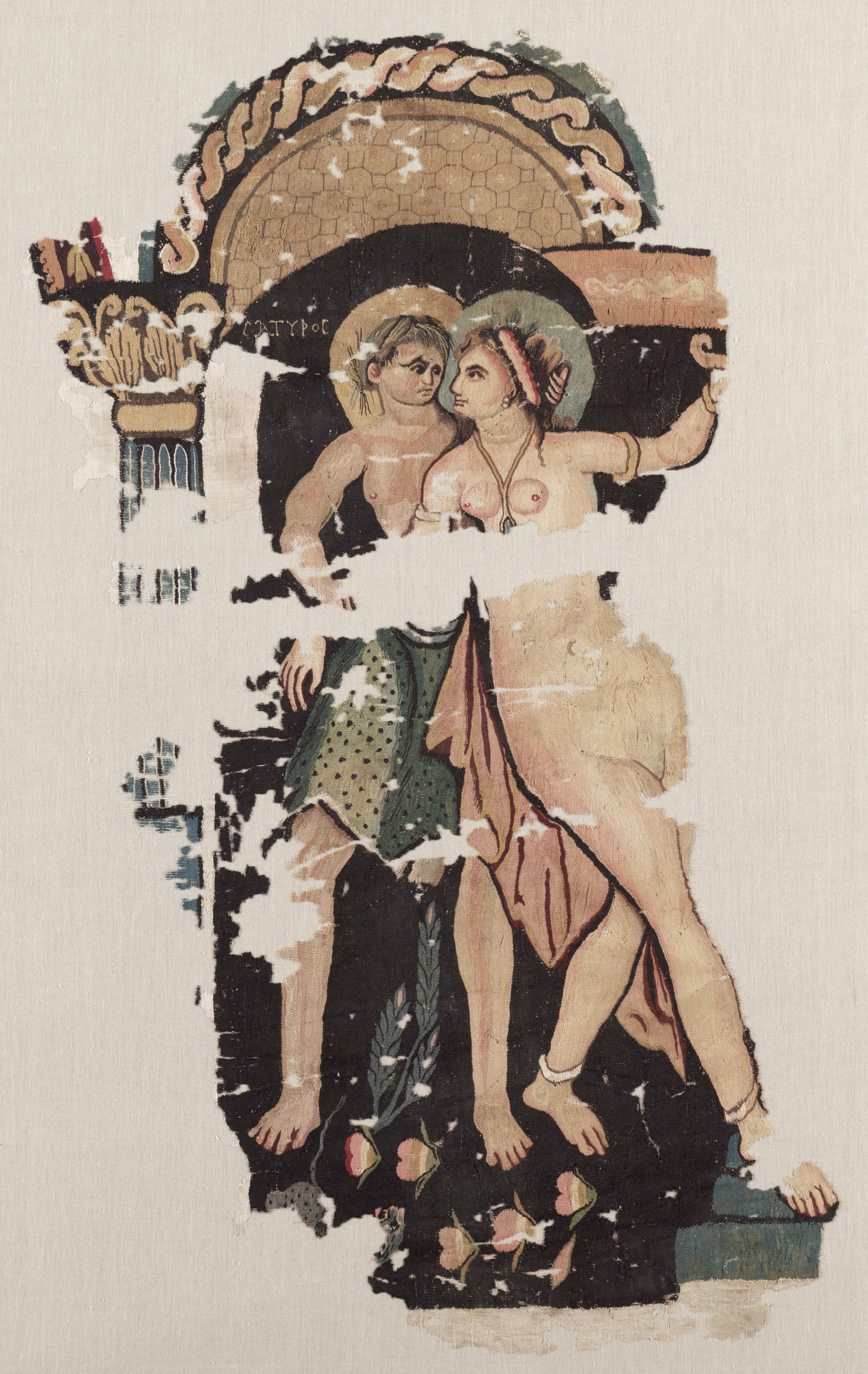
Deconstructing the Fragment: A Technical and Thematic Analysis
As the Chief Fabric Deconstructionist for Zoey Fashion Lab, I am tasked with dissecting the Fragment with Satyr and Maenad, a Byzantine textile from Egypt, to extract its avant-garde potential. This analysis moves beyond conventional art historical appreciation, focusing instead on the material, structural, and symbolic elements that challenge contemporary fashion paradigms. The fragment, dated to the Byzantine period in Egypt (circa 4th–7th century CE), is composed of undyed linen and dyed wool, executed in a plain weave ground with tapestry weave details. Its preservation—a rare survival of textile art—offers a direct line to a culture where classical mythology, Christian symbolism, and local Egyptian craftsmanship converged. For Zoey Fashion Lab, this artifact is not a relic but a blueprint for deconstruction: a system of threads, tensions, and narratives that can be unspooled to inform avant-garde design.
Materiality and Technique: The Foundation of Deconstruction
The fragment’s material composition is deceptively simple. Undyed linen serves as the ground, providing a neutral, earthy base that contrasts with the dyed wool used for the figural tapestry. Linen, derived from flax, is inherently rigid and absorbent, while wool offers elasticity and depth of color. This dichotomy is central to the avant-garde approach: linen represents structure, tradition, and restraint; wool embodies movement, expression, and vulnerability. The plain weave ground—a simple over-under interlacing—is the most basic textile structure, yet it forms the canvas for the tapestry weave technique, where weft threads are manipulated to create intricate, discontinuous patterns. This juxtaposition of simplicity and complexity is a hallmark of deconstructionist fashion, where the mundane is elevated through intervention.
In the context of Zoey Fashion Lab, the fragment’s technical construction suggests a method for creating garments that expose their own making. The tapestry weave, with its visible color changes and weft floats, can be reinterpreted as deliberate imperfections or exposed seams in a modern silhouette. The undyed linen ground, when left raw, evokes the unfinished, the provisional—a quality prized in avant-garde aesthetics. By isolating these technical elements, we can design textiles that celebrate the tension between the foundational and the decorative, the stable and the volatile. The fragment’s palette—muted linen against vibrant wool dyes—further informs a color theory of opposition: neutral versus saturated, natural versus synthetic, ancient versus contemporary.
Iconography: The Satyr and Maenad as Avant-Garde Archetypes
The imagery of the Satyr and Maenad is drawn from Greek mythology, but its Byzantine-Egyptian context transforms it into a hybrid symbol. The satyr, a half-human, half-animal creature, represents instinct, chaos, and the untamed body. The maenad, a female follower of Dionysus, embodies ecstatic liberation and ritualistic frenzy. Together, they evoke a narrative of transgression and release—themes that resonate deeply with avant-garde fashion’s rejection of normative structures. For Zoey Fashion Lab, these figures are not merely decorative motifs but archetypes of deconstruction: the satyr’s animality challenges human-centered design, while the maenad’s movement suggests garments that are alive, kinetic, and uncontrollable.
The fragment’s iconography also reflects cultural fusion. Egypt under Byzantine rule was a crossroads of Hellenistic, Roman, Coptic, and Islamic influences. The satyr and maenad, originally pagan, were adapted into Christian contexts, often symbolizing the struggle between flesh and spirit. This layering of meanings aligns with the avant-garde practice of appropriation and recontextualization. In a Zoey Fashion Lab collection, these figures could be abstracted into graphic patterns, distorted through digital printing, or rendered as structural elements—such as boning that mimics satyr horns or draped fabrics that evoke maenadic ecstasy. The fragment’s narrative of cultural collision becomes a design strategy: juxtaposing historical references with futuristic materials, or combining sacred and profane iconography to provoke new readings.
Archive Resonance: Bridging Centuries
The archive note, Archive Resonance: 在人类文明的长河中,器物与绘画不仅是时代技艺的结晶,更是文化碰撞与美学交融的无声见证。十六至十七世纪...., underscores the fragment’s role as a silent witness to cultural exchange. The phrase “器物与绘画” (objects and paintings) positions textiles as both functional artifacts and artistic documents. For Zoey Fashion Lab, this resonance demands that we treat the fragment not as a static object but as a dynamic archive of techniques, materials, and meanings. The reference to the 16th–17th centuries, though later than the Byzantine period, hints at a continuum of textile innovation—from Coptic tunics to Renaissance tapestries to contemporary deconstruction. This temporal fluidity is essential for avant-garde design, which often collapses historical periods into a single garment.
The fragment’s survival—its frayed edges, faded dyes, and missing sections—becomes a design feature. In deconstructionist fashion, wear and decay are celebrated as evidence of process. Zoey Fashion Lab can replicate this patina through distressing, laser-cutting, or over-dyeing techniques. The incomplete nature of the fragment invites speculation: what scenes were lost? How did the original garment drape? This ambiguity fuels creativity, allowing designers to fill in gaps with contemporary interventions. The archive resonance also suggests a methodology of translation: converting the fragment’s two-dimensional tapestry into three-dimensional forms, such as asymmetrical hemlines, uneven layering, or exposed warp threads that mimic the plain weave ground.
Avant-Garde Implications: Towards a New Textile Language
The fragment’s avant-garde potential lies in its ability to disrupt conventional fashion hierarchies. By privileging the tapestry weave—a technique often associated with decorative arts—over the plain weave ground, the fragment inverts expectations of what constitutes a garment’s “main” fabric. Zoey Fashion Lab can push this inversion further: using tapestry panels as structural elements (e.g., a sleeve or bodice) while the plain weave becomes a translucent overlay. The dyed wool, with its rich hues (likely derived from madder, woad, or kermes), offers a palette that is both historical and radical. These colors can be extracted and recombined into gradient patterns that evoke the fragment’s fading, or they can be juxtaposed with synthetic dyes to create temporal dissonance.
The satyr and maenad’s dynamic poses—caught in a dance or pursuit—suggest motion and tension. In fashion, this translates to garments that are asymmetrical, wrapped, or twisted, as if caught in the act of transformation. The fragment’s small scale (likely a portion of a larger tunic or hanging) implies a modular approach: individual motifs can be isolated and repeated, or the entire composition can be scaled up to create a single, dominating print. The plain weave ground, when left unadorned, becomes a negative space that frames the narrative, much like a runway backdrop or a minimalist silhouette against maximalist detailing.
Finally, the fragment’s origin in Byzantine Egypt—a society of shifting borders and beliefs—resonates with contemporary debates on cultural appropriation and hybridity. Zoey Fashion Lab must approach this artifact with critical reverence, acknowledging its origins while reimagining it for a global audience. The avant-garde style demands that we not merely copy but deconstruct and reconstruct, honoring the fragment’s technical and symbolic complexity while pushing it toward new forms. In doing so, we create garments that are not just clothing but textile manifestos—statements on history, identity, and the transformative power of thread.