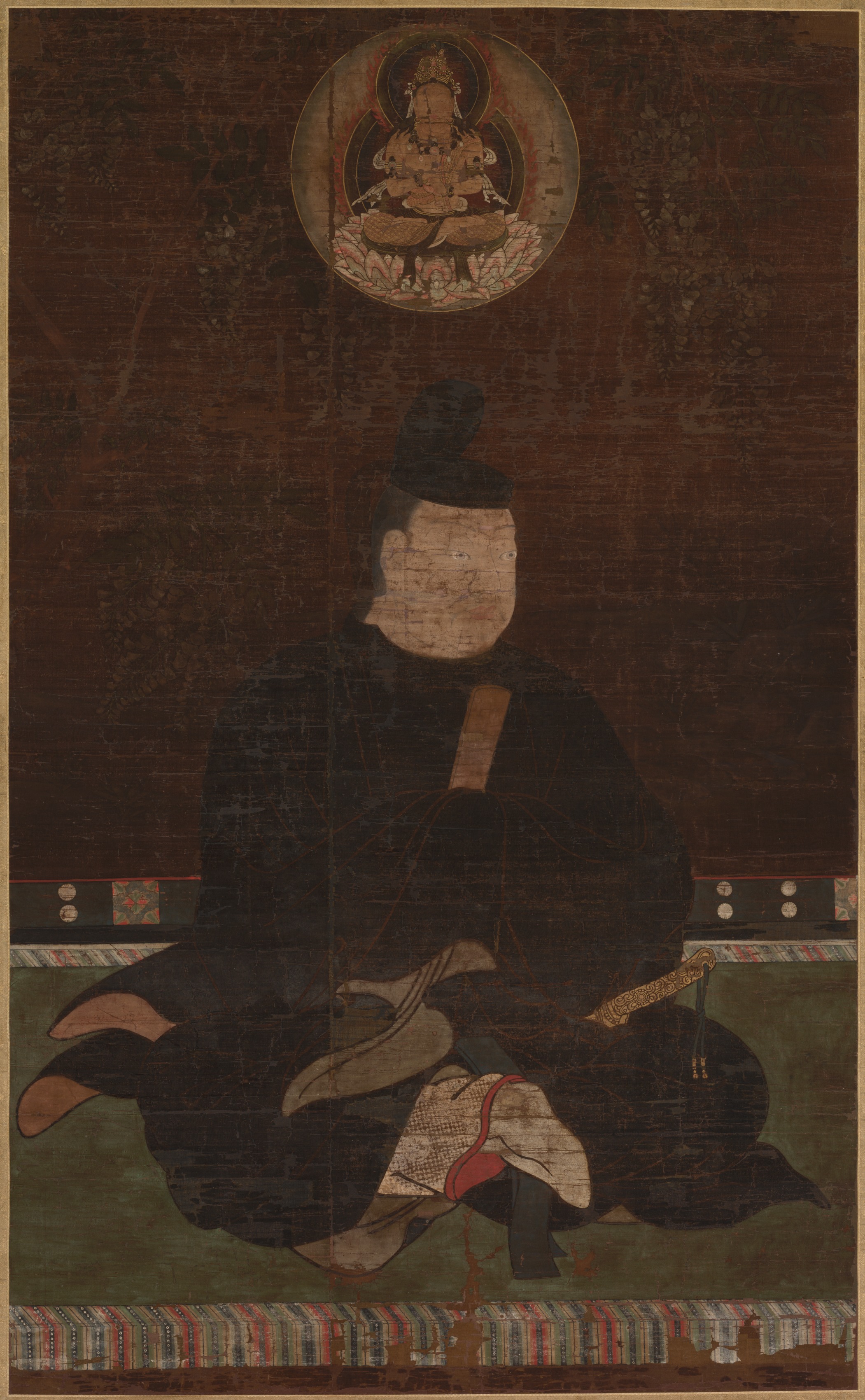
Fujiwara no Muchimaro: A Kamakura Relic Reimagined Through Avant-Garde Deconstruction
At Zoey Fashion Lab, we approach historical textiles not as artifacts to be preserved, but as living narratives to be unraveled and rewoven. The subject of our latest analysis—a hanging scroll depicting Fujiwara no Muchimaro from Japan’s Kamakura period (1185–1333)—presents a singular opportunity for deconstruction. Executed in ink, color, gold, and cut gold on silk, this work embodies the refined austerity of its era while harboring a latent dynamism. Our task is to extract its structural DNA and translate it into an avant-garde fashion language, where tradition is not abandoned but fractured, recombined, and electrified.
Historical Context: The Kamakura Aesthetic as a Foundation for Rupture
The Kamakura period was marked by a shift from the courtly elegance of the Heian era to a more robust, martial, and spiritually introspective culture. Fujiwara no Muchimaro (680–737), though a historical figure from an earlier time, was often depicted in Kamakura scrolls as a symbol of aristocratic lineage and Buddhist devotion. The hanging scroll format itself—a vertical, portable icon—suggests a tension between permanence and transience, a theme ripe for avant-garde reinterpretation. The materials—silk, mineral pigments, gold leaf, and cut gold (kirikane)—were used to create a surface that shimmered with divine light, yet the composition often adhered to rigid iconographic codes.
For Zoey Fashion Lab, this tension is the entry point. The scroll’s structured hierarchy—the central figure, the halo, the drapery—becomes a cage we intend to break. The gold, originally a symbol of enlightenment, is reimagined as a disruptive, reflective surface that challenges the viewer’s gaze. The silk, once a support for narrative, is treated as a mutable skin. Our deconstruction begins by identifying three core elements: the material palette (silk, gold, mineral pigments), the compositional grid (verticality, symmetry, framing), and the symbolic weight (lineage, spirituality, authority).
Material Deconstruction: Silk, Gold, and the Cut-Gold Reconfiguration
The scroll’s silk ground is a plain-weave fabric, likely treated with a sizing of animal glue and alum to receive pigments. In our lab, we view this not as a passive surface but as a tensile membrane that can be stretched, slashed, and layered. The ink lines—fluid, calligraphic—define the figure’s robes and face with an economy of gesture. The color, predominantly vermilion, indigo, and ochre, is applied in flat washes, while gold is reserved for highlights: the halo, the jewelry, the hems. The cut gold (kirikane) technique involves slicing gold leaf into fine threads or tiny squares, then adhering them to the silk to create geometric patterns—a painstaking process that produces a mosaic-like shimmer.
Our avant-garde approach repurposes these materials as a new textile DNA. We extract the kirikane logic and translate it into a laser-cut metallic organza, where the gold threads are replaced by iridescent polymer filaments that shift color under movement. The silk is chemically treated to achieve a distressed, almost leathery texture, referencing the scroll’s age while subverting its delicacy. The vermilion and indigo are synthesized into a digital print that is then hand-painted over with a reactive dye, creating a surface that is both flat and deeply dimensional. The halo, originally a perfect circle, is fragmented into a series of elliptical forms that warp as they cascade down a garment’s spine, simulating a deconstructed mandorla.
Compositional Grid: Breaking the Vertical Hierarchy
The hanging scroll’s vertical axis is its primary organizational principle. The figure of Muchimaro occupies the central register, with a halo above and a lotus pedestal below. The composition is bilateral, with drapery folds falling symmetrically. This hierarchy is a visual prison that we dismantle. In our fashion analysis, we map the scroll’s grid onto a human silhouette: the head corresponds to the collar, the torso to the bodice, the hem to the train. But instead of replicating this alignment, we offset it.
We propose a garment where the halo is relocated to the shoulder, becoming a stiff, asymmetrical collar that juts outward like a broken wheel. The lotus pedestal is inverted and transformed into a train that drags behind, printed with a pixelated version of the original flower. The drapery folds are not rendered as soft pleats but as rigid, sculptural panels of heat-set silk, each one cut at a different angle to catch light. The bilateral symmetry is shattered: one sleeve is elongated to the floor, the other cropped at the elbow, creating a visual imbalance that echoes the scroll’s latent tension between order and chaos.
Symbolic Weight: From Lineage to Liminality
Fujiwara no Muchimaro is a figure of authority—a courtier, a patriarch, a devotee. The scroll’s gold and cut gold signify his proximity to the divine. In our avant-garde reinterpretation, this symbolism is inverted and multiplied. The gold is no longer a sign of purity but of excess, applied in thick, dripping layers that suggest both opulence and decay. The cut gold patterns, originally geometric (diamonds, squares), are replaced by chaotic, fractal shapes that reference digital glitches—a commentary on the fragmentation of lineage in the modern era.
The figure’s face, rendered in ink with minimal expression, is abstracted into a mask-like motif that appears on the garment’s back, printed in a reflective silver that only becomes visible under direct light. This hidden face suggests the duality of identity: the public persona versus the private self. The Buddhist iconography—the halo, the lotus—is repurposed as a critique of spiritual commodification, with the lotus becoming a pattern of overlapping, semi-transparent petals that obscure rather than reveal.
New DNA Strand: Synthesis and Avant-Garde Application
The final step in our analysis is the creation of a new DNA strand—a conceptual and material blueprint that fuses the scroll’s essence with avant-garde fashion. We identify three strands: 1) Material Hybridity: combining traditional silk with smart textiles that change color in response to temperature, mimicking the scroll’s shifting gold light; 2) Structural Dislocation: using the scroll’s verticality as a starting point for a garment that can be worn in multiple configurations—draped, wrapped, or suspended—echoing the scroll’s portability; 3) Symbolic Subversion: embedding the cut gold technique into a pattern of micro-LEDs that flicker like dying embers, transforming the sacred into the transient.
This new DNA strand is not a reproduction but a mutation. The resulting garment—a deconstructed kimono-dress hybrid—features a bodice of distressed silk organza, a skirt of laser-cut metallic panels, and a train of heat-set silk printed with a glitched lotus. The gold is present not as leaf but as a liquid metal foil that cracks as the wearer moves. The cut gold patterns are echoed in the seams, which are stitched with a conductive thread that powers the micro-LEDs. The garment is both a tribute and a critique, a relic and a rupture.
In conclusion, the Fujiwara no Muchimaro scroll offers a rich vocabulary for avant-garde fashion, but only if we are willing to deconstruct its every element. By treating its materials, composition, and symbolism as mutable, we unlock a new aesthetic that honors the past while propelling it into the future. At Zoey Fashion Lab, we do not preserve history—we reinvent it, one cut, one thread, one gold flake at a time.