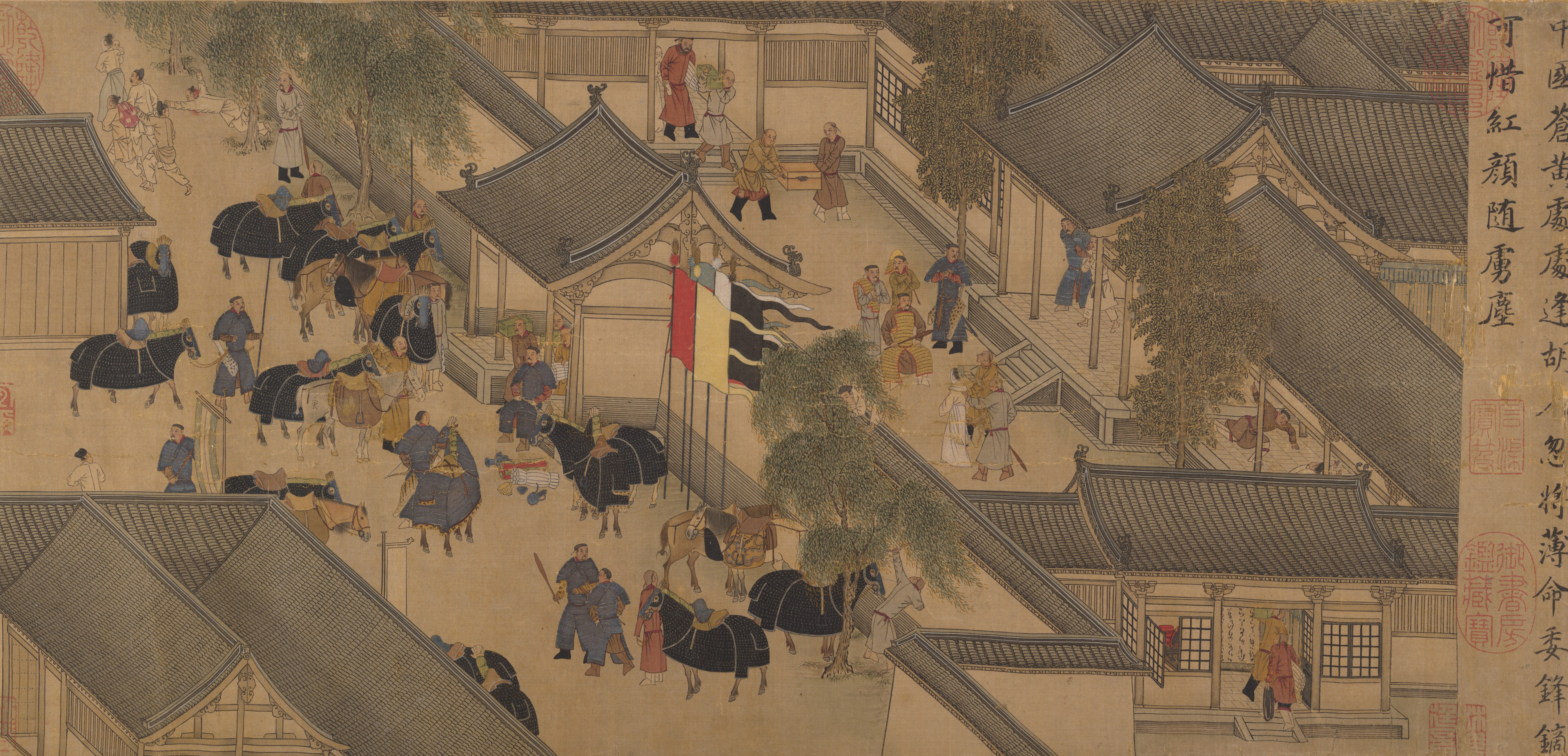
Deconstructing the Silk Road: A Futuristic Silhouette Analysis of “Eighteen Songs of a Nomad Flute” for SS26
The hallowed handscroll, “Eighteen Songs of a Nomad Flute: The Story of Lady Wenji,” typically resides in the quietude of art history, a narrative of displacement and resilience painted in ink, color, and gold on silk. For Zoey Fashion Laboratory’s SS26 avant-garde study, we must strip this artifact of its historical patina and re-engineer its core visual data into a language of radical structural innovation. The scroll is not a story; it is a blueprint for futuristic silhouettes that challenge the very notion of garment as a static object. We are not recreating a Han dynasty costume; we are distilling the kinetic tension between nomadic chaos and imperial order into three-dimensional form.
Phase One: The Scroll as a Woven Metropolis
The fundamental innovation begins with the handscroll’s physicality. Its horizontal format—a continuous, unfolding plane of silk—is a direct challenge to the vertical, symmetrical tyranny of the Western dress form. For SS26, we propose the “Unfurling Silhouette.” This is not a garment that hangs; it is a garment that narrates as it moves. Imagine a coat constructed from layered, laser-cut panels of liquid-silver organza, each panel a digital translation of a scroll segment. The front hem is sharply truncated at the sternum, while the back cascades into a 2.5-meter train, its edge serrated like torn silk. The gold leaf pigment is reinterpreted as thermochromic thread woven into the train’s inner lining—activated by body heat, it reveals hidden calligraphic fragments of Wenji’s poetry, rendering the garment a living, responsive manuscript.
The structural innovation lies in the “Scroll-Lock” closure system. Instead of buttons or zippers, the garment is secured by a series of interlocking, CNC-milled carbon fiber dowels that mimic the wooden roller ends of the scroll. When the wearer turns, the dowels rotate, causing the fabric to shift and re-fold, creating a perpetually morphing silhouette. This is deconstruction as a verb, not a noun. The garment is never the same shape twice, echoing the scroll’s infinite potential for unfolding and re-rolling.
Phase Two: Nomadic Architecture and the Anti-Sleeve
Wenji’s journey is one of forced migration across the Gobi Desert. The traditional Chinese sleeve—wide, flowing, and ceremonial—is an artifact of sedentary civilization. For the nomad, the sleeve becomes a container, a tool, a shelter. Our response is the “Felted-Cloud Sleeve.” This is a sleeve that is not attached to the bodice but floats independently, suspended from the shoulder by a single, tensioned cable of braided horsehair (a nod to the Xiongnu horsemen). The sleeve itself is constructed from a 3D-printed lattice of recycled nylon, coated in a felted wool composite. It is rigid on the outside, soft on the interior. The sleeve’s volume is not static; it can be cinched into a compact bicep band via a hidden drawcord, or fully expanded into a cocoon-like pocket large enough to hold a tablet or a water flask. This is utilitarian futurism—the garment as portable architecture.
The bodice beneath is a study in negative space. We deconstruct the traditional Han ru (jacket) by removing its front panel entirely, leaving only a structural “X” frame of carbon fiber and silk moiré. This frame, visible through a sheer, gold-dusted mesh underlayer, is the “Nomad’s Harness.” It is a direct reference to the saddle and the tent pole, translating the structural logic of nomadic life into a high-fashion silhouette. The harness’s crossing point sits at the solar plexus, a focal point of tension and release. The back of the bodice is a solid, sculpted shell of blackened aluminum, its surface etched with a topographic map of the Silk Road. This is armor for the modern exile—protective, beautiful, and unapologetically structural.
Phase Three: The Gold Leaf Gradient and Kinetic Hemming
The original handscroll employs gold leaf to demarcate imperial space from the barren wilderness. For SS26, we translate this into a chromatic gradient that is not merely printed but engineered. The skirt—a high-waisted, asymmetric column—is constructed from a single, seamless piece of electro-luminescent silk. The gold pigment is applied via a digital flocking process that creates a 3D, velvety texture. The gradient begins as a solid, reflective gold at the waist, then dissolves into a matte, charcoal-hued “dust” at the hem. This is the “Desert Sunset” effect—a literal fading of color that mirrors the transition from civilization to wilderness.
The hem itself is a kinetic sculpture. Small, micro-servo motors (powered by a thin, flexible battery panel sewn into the waistband) are embedded at the hemline. Triggered by the wearer’s step, they cause the hem to undulate in a slow, wave-like motion, mimicking the shifting sand dunes of the Gobi. This is not a gimmick; it is a structural necessity that allows the garment to move with the body without breaking the severe, architectural line of the silhouette. The hem’s oscillation also creates a subtle, rustling sound—the auditory ghost of the nomad’s flute, a soundscape embedded in the garment’s construction.
Phase Four: The Invisible Cartography of Gold Thread
The gold thread in the original scroll is not merely decorative; it is narrative mapping. For SS26, we weave this thread into the garment’s internal structure, invisible to the naked eye but legible to the body. A fine, gold-plated copper thread is woven into the “Scroll-Lock” dowels. When the wearer moves, the thread creates a faint, low-voltage electrical field. This field is read by a wearable haptic system embedded in the lining of the “Nomad’s Harness.” As the garment’s silhouette shifts, the haptic feedback pulses along the wearer’s spine, creating a physical, tactile representation of the scroll’s unfolding. The wearer feels the narrative of Wenji’s journey—the jolt of capture, the rhythm of the horse, the stillness of exile—through the garment itself. This is the ultimate fusion of deconstruction and futurism: the garment is not a container for the body but a co-author of experience.
Conclusion: The Garment as Nomadic Archive
Zoey Fashion Laboratory’s SS26 interpretation of “Eighteen Songs of a Nomad Flute” rejects historical reproduction in favor of conceptual archaeology. The handscroll is not a relic; it is a living system. Our silhouettes are not clothing; they are portable architectures that house the body while simultaneously deconstructing the very notion of shelter, identity, and narrative. The “Unfurling Silhouette,” the “Felted-Cloud Sleeve,” the “Nomad’s Harness,” and the “Desert Sunset” hem are not mere garments. They are structural poems, written in carbon fiber, electro-luminescent silk, and gold thread, that ask the wearer: What does it mean to be displaced, to carry your home on your back, to turn a story into a dress? The answer is not in the past. It is in the futuristic silhouette that moves, breathes, and remembers. This is not fashion. This is avant-garde cartography for the body in flight.