Deconstructing the Divine: Eleven-Headed Kannon as an Avant-Garde DNA Strand
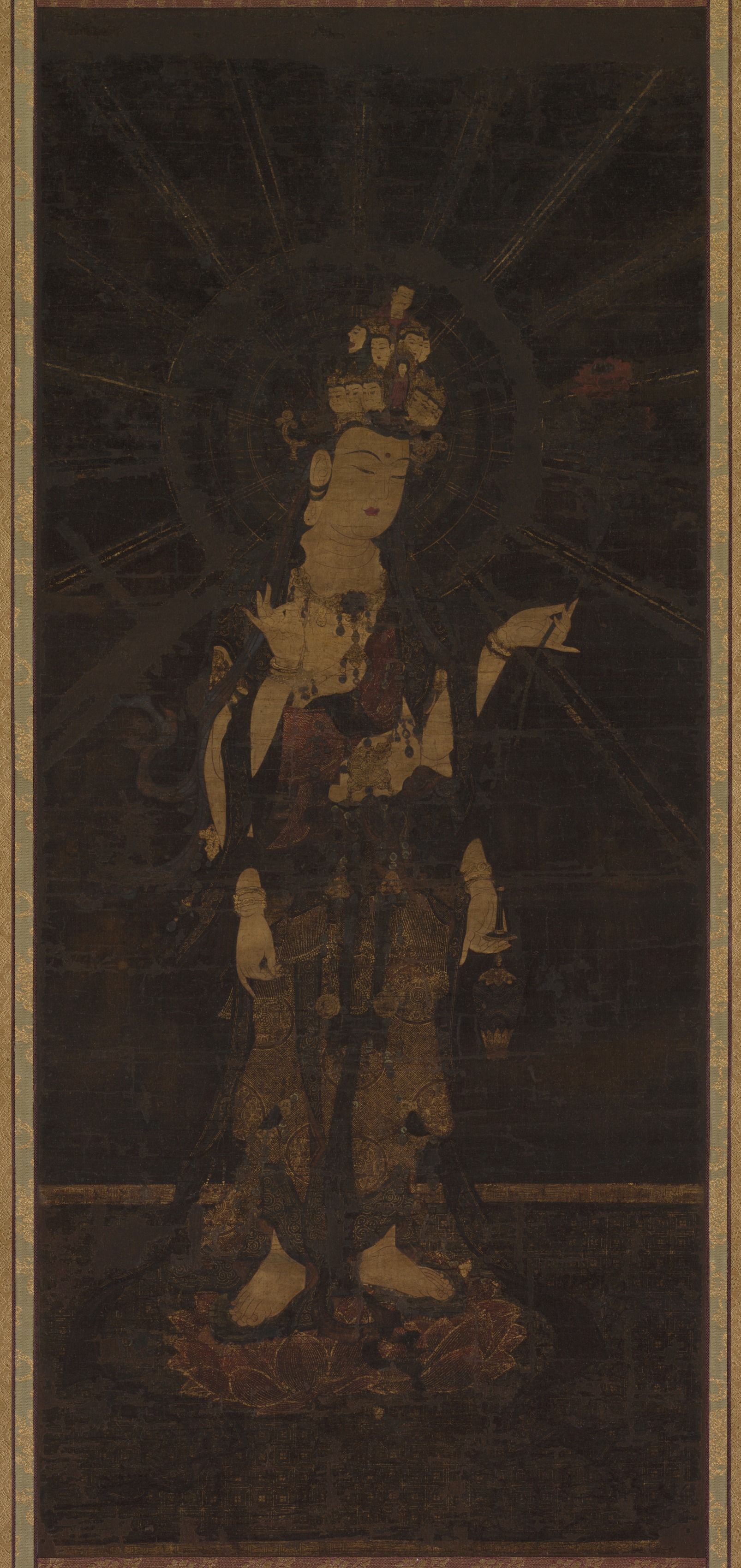
At Zoey Fashion Lab, the Chief Fabric Deconstructionist approaches the Eleven-Headed Kannon (Jūichimen Kannon) not as a static religious artifact, but as a living, mutable codex of textile and spiritual engineering. Hailing from Japan’s Kamakura period (1185–1333), this hanging scroll—executed in color and cut gold (kirikane) on silk—represents a pinnacle of medieval artistry. However, for the avant-garde lens of Zoey Fashion Lab, it is a New DNA Strand: a blueprint for reimagining the divine through radical materiality, temporal fragmentation, and the deconstruction of sacred geometry. This analysis dissects the Kannon’s formal, symbolic, and textural elements, proposing a translation into a contemporary, deconstructive fashion narrative that honors its origin while obliterating its historical context.
The Anatomy of the Divine: Eleven Heads as a Structural Code
The Eleven-Headed Kannon’s most arresting feature—the eleven smaller heads crowning the primary face—is not merely a hierarchical arrangement but a modular system of perception. Each head represents a distinct aspect of compassion: the ability to see suffering from multiple angles, to hear cries for help in all directions, to act with omniscient mercy. In textile terms, these heads function as repeating, asymmetrical motifs, akin to a genetic sequence where each unit carries a variation of the same core information. For the avant-garde designer, this suggests a garment constructed from discrete, interchangeable panels—a coat or a dress where the collar, shoulders, and sleeves are independent, detachable “heads” of fabric, each with its own color, pattern, and texture.
The Kamakura period’s technical mastery of kirikane—cut gold leaf applied in precise, linear patterns—transforms the silk surface into a luminous, fragmented skin. The gold does not merely decorate; it interrupts the painted narrative, creating a shimmering grid that both binds and breaks the figure. This is a precursor to modern deconstruction: the gold lines are seams that reveal the underlying structure, much like exposed zippers or raw edges in avant-garde fashion. Zoey Fashion Lab would reinterpret this as metallic threadwork or laser-cut gold foil applied over distressed silk, where the “cuts” are not decorative but functional—allowing the fabric to breathe, to fray, to reveal its own construction. The gold becomes a fractal DNA, repeating and mutating across the garment’s surface, echoing the Kannon’s infinite compassion through infinite pattern variation.
Materiality as Metaphor: Silk, Gold, and the Deconstruction of Time
Silk, as a medium, is inherently temporal. It ages, it wrinkles, it absorbs the oils of hands and the dust of centuries. The Kamakura scroll, preserved in a museum, is a frozen moment of devotion. However, for the deconstructionist, this silk is a living membrane that carries the memory of its making. The color palette—subdued mineral blues, vermillion reds, and muted golds—is not static; it shifts with light, humidity, and perspective. Zoey Fashion Lab would deconstruct this by layering sheer, hand-dyed silks in analogous hues, allowing the underlayers to bleed through like a palimpsest. The gold kirikane would be replaced with hand-stitched metallic thread that catches light asymmetrically, creating a moiré effect that mimics the scroll’s original luminosity.
The concept of the New DNA Strand is critical here. In genetic terms, DNA is a double helix that encodes information through repetition and variation. The Kannon’s eleven heads, the repeated gold lines, the rhythmic folds of the robe—all are repetitive structures that encode compassion. In fashion, this translates to a modular garment system: a base dress of raw silk, onto which are attached eleven “heads” of fabric—each a different texture (organza, velvet, linen, metallic mesh) and each representing a different aspect of the divine. The wearer becomes a living scroll, a mobile temple whose compassion is expressed through the act of dressing. The garment’s seams are not hidden but exaggerated, stitched with gold thread in a pattern that mimics the kirikane’s geometry. The hem is left raw, fraying into a fringe that echoes the scroll’s aged edges.
Deconstructing the Icon: From Object to Performance
The Kannon scroll is a static object, designed for veneration in a fixed space. The avant-garde impulse, however, demands motion, transformation, and interaction. Zoey Fashion Lab would deconstruct the icon by removing its frame—literally and metaphorically. The hanging scroll’s format suggests a vertical, linear reading; the deconstructed garment would be asymmetrical, cascading, with one shoulder bare and the other layered in fabric “heads” that trail down the back like a train. The eleven heads are not all visible at once; they emerge as the wearer moves, turning, revealing, hiding—a kinetic meditation on omniscience.
The color and cut gold technique is reinterpreted as cutwork and appliqué. The gold is not painted but stitched into the fabric using a technique derived from sashiko (Japanese decorative reinforcement stitching). The stitches form the outlines of the Kannon’s faces, but they are incomplete—some faces are only half-stitched, others are suggested by negative space. This is a deconstruction of the divine: the sacred is not a finished image but a process, a becoming. The garment’s wearer is both the devotee and the deity, the observer and the observed.
The Avant-Garde Synthesis: Compassion as a Material Practice
Ultimately, the Eleven-Headed Kannon as a New DNA Strand for Zoey Fashion Lab is not about appropriation but translation. The Kamakura scroll’s core function—to embody compassion—is preserved, but its form is fractured, recombined, and reanimated through avant-garde techniques. The garment becomes a wearable relic, a piece that carries the weight of history while being utterly contemporary. The frayed edges, exposed seams, and modular panels are not signs of decay but of potential—the DNA is still active, still capable of mutation.
In the studio, this analysis would produce a collection of eleven pieces, each corresponding to one of the Kannon’s heads. Each piece would be a deconstructed garment (a jacket with one sleeve, a skirt with a missing panel, a bodice with a cutout) that, when combined, forms a complete ensemble—a full “body” of compassion. The gold kirikane would be replaced with laser-cut gold leather appliqués that cast shadows on the silk, creating a three-dimensional, interactive surface. The color palette would be muted but luminous, with indigo, rust, and ochre dominating, punctuated by flashes of pure gold thread.
This is not a costume; it is a deconstruction of the divine into wearable form. The Eleven-Headed Kannon, through the lens of Zoey Fashion Lab, becomes a living text—a garment that is both a prayer and a statement, a relic and a revolution. The New DNA Strand is not a metaphor but a material reality: the silk, the gold, the stitches, and the cuts all encode a new vision of compassion—one that is fragmented, mutable, and eternally unfolding. In this deconstruction, the Kannon is not diminished but expanded, its eleven heads now multiplied across a thousand possible forms, each one a thread in the fabric of a new, avant-garde divinity.