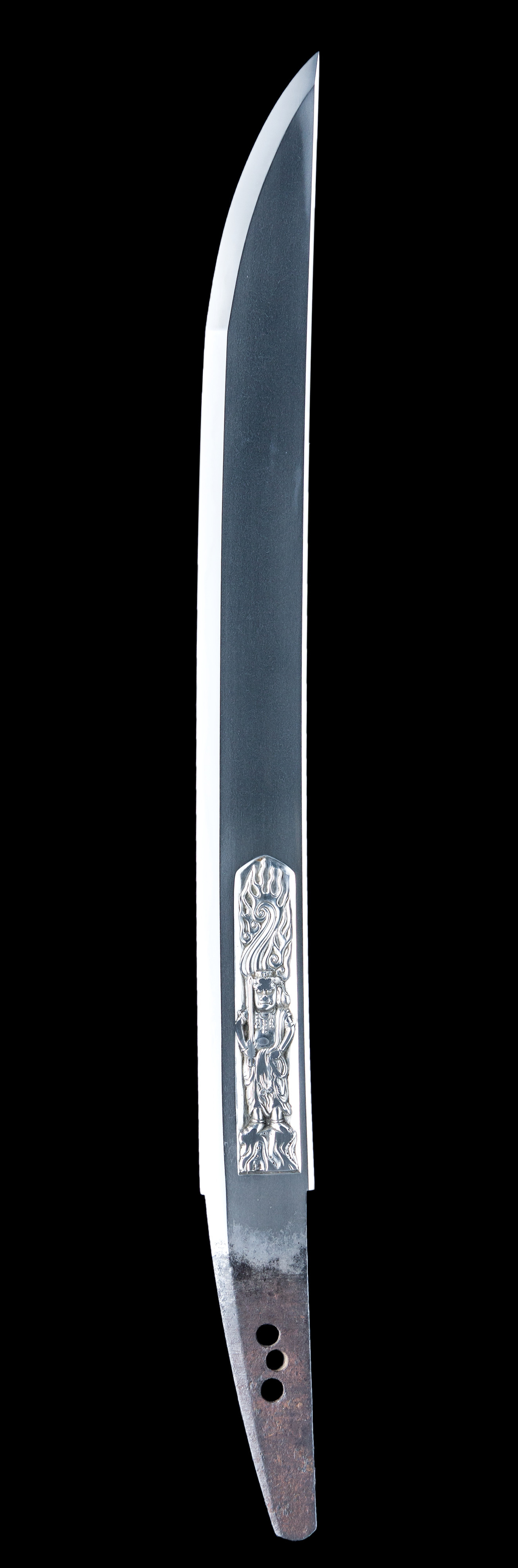
Deconstructing the Wakizashi: An Avant-Garde Lexicon for SS26
The wakizashi, a short sword traditionally worn as a companion to the katana, is an object of profound structural and philosophical rigor. Its form—a blade forged from layered steel, a tsuka (hilt) wrapped in ray skin and silk, and a tsuba (guard) of precious alloys—represents a pinnacle of functional craftsmanship. For Zoey Fashion Laboratory’s SS26 collection, this artifact is not merely a historical reference; it is a generative matrix for a new sartorial language. This analysis dissects the wakizashi’s components—blade, mounting, and materiality—to extract principles for futuristic silhouettes, structural innovation, and a deconstructive aesthetic that redefines the body as a site of kinetic armor and architectural drape.
1. The Blade: Silhouette as Forged Line
The wakizashi’s blade is defined by its hamon—the tempered edge line that separates hard steel from soft. This is not a decorative flourish but a functional boundary. In SS26, we reinterpret this as a silhouette principle: the garment’s primary seam or folded edge becomes a line of stress and release. Imagine a coat where the left side is constructed from rigid, laser-cut steel-gray leather (the hard steel), and the right side from fluid, liquid-silver jersey (the soft steel). The seam, running diagonally from the shoulder to the opposite hip, is the hamon—a zone of tension where the two materials meet. This creates a dynamic asymmetry that shifts with movement, echoing the blade’s purposeful curve (sori). The silhouette is not static but a frozen moment of forging, where the body’s motion completes the tempering process.
Furthermore, the blade’s kissaki (tip) informs the termination points of sleeves, hems, and collars. Instead of soft, rounded edges, we propose sharp, acute angles—a jacket’s lapel that tapers to a needle point, or a skirt’s hem that slices upward at a 45-degree angle. These points are not arbitrary; they are functional, directing the eye and creating a visual trajectory akin to a sword’s thrust. The wakizashi’s length—shorter than a katana—suggests a more intimate, compressed silhouette for the torso. Garments are cropped, layered, and stacked, creating a sense of condensed power. A bolero jacket, for instance, ends abruptly at the waist, its hemline mimicking the munemachi (notch at the blade’s base), while a high-waisted pant flares outward like the shinogi (ridge line) of the blade’s cross-section.
2. The Mounting: Structural Innovation as Armature
The wakizashi’s mounting (koshirae) is a masterclass in layered construction. The tsuka (hilt) features a core of wood wrapped in samé (ray skin), then bound with silk or cotton ito (cord). This is not mere decoration; the ray skin provides grip, and the cord pattern (tsuka-maki) distributes force. For SS26, we translate this into a structural exoskeleton for the upper body. A harness or bodice is constructed from a base of molded, lightweight carbon fiber (the wood core), overlaid with a grid of laser-cut, diamond-patterned leather (the ray skin texture), and then cross-laced with metallic gold and shakudō-colored cords. The lacing is not purely aesthetic; it is functional tensioning—the wearer can adjust the garment’s fit by tightening or loosening the cords, mirroring the samurai’s ability to customize the sword’s grip. This creates a kinetic armature that moves with the body while maintaining structural integrity.
The tsuba (guard) is the nexus of innovation. Traditionally made from shakudō (copper-gold) or shibuichi (copper-silver), it is a flat, often intricately carved disc that separates blade from hilt. In our avant-garde context, the tsuba becomes a modular joint—a circular, detachable element that connects different garment volumes. Imagine a dress where the skirt is attached to the bodice via a large, polished malachite and shakudō ring at the waist. This ring is not sewn; it is clasped, allowing the skirt to be swapped or detached entirely. The ring’s surface is carved with geometric patterns reminiscent of sukashi (openwork tsuba), creating negative space that reveals the body beneath. This principle extends to sleeves, collars, and even footwear—a boot’s shaft is connected to its sole via a copper-alloy ring, enabling modularity and repair, a direct challenge to fast fashion’s disposability.
3. Materiality: The Alchemy of Precious Alloys and Organic Surfaces
The wakizashi’s materials—steel, wood, lacquer, ray skin, malachite, gold, shakudō, shibuichi—are not just functional; they are alchemical signifiers of status, protection, and impermanence. For SS26, we deploy these materials in a dialectical tension between the organic and the industrial. The samé (ray skin) pattern, with its pebbled texture, is recreated via 3D-printed silicone panels applied to the interior of a jacket, providing grip and a tactile, almost reptilian sensation against the skin. The malachite, with its vivid green bands, is cut into thin, flexible tiles and inlaid into a structural corset, its color evoking both verdant growth and oxidized copper—a bridge between nature and metallurgy.
The alloys—shakudō (a deep blue-black copper-gold) and shibuichi (a pale silver-grey copper-silver)—are the chromatic anchors of the collection. Their subtle, non-reflective patinas challenge the high-shine luxury of conventional fashion. We propose applying these alloys as vapor-deposited films onto fabric, creating a surface that shifts from deep indigo to gunmetal grey depending on the light. A pant leg, for instance, might be coated in a shakudō gradient from hip to hem, mimicking the blade’s yakiba (hardened edge). The gold is used sparingly, as accent rivets or thread in the lacing, echoing the menuki (decorative hilt ornaments) that serve no structural purpose but are essential for spiritual protection. This hierarchy of materials—base steel (leather), organic ray skin (silicone), precious alloy (coated fabric)—creates a stratified surface that invites close inspection, rewarding the observer with hidden details.
4. Deconstructive Aesthetics: The Wabi-Sabi of the Sword
The wakizashi, despite its precision, is subject to wear—the sori (curve) can warp, the habaki (collar) can loosen. This impermanence is celebrated in the Japanese aesthetic of wabi-sabi. For SS26, we embrace deconstructive finishes that reveal the garment’s construction. Seams are left raw, edges are frayed, and layers are deliberately misaligned. A jacket might have its ura-omote (inside-out) construction exposed, with the lining (ray skin-patterned silicone) visible at the cuffs and hem. The ito (cord) lacing is intentionally loose in some areas, creating a sense of controlled decay. This is not sloppiness but a narrative of use—the garment is a living artifact, its history written in its fraying cords and patinated surfaces.
The tsuka’s wrapping pattern, typically a tight hineri-maki (twisted wrap), is translated into a deconstructed lattice on a skirt. The fabric is cut into strips, twisted, and re-sewn at intervals, creating a three-dimensional, sculptural surface that echoes the sword’s grip. The kashira (pommel) is reimagined as a weighted, detachable pendant at the end of a long scarf, its malachite and shakudō composition providing both aesthetic closure and functional counterbalance. The entire ensemble, from blade to mounting, becomes a portable architecture—a structure that is both protective and expressive, rigid and fluid, ancient and futuristic.
Conclusion: The Wakizashi as a Blueprint for SS26
The wakizashi is not a weapon but a philosophical instrument of form, function, and material truth. By deconstructing its blade, mounting, and materiality, Zoey Fashion Laboratory can forge a collection that is at once fiercely structural and poetically ephemeral. The futuristic silhouette is not about space-age plastics but about the revelation of construction—the hamon seam, the modular tsuba joint, the kinetic tsuka lacing. The materials—steel leather, malachite inlay, shakudō film—are not decorative but functional alchemies that challenge the wearer to engage with the garment as a living system. In SS26, the body becomes the blade, the mounting becomes the armor, and the wakizashi’s 400-year-old wisdom becomes the cutting edge of tomorrow’s fashion.