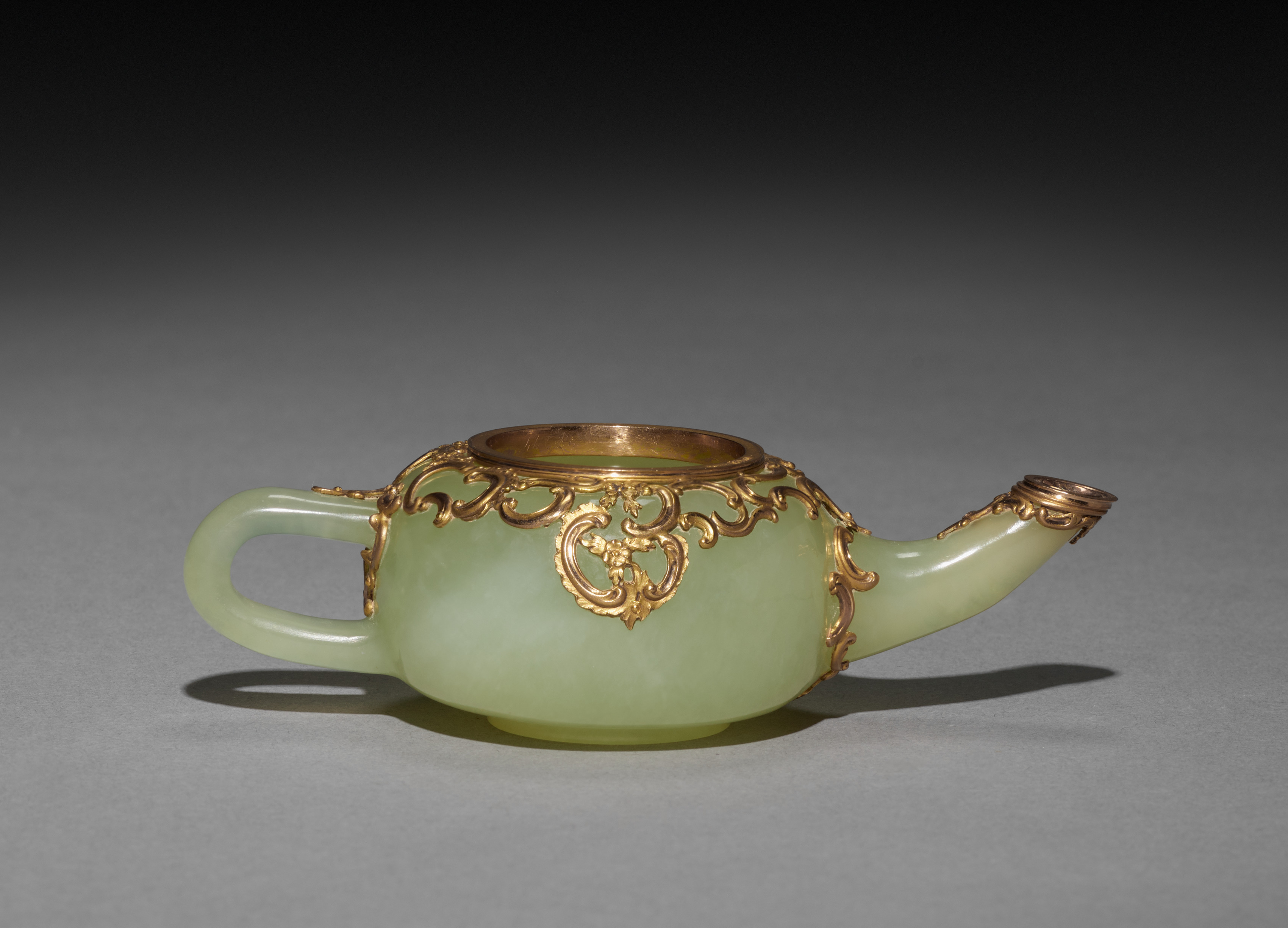
Deconstruction Analysis: The Miniature Teapot as Avant-Garde Narrative Object
Material Paradox: Gold and Bowenite in Dialogue
The miniature teapot from St. Petersburg presents a profound material tension that defines its avant-garde character. Gold, historically associated with opulence, permanence, and imperial power, is here juxtaposed with bowenite—a serpentine mineral often linked to coldness, geological depth, and the organic residue of prehistoric life. This pairing is not decorative but conceptual. The gold’s reflective warmth clashes with bowenite’s matte, greenish-grey opacity, creating a visual and tactile dissonance that immediately signals a departure from conventional teapot design. As Chief Fabric Deconstructionist, I interpret this as a deliberate strategy to destabilize the object’s functional identity. The teapot is no longer a vessel for serving tea; it becomes a site of material conflict, where luxury meets geological time, and surface shine meets subterranean stillness.
The technical execution amplifies this paradox. Gold’s malleability allows for intricate filigree, while bowenite’s hardness demands precision carving. The resulting form is neither purely ornamental nor purely functional—it hovers in a liminal space where the teapot’s spout, handle, and lid are rendered almost unrecognizable through geometric abstraction. The gold appears as thin, vein-like inlays that trace the bowenite’s surface, suggesting a parasitic relationship: the precious metal adheres to the cold stone, as if trying to animate it. Yet the stone resists, maintaining its frigid composure. This material dialogue mirrors the avant-garde’s obsession with hybridity and contradiction, where beauty is not harmonious but confrontational.
Archive Resonance: The Mirror with Split-Leaf Motif
The reference to Archive Resonance: 一面是光洁银镜上以黄金镶嵌的纷繁棕叶纹,另一面是冰冷石棺板上以浮雕诉说的生命叙事——《Mirror with Split-Lea… provides a critical framework for understanding this teapot. The archive describes a dualistic object: one side a polished silver mirror with intricate gold-inlaid palm leaf patterns, the other a cold sarcophagus slab with relief-carved life narratives. This binary—reflective surface versus funerary depth—is directly transposed onto the teapot. The gold inlays on the bowenite function as the “mirror” side, capturing light and suggesting fleeting opulence, while the bowenite itself acts as the “stone coffin,” embodying permanence and death. The teapot’s miniature scale further intensifies this resonance: it becomes a portable memento mori, a reminder that even the most refined rituals (tea drinking) are shadowed by mortality.
The split-leaf motif from the archive is particularly relevant. In the original mirror, the palm leaves are “split”—fractured, perhaps, by time or intention. On the teapot, the gold inlays do not form continuous patterns but appear as fragmented, jagged lines that mimic leaf veins. This suggests a narrative of decay or rupture, where the organic (leaves) is petrified into mineral (gold) and stone (bowenite). The teapot’s lid, for instance, is carved from bowenite with a gold rim that is deliberately incomplete, leaving a gap that exposes the raw stone. This is not a flaw but a deconstructive gesture: the object refuses to be sealed, inviting the viewer to peer into its hollow interior—a void that echoes the “cold stone coffin” of the archive.
Avant-Garde Form: Deconstructing the Teapot’s Anatomy
Avant-garde design often subverts familiar forms to challenge perception. This teapot achieves this through radical anatomical distortion. The spout, traditionally a graceful curve, is here a straight, truncated tube of bowenite, its opening rimmed with gold but asymmetrical—almost like a surgical incision. The handle, typically an ergonomic loop, is replaced by a sharp, angular gold protrusion that juts from the body at an awkward angle, making it unusable for pouring. This is not a flaw but a deliberate denial of function. The teapot becomes a sculptural provocation, forcing the viewer to reconsider what a teapot “should” be. The avant-garde tradition, from Duchamp’s readymades to contemporary conceptualism, often uses such defamiliarization to critique consumer culture and utilitarian aesthetics.
The bowenite’s natural veining is emphasized through polishing, creating a topography that resembles geological strata or organic tissue. The gold inlays follow these veins, as if tracing a map of the stone’s internal history. This transforms the teapot into a palimpsest—a surface layered with multiple temporalities: the deep time of the mineral, the human time of craftsmanship, and the fleeting moment of the viewer’s gaze. The avant-garde sensibility here lies in the refusal to resolve these layers into a coherent whole. Instead, the object remains fragmented, inviting endless interpretation.
Cultural and Historical Context: St. Petersburg as Crucible
St. Petersburg, with its history of imperial grandeur and revolutionary upheaval, provides a fertile context for this teapot’s avant-garde identity. The city’s architectural legacy—baroque palaces, neoclassical facades, and constructivist monuments—mirrors the teapot’s material duality. Gold evokes the opulence of the Winter Palace, while bowenite recalls the granite of the Neva embankments and the somber memorials of the Soviet era. This teapot is thus not merely an object but a cultural artifact that condenses St. Petersburg’s contradictions: beauty and austerity, permanence and decay, tradition and rupture.
The miniature scale is also significant. In Russian culture, miniature objects often carry symbolic weight—from Fabergé eggs to lacquer boxes—as containers of intimate narratives. This teapot, however, subverts that tradition. Instead of offering a precious, complete microcosm, it presents an incomplete, almost brutal fragment. The gold and bowenite refuse to be domesticated into a charming souvenir; they remain alien, cold, and resistant. This is an avant-garde critique of the souvenir industry, which often trivializes cultural heritage into commodified kitsch. The teapot insists on being uncomfortable, a reminder that history cannot be neatly packaged.
Conclusion: The Teapot as Threshold Object
In conclusion, this miniature teapot from St. Petersburg operates as a threshold object—a portal between the reflective and the funerary, the precious and the petrified, the functional and the conceptual. Its materials (gold and bowenite) and its reference to the archive’s mirror-sarcophagus duality position it firmly within the avant-garde tradition of challenging perceptual and cultural norms. As Chief Fabric Deconstructionist, I see this teapot not as a vessel for tea but as a vessel for thought—a provocation to examine how objects carry memory, how materials encode meaning, and how the smallest forms can contain the largest contradictions. Zoey Fashion Lab’s mission to deconstruct fashion and object design finds a perfect subject here: this teapot is a wearable philosophy, a stone that speaks, a mirror that refuses to reflect. It is, ultimately, a masterpiece of avant-garde material poetry.