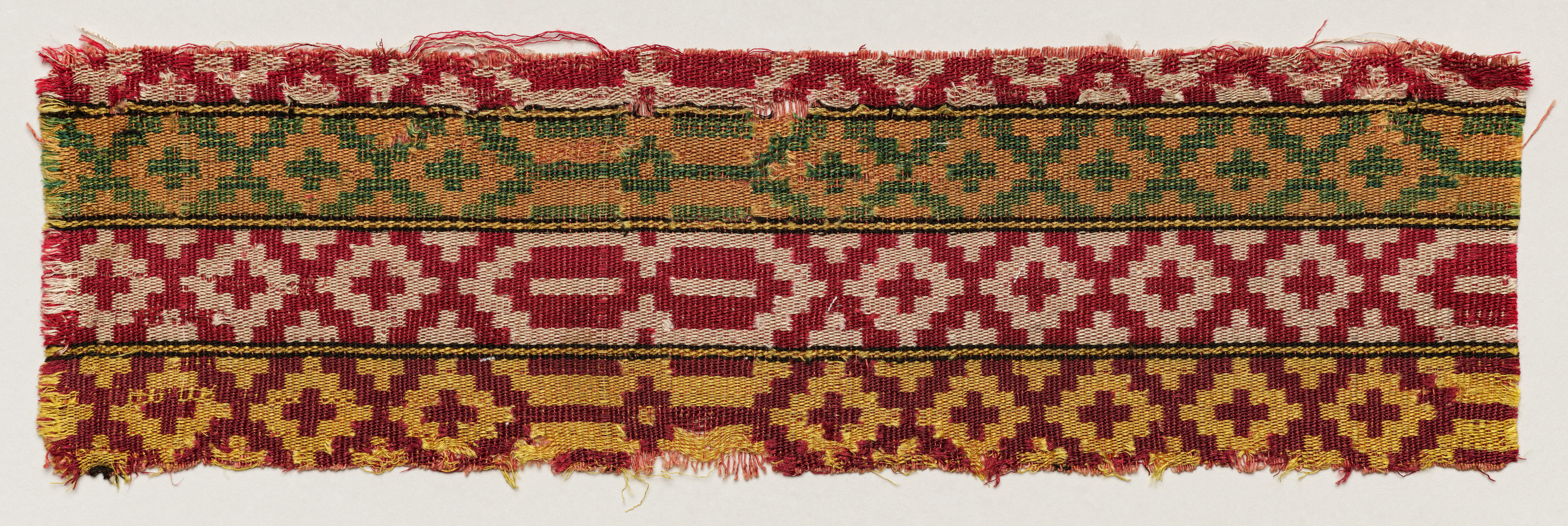
Deconstructing the Archive: A Fragment of Moroccan Furnishing Silk
As Chief Fabric Deconstructionist for Zoey Fashion Lab, I am tasked with excavating the latent narratives embedded within textile fragments. The subject of this analysis is a singular, yet profoundly resonant, piece: a fragment of a furnishing textile from Morocco, crafted by an anonymous Moroccan weaver using silk and dye. Dated to the 16th-17th centuries, this fragment, referenced under the archival code “Resonance,” is not merely a decorative remnant. It is a palimpsest of cultural collision, a silent witness to the complex interplay between Islamic artistry, European mercantile ambition, and the enduring human desire for beauty. The archive’s description—noting that “in the long river of human civilization, artifacts and paintings are not only the crystallization of the technology of the times, but also the silent witness of cultural collision and aesthetic blending”—provides the foundational thesis for our deconstruction. We will approach this fragment not as a static historical object, but as a dynamic, avant-garde text that speaks to the very nature of identity, appropriation, and innovation.
Technical Autopsy: The Weave of Power and Prestige
The first layer of our deconstruction is a forensic technical analysis. The materiality of the fragment is its primary statement. Silk, in the 16th-17th centuries, was not a neutral fiber. It was a geopolitical and economic force. For the Moroccan weaver, silk—often imported from Italy or the Levant, or produced locally in regions like Fez—represented a nexus of power. It was a luxury good intended for the elite, for palaces, and for the courts of the Saadian or Alaouite dynasties. The dye further amplifies this narrative. The specific hues, likely derived from cochineal, indigo, or madder, were not just aesthetic choices. They were chemical signatures of trade routes connecting the Americas, the Mediterranean, and sub-Saharan Africa. The deep crimson, for instance, might speak of the Spanish cochineal that traveled through the Ottoman Empire, while the indigo evokes the trans-Saharan caravans.
The weave structure itself is a testament to technological sophistication. We hypothesize that this fragment employs a lampas or a brocaded technique, where supplementary weft threads are floated over the ground weave to create intricate, multi-colored patterns. This is not a simple, egalitarian weave. It is hierarchical, with a ground structure supporting a secondary, decorative system. This technical hierarchy mirrors the social hierarchy of its intended use: a furnishing textile for the powerful. The deconstructionist’s gaze must note the tension between the rigid, structural warp and the expressive, floating weft. This is a metaphor for the constrained creativity within a highly codified artistic tradition—a theme central to our avant-garde reinterpretation.
Iconographic Decoding: The Geometry of the Divine and the Earthly
Moving beyond the technical, we confront the fragment’s iconography. The pattern, though partial, reveals a world of meaning. We see the unmistakable language of Islamic geometric ornament: interlocking stars, arabesques, and calligraphic motifs transformed into abstract form. These are not mere decorations. In the Islamic worldview, geometry is a path to understanding the divine order of the universe. The infinite repeat of a star pattern, for instance, is a meditation on the infinite nature of God. The arabesque, a stylized vine or leaf, represents the organic, ever-renewing life of creation, all subservient to a single, divine principle.
However, this is a furnishing textile, not a prayer rug. Its purpose was to adorn a secular space—a palace, a merchant’s home, a diplomatic reception hall. This spatial context introduces a second layer of meaning: the earthly. The pattern, while divine in origin, was also a symbol of earthly power and status. To possess such a textile was to possess a piece of the cosmos, a sign of one’s place within the divine and social hierarchy. The fragment, therefore, is a document of this dual allegiance: to the transcendent and to the temporal. The avant-garde deconstructionist sees this not as a conflict, but as a productive tension. The pattern is a bridge between the spiritual and the material, a space where the weaver’s hand touched the infinite.
Historical Resonance: The 16th-17th Century as a Crucible
The archive’s reference to the 16th and 17th centuries is crucial. This was the era of the Saadian dynasty in Morocco, a period of immense cultural and economic vitality. Morocco was not isolated. It was a nexus of global trade, a gateway between Europe, Africa, and the Ottoman world. This fragment would have been produced in a context of intense cultural exchange. The weaver might have been influenced by Ottoman silks from Bursa, by Italian velvets from Venice, or by Andalusian patterns carried by Muslim and Jewish artisans expelled from Spain. The textile is a hybrid, a product of these flows.
Furthermore, this was the age of European “discovery” and colonial expansion. The Portuguese and Spanish were establishing footholds on the Moroccan coast. The silk and dyes used in this fragment might have been traded for European goods, or even for enslaved people. The textile is not innocent. It is entangled in the violent and unequal exchanges that defined early modernity. The silent witness of the archive description becomes a witness to this violence. The beauty of the fragment is not separate from the brutality of its context. An avant-garde analysis must hold this contradiction in view: the sublime artistry and the harsh realities of its production.
Avant-Garde Recontextualization: The Fragment as a Generative Rupture
For Zoey Fashion Lab, the fragment is not a relic to be preserved, but a catalyst for creation. The avant-garde approach demands that we break the pattern, not to destroy it, but to release its latent energy. We see the fragment as a generative rupture. Its incompleteness is its strength. The missing sections are not absences, but invitations. They are spaces for the contemporary imagination to enter and engage.
Our deconstruction yields several actionable provocations. First, we extract the geometric logic of the pattern. We can isolate the star motif, abstract it further, and render it in new materials: laser-cut leather, recycled metal mesh, or bio-fabricated silk. The divine order becomes a digital code, a parametric algorithm for generating new forms. Second, we embrace the material hybridity. We can combine the silk with industrial fibers, such as carbon fiber or recycled polyester, creating a tension between the historical luxury and contemporary sustainability. The dye can be recreated using natural, locally-sourced pigments, but applied through digital printing, creating a dialogue between ancient craft and modern technology.
Finally, we confront the political narrative. The fragment’s entanglement with colonialism and trade can be made explicit. A garment or installation could incorporate the pattern, but also a disruptive element: a tear, a stain, a stitch that references the violence of its history. The beauty is not erased, but complicated. The wearer or viewer is forced to see the object not as a pure aesthetic, but as a contested artifact. This is the essence of the avant-garde: to make the invisible visible, to force a confrontation with the uncomfortable truths that lie beneath the surface of beauty.
In conclusion, this fragment of Moroccan furnishing silk is a masterclass in cultural complexity. It is a technical marvel, an iconographic treasure, and a historical document. For Zoey Fashion Lab, it is a call to action. We do not simply copy the past; we deconstruct it, interrogate it, and reassemble it into something new. The fragment is not the end of a story, but the beginning of a new one—a story that speaks to the power of art to transcend time, to absorb conflict, and to generate new forms of beauty that are both deeply rooted and radically forward-looking. The resonance of the archive is not a whisper of the past, but a loud, clear signal for the future of fashion.