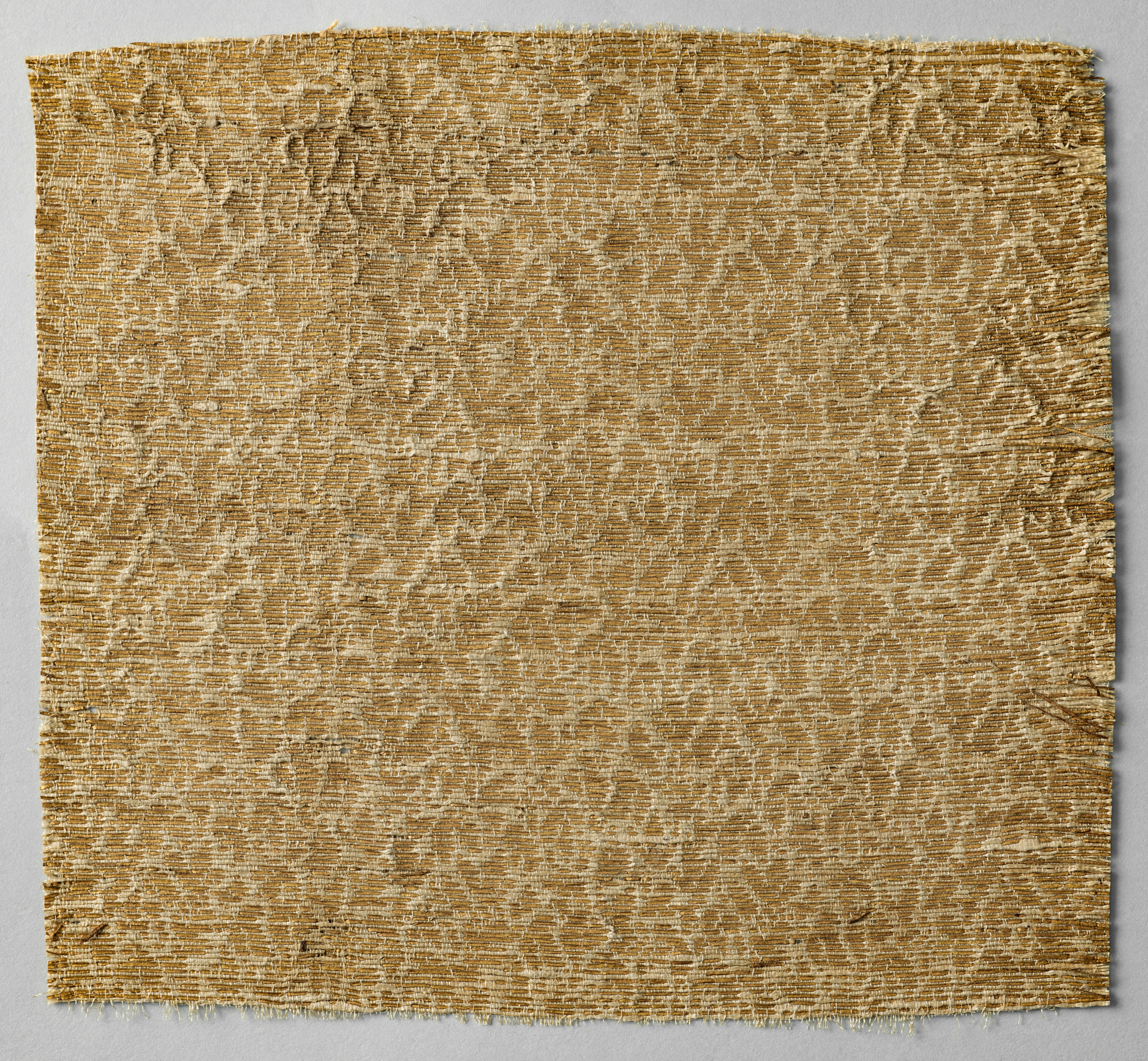
Deconstructing the Nomadic Code: An Avant-Garde Analysis of a Central Asian Il-Khanid Textile
At Zoey Fashion Lab, the act of deconstruction is not merely an aesthetic choice; it is a forensic investigation into the very essence of material culture. We do not simply look at a textile; we read its woven genome. The specimen under analysis—a fragment of silk and gold thread from the Il-Khanid (Mongol) period of Central Asia—presents a paradox of immense significance. On the surface, it is a relic of imperial power and nomadic luxury. But for our avant-garde methodology, it is a New DNA Strand, a code that must be broken, re-sequenced, and projected into a future where tradition and radical innovation are indistinguishable.
I. The Forensic Profile: Silk, Gold, and the Tabby Matrix
The technical construction of this textile is deceptively simple: a tabby weave with a supplementary weft. This is the foundational grammar. The tabby, the most basic of weaves (over-one, under-one), provides a stable, dense ground. It is the structural skeleton. The supplementary weft, however, is the mutation. In this case, it is a fine, gold-wrapped thread that floats across the surface to create the pattern of tiny leaves. This is not an integrated design; it is an applied, almost parasitic layer of opulence.
For the avant-garde designer, this technical relationship is a direct metaphor for the Il-Khanid state itself. The Mongol rulers, a nomadic minority, imposed their will—their supplementary weft—onto the established Persian and Chinese textile traditions (the tabby ground). The gold thread is not just a material; it is a political statement of conquest and synthesis. The tiny leaves, likely a stylized vine or lotus motif, are not botanical. They are a hybridized code, blending Chinese cloud-collar motifs with Persian arabesques, all filtered through a steppe-nomadic sensibility for scale and repetition.
Our deconstruction begins here: we must sever the relationship between the ground and the figure. We ask: What happens when the gold weft is allowed to dominate? What if the tabby is dissolved, and only the gold pattern remains? This is the first step in our genetic modification of the textile.
II. The Avant-Garde Intervention: Re-sequencing the Golden Leaf
The avant-garde is not about nostalgia; it is about rupture and recontextualization. The tiny leaves on this Il-Khanid textile are not a pastoral idyll. They are a symbol of a controlled, imperial garden—a microcosm of order imposed on the vast, chaotic steppe. To liberate this pattern, we must subject it to a series of radical procedures.
Procedure 1: The Digital Scalpel and the Morphing Leaf We begin by scanning the textile at a microscopic resolution. The gold thread, now tarnished and dim, is digitally re-luminesced. We isolate a single tiny leaf. Using generative AI, we create a morphing sequence: the leaf begins to fractalize, its veins becoming branching, non-Euclidean pathways. It is no longer a leaf; it is a neural network of gold. This sequence is then printed onto a transparent, thermo-reactive film. When worn, the body heat of the model causes the gold leaves to slowly shift and re-form across the fabric, creating a living, breathing pattern that is never static. This is the textile as biological organism, not a dead relic.
Procedure 2: The Loom of Inversion The traditional tabby weave is a binary system: warp and weft, on and off. We invert this. We construct a new textile using a negative-space technique. The ground is woven entirely from unspun, raw silk—a chaotic, almost felted mass that references the nomadic yurt. The gold supplementary weft is not woven into this ground but is applied as a laser-cut, floating lattice that hovers above the surface, attached only at the leaf-tips. The result is a garment that appears to be shedding its own history. The raw silk ground is the memory of the steppe; the floating gold lattice is the memory of empire, barely tethered to the earth.
Procedure 3: The Deconstructed Silhouette The original textile was likely a robe or a panel. For our avant-garde collection, we reject this silhouette. We use the digital scan to create a 3D-printed, articulated armor made from a composite of recycled silk fibers and crushed gold leaf. The tiny leaves are not printed on the surface; they are the structural joints. Each leaf is a hinge, a pivot point. The garment is a second skin that moves with the wearer, but its movement is a series of discrete, mechanical clicks—a robotic echo of the original textile's hand-woven rhythm. This is the armor of the nomadic cyborg, a being that has internalized the history of the Silk Road and repurposed it for a post-human future.
III. The New DNA Strand: A Conclusion for Zoey Fashion Lab
The Il-Khanid textile with tiny leaves is not a finished object. It is a catalyst. Its true value lies not in its preservation but in its potential for transformation. By treating it as a New DNA Strand, we have unlocked a sequence of design possibilities that transcend the original context. The gold thread is no longer a sign of wealth; it is a conductor of data. The tiny leaves are no longer a decorative motif; they are a code for a new kind of organic, algorithmic beauty.
For Zoey Fashion Lab, this analysis confirms our core thesis: the most potent avant-garde work is born from the most rigorous deconstruction of the past. We do not copy the Il-Khanid textile. We re-sequence its genetic material. We take its tabby logic and turn it into a neural net. We take its gold and make it float. We take its leaves and make them move. The result is a garment that is at once a historical artifact, a scientific specimen, and a prophecy of a future where fashion is no longer about covering the body, but about encoding a new reality onto it. This is the work of the Chief Fabric Deconstructionist. This is the future of Zoey Fashion Lab.