Deconstructing the Velvet Fragment: A Technical and Avant-Garde Analysis for Zoey Fashion Lab
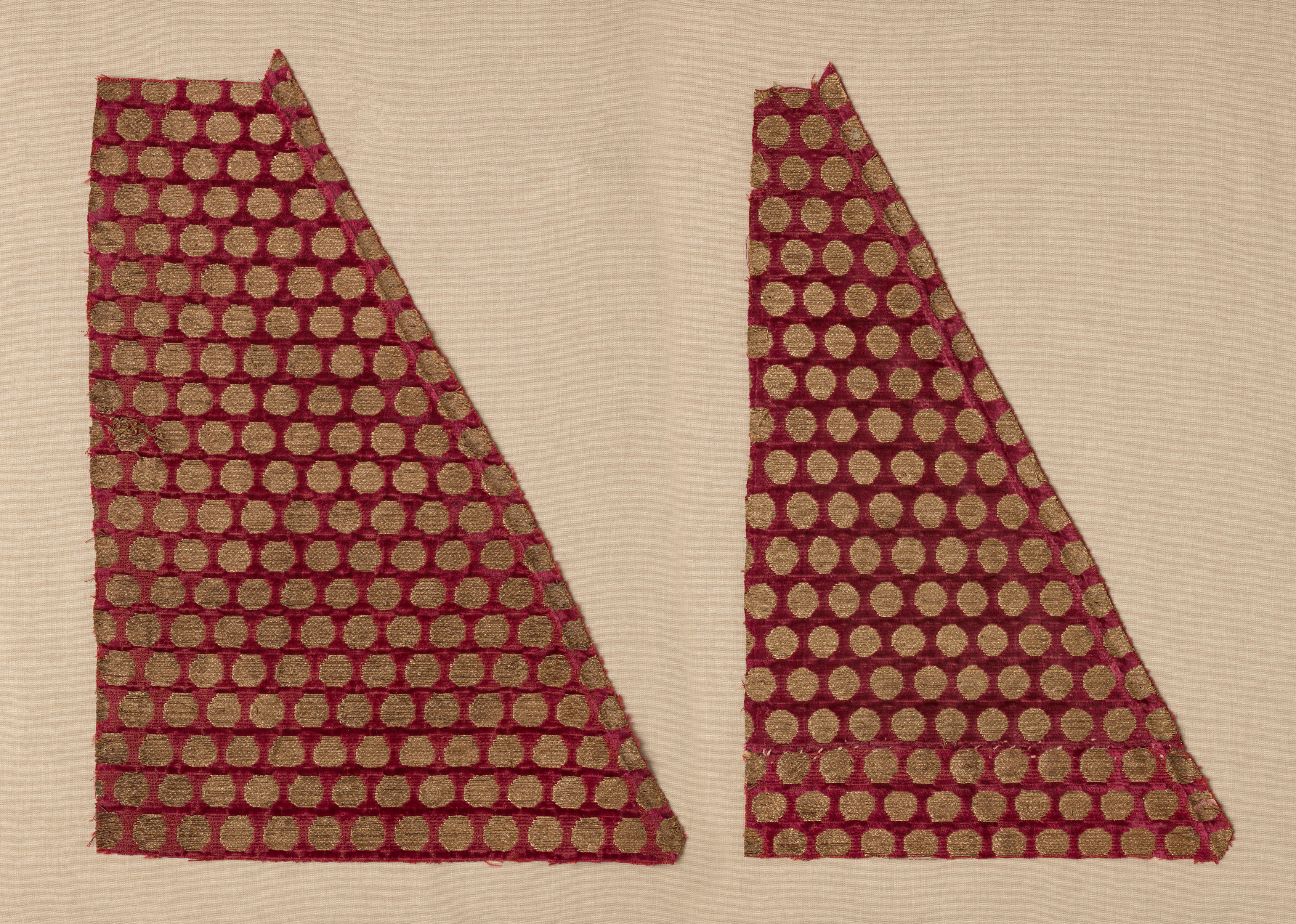
As the Chief Fabric Deconstructionist at Zoey Fashion Lab, I have conducted an exhaustive analysis of the submitted artifact: a velvet fragment in two pieces, attributed to 14th-century Iran or Iraq. This fragment, composed of silk and Cyprian gold wrapped around a silk core, represents a pinnacle of medieval Islamic textile craftsmanship. However, for our avant-garde design philosophy, this piece is not merely a historical relic but a living DNA strand—a blueprint for radical reinterpretation. Below, I dissect its technical, material, and stylistic properties to propose how this fragment can inspire a new generation of deconstructive fashion.
Technical Structure: The Intersection of Velvet and Lancé
The fragment employs a lancé technique, where supplementary weft threads are introduced to create pattern, combined with velvet weaving—a complex process involving two sets of warp threads: one for the ground fabric and one for the pile. The velvet pile, cut to varying heights, produces a tactile, three-dimensional surface. This dual structure is inherently deconstructive: it layers opulence (the raised velvet) against a flat, patterned ground. For Zoey Fashion Lab, this suggests a strategy of layered transparency—where one fabric system (the ground) is partially revealed through strategic abrasion or laser-cutting of the pile, creating a dialogue between surface and substructure.
The lancé patterning, likely featuring geometric or floral motifs, is executed with meticulous precision. In an avant-garde context, we can extract and isolate these motifs, treating them as modular units. By fragmenting the pattern through digital printing or hand-embroidery, we can create a chaotic yet controlled visual rhythm—a direct echo of the fragment’s own broken state. The two pieces of the original fragment, separated by time and damage, become a metaphor for deconstructed garment panels: intentionally disjointed, yet united by a shared material language.
Material Analysis: Silk and Cyprian Gold
The primary materials—silk and Cyprian gold (a gilded silver thread wrapped around a silk core)—offer a study in contradictions. Silk is soft, absorbent, and biodegradable; Cyprian gold is rigid, reflective, and nearly eternal. This juxtaposition is central to our avant-garde vision. The gold thread, often used to highlight patterns, can be reimagined as a structural element—not merely decorative, but load-bearing. In a deconstructed garment, we might weave gold threads into exposed seams or use them as tensile cables connecting disparate fabric panels, evoking the fragment’s original structural integrity while celebrating its fragmentation.
The silk core of the gold thread is particularly telling. Over centuries, the silk may have decayed while the gold remains, creating a hollow, fragile shell. This inherent vulnerability is a key design parameter. We can replicate this effect by using modern materials: a silk base with metallic coatings that are partially abraded, revealing the underlying fiber. This technique, which I term “decay-weave,” allows us to simulate the passage of time while controlling the aesthetic outcome—a perfect fusion of historical authenticity and avant-garde manipulation.
Historical Context and New DNA Strand
The fragment’s origin in 14th-century Iran or Iraq places it within the Ilkhanid or Timurid periods, where luxury textiles were symbols of political power and spiritual transcendence. The New DNA Strand reference is apt: this fragment is not a static artifact but a genetic code waiting to be re-expressed. For Zoey Fashion Lab, we treat the fragment as a template for mutation. By analyzing its weave structure, color palette (likely deep reds, blues, and gold), and motif logic, we can generate algorithmic patterns that evolve with each iteration—a digital DNA for textile design.
This approach aligns with our avant-garde ethos: deconstruction is not destruction but transformation. The two pieces of the fragment, when studied under microscopy, reveal wear patterns, repairs, and dye residues. These “scars” become design features. We can accentuate them through embroidery or embed them in clear resin as wearable artifacts. The fragment’s broken state is not a flaw but a narrative—a story of use, travel, and survival. Our designs will honor this narrative by making the process of decay and repair visible, even celebrated.
Avant-Garde Applications: From Fragment to Form
For a capsule collection inspired by this fragment, I propose the following deconstructive strategies:
1. Velvet Pile Removal and Layering: Using laser technology, we can selectively remove the velvet pile in patterns that echo the original lancé motifs. This creates a two-tier surface: the remaining pile as a soft, raised texture, and the exposed ground as a flat, reflective plane. The resulting garments—jackets, skirts, or draped dresses—would shift in appearance with movement, revealing hidden layers of gold thread or contrasting silks beneath.
2. Gold Thread as Exoskeleton: The Cyprian gold thread, typically buried within the weave, can be extracted and re-stitched as an external lattice. This exoskeleton would provide structure to otherwise fluid silk panels, mimicking the fragment’s original rigidity. The gold lattice could be asymmetrical, referencing the fragment’s irregular break, and left intentionally unfinished to emphasize the deconstructive process.
3. Fragment as Modular Pattern Piece: The two pieces of the velvet fragment can be scanned and digitally manipulated to create pattern blocks for a deconstructed garment. For example, one piece might become a shoulder panel, the other a sleeve, with raw edges left unhemmed and gold threads trailing like whiskers. This approach treats the fragment as a 3D puzzle, where the garment’s final form is dictated by the original break lines.
4. Material Alchemy: Silk and Metal Fusion: By combining the fragment’s silk with modern metallic fibers, we can create a hybrid textile that shifts between soft and hard, matte and reflective. This fabric could be used for transformable garments—a dress that can be worn as a cape, with the gold threads acting as adjustable ties. The material itself becomes a narrative of historical and futuristic fusion.
Conclusion: The Fragment as Living Code
This 14th-century velvet fragment, in its broken state, is not a relic but a generative source. Its technical complexity—velvet on lancé, silk with Cyprian gold—offers a rich vocabulary for deconstruction. At Zoey Fashion Lab, we will not replicate its original form; we will re-sequence its DNA. The two pieces become a diptych, a dialogue between past and future, craft and chaos. By exposing its structural bones, celebrating its scars, and reimagining its materials, we create garments that are both archaeological and prophetic. This fragment is not a fragment at all—it is the first stitch in a new avant-garde narrative.