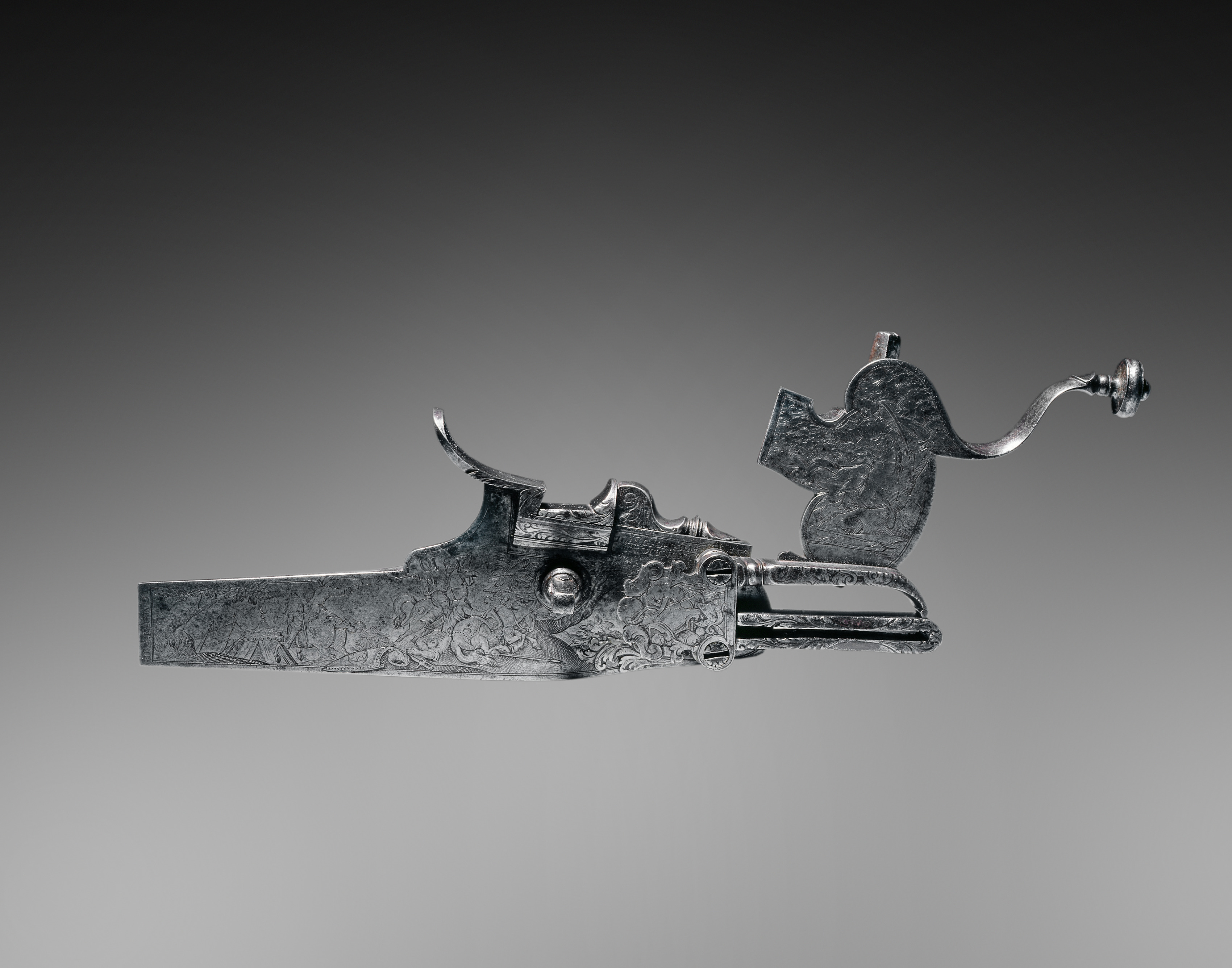
Deconstructing the Wheel-Lock: A New DNA Strand for Zoey Fashion Lab
At Zoey Fashion Lab, our mission is to interrogate historical artifacts, extracting their core structural and aesthetic principles to forge entirely new sartorial languages. The subject before us—an 18th-century German wheel-lock mechanism from a hunting rifle, crafted in Munich—is not merely a relic of martial history. It is a complex, three-dimensional blueprint for an avant-garde design system. This analysis will deconstruct the wheel-lock’s technical anatomy, its engraved artistry, and its contextual narrative, translating these elements into a New DNA Strand for our collections.
Technical Anatomy: The Mechanical Skeleton
The wheel-lock represents a pinnacle of pre-industrial mechanical ingenuity. Its primary components—the wheel, the dog (or cock), the pan, and the mainspring—function as a precise, interdependent system. For Zoey Fashion Lab, this is not a weapon but a kinetic architecture. The central wheel, serrated and rotated by a key, is the core motif. Its circular, toothed form suggests a new silhouette for structural garments: a spiral or radial construction around a central axis, perhaps in a bodice or a sculptural collar.
The dog, which holds the pyrite, and the spring-loaded arm that strikes the wheel, introduce principles of tension and release. This can be translated into garment fastenings and closures that are not passive but active. Imagine a jacket where the front closure is a series of interlocking, spring-loaded discs that require a deliberate, ritualistic motion to engage. The mainspring, coiled and stored, represents potential energy. In fabric, this manifests as pleated structures, gathered panels, or integrated elastic elements that create volume and silhouette on demand, echoing the mechanism’s latent power.
The steel itself—cold, rigid, and unforgiving—provides a material counterpoint to traditional textiles. We propose a hybrid approach: using laser-cut stainless steel mesh as a base for certain structural elements, or integrating hardware-grade polymer accents that mimic the patina of aged steel while remaining lightweight and flexible. The wheel-lock’s mechanical logic dictates a design language where form follows function, but with an avant-garde twist: function is aestheticized, and mechanics become ornament.
Engraved Narrative: Surface as Story
The engraved surface of this 18th-century wheel-lock is not decorative; it is a document of status, craft, and narrative. The intricate scrollwork, arabesques, and likely hunting scenes or mythological references transform the cold steel into a canvas. For Zoey Fashion Lab, this engraving becomes a textile printing and embossing methodology.
We deconstruct the engraver’s hand: the deep, confident cuts; the fine, hairline lines; the interplay of light and shadow on the metal’s surface. This translates directly into digital jacquard weaving and laser-embossed leather. The scrollwork can be abstracted into a continuous, flowing pattern that wraps around a garment’s seams, mimicking the way the engraving follows the contours of the lock plate. The hunting motifs—stags, hounds, foliage—are not literal but fragmented and reassembled into a chaotic, organic print that suggests motion and pursuit. The patina of age—the subtle tarnish and wear marks—becomes a color palette: oxidized greens, deep browns, muted golds, and the stark silver of polished steel.
Furthermore, the engraving’s depth and texture can be replicated using 3D-printed resin appliqués or hand-stitched metallic thread embroidery that rises from the fabric’s surface. The garment becomes a wearable artifact, where every panel tells a story of craftsmanship, but the story is rewritten in a contemporary, avant-garde vernacular.
Contextual Narrative: The Hunter and the Hunted
The wheel-lock’s origin—an 18th-century hunting rifle from Munich—imbues it with a powerful narrative of power, predation, and ritual. This is not a tool of war but of aristocratic leisure, a symbol of status and dominion over nature. For Zoey Fashion Lab, this narrative is deconstructed and inverted. The hunter becomes the hunted, the weapon becomes armor, and the ritual of the hunt becomes a performance.
We propose a collection where the wearer is both predator and prey. Garments are designed with asymmetrical, aggressive silhouettes that suggest a poised, predatory stance. Sharp, angular lapels mimic the dog’s jaw. Layered, segmented panels echo the lock’s complex mechanics. The color palette shifts from the forest greens and browns of the hunt to the stark, industrial grays and blacks of the steel itself.
The ritual of loading and firing—the winding of the wheel, the placement of the pyrite, the pull of the trigger—becomes a choreography of dressing. A garment might require a specific sequence of fastenings, a deliberate turning of a dial, or the insertion of a key to activate a hidden pocket or structural element. This transforms the act of dressing into a performative ritual, aligning with avant-garde fashion’s interest in process and experience over static form.
Avant-Garde Synthesis: The New DNA Strand
The synthesis of these elements—mechanical skeleton, engraved narrative, and contextual power—forms the New DNA Strand for Zoey Fashion Lab. This strand is not a literal reproduction of the wheel-lock but a genetic code that informs every design decision.
Key Design Principles Derived:
- Kinetic Structure: Garments are designed with moving parts, tension systems, and adjustable volumes, echoing the wheel-lock’s mechanical logic.
- Surface as Archive: Every surface—fabric, leather, metal—is treated as a canvas for engraved or embossed narrative, using digital and handcraft techniques.
- Ritualistic Interaction: The act of wearing and adjusting becomes a deliberate, almost ceremonial process, involving fastenings that require knowledge and intention.
- Material Hybridity: Steel, polymer, resin, and traditional textiles are fused, creating a new material taxonomy that is both hard and soft, historic and futuristic.
- Power Inversion: The narrative of the hunter is subverted, creating garments that empower the wearer as a figure of controlled, mechanical force, not brute violence.
In conclusion, the 18th-century wheel-lock is not a historical artifact to be copied but a generative system to be reinterpreted. Zoey Fashion Lab will use this New DNA Strand to create a collection that is both a tribute to German precision craftsmanship and a radical, avant-garde statement on the future of wearable architecture. The result is fashion that clicks, winds, and releases—a living mechanism on the body.