Deconstructing the Lattice: A Technical and Stylistic Analysis of 15th Century Florentine Velvet
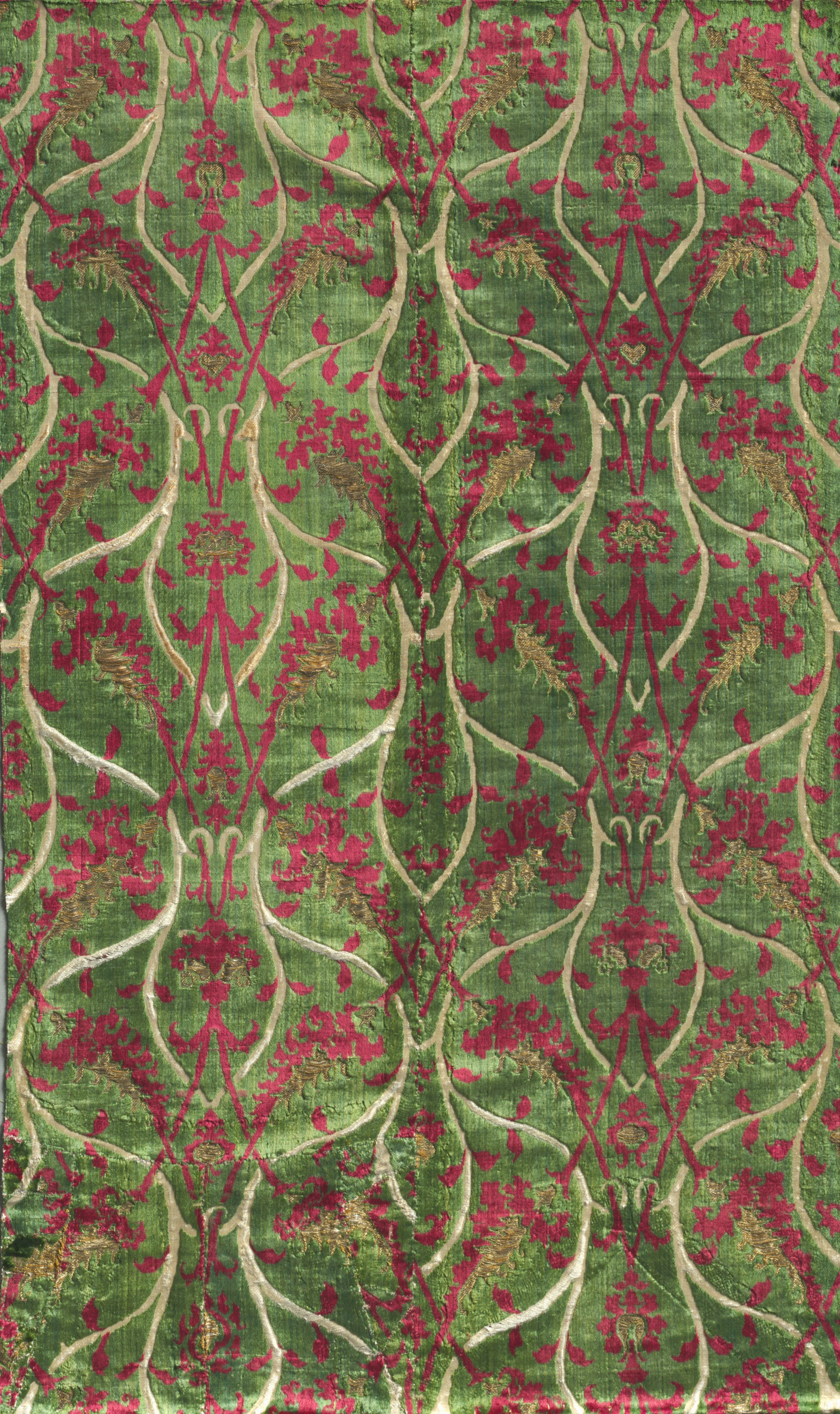
At Zoey Fashion Lab, the act of deconstruction is not merely about taking apart; it is a forensic and creative process that unearths the latent potential within historical textiles. The subject of this analysis is a fragment of two-color velvet with gold, originating from Italy, likely Florence, circa the 15th century. This is not a relic to be preserved under glass, but a genetic code for a new, avant-garde design language. The fabric—a polychrome velvet executed in cut pile, brocaded, and voided techniques—presents a sophisticated interplay of material, structure, and pattern. Our task is to dissect its technical DNA and re-sequence it for a contemporary, disruptive aesthetic.
Technical Provenance: The Florentine Weave
The fabric’s origin in 15th-century Florence is critical. This was the epicenter of luxury textile production, where the Arte della Seta (Silk Guild) regulated the creation of velvets of unparalleled complexity. The base structure is a silk velvet, likely using a weave of two warps: a ground warp (for the foundation) and a pile warp (for the raised loops). The cut pile technique—where loops of the pile warp are sheared open—creates the dense, plush surface that defines velvet. In this specimen, the cut pile is likely executed in two colors: a deep, resonant crimson or a midnight blue, and a contrasting secondary hue, perhaps a verdant green or a deep burgundy. This is not a simple solid; it is a dialogue between two chromatic fields.
The voided technique is the key to the pattern’s visual rhythm. Here, sections of the pile warp are deliberately omitted during weaving, leaving the ground weave exposed. This creates negative space, a flat, silk-satin surface that contrasts sharply with the plush, raised pile. The voided areas are not random; they form the negative of the lattice pattern, allowing the ground to breathe and the gold to emerge. The brocaded element introduces a third, metallic dimension. Gold thread—likely a gilded silver or gold strip wrapped around a silk core—is interwoven into the fabric during the weaving process, not as a continuous weft but as a supplementary, discontinuous thread. This gold is not dyed; it is a physical, reflective substance, applied in specific areas to highlight the lattice’s intersections or curves.
Pattern Analysis: The Double Curved Lattice
The pattern itself is a double curved lattice, a geometric structure that predates and anticipates modern molecular forms. Unlike a simple grid or a floral arabesque, this lattice is formed by two intersecting sets of undulating, S-shaped curves. These curves are not random; they are mathematically precise, creating a series of interlocking, diamond-like or ovoid compartments. The double curvature means that each line bends in two directions, creating a sense of continuous, flowing motion that is both stable and dynamic. The gold thread traces these curves, acting as a luminous skeleton against the velvet’s plush fields. The voided areas within the lattice’s cells allow the ground silk to appear, creating a layered depth: the gold on the surface, the cut pile in the middle, and the voided ground at the deepest level.
This pattern is a precursor to the molecular lattice of a DNA strand. The double helix, with its two intertwined, curved backbones and connecting base pairs, is a structural echo of this 15th-century design. The velvet’s lattice is not a helix, but it shares the same principle of interlocking, repeating units that create a sense of infinite, structured expansion. The gold threads are the “bonds” that hold the pattern together, while the colored piles and voided spaces represent the information-carrying bases. This is not a mere decorative motif; it is a proto-scientific visualization of order and complexity.
Avant-Garde Re-sequencing: The New DNA Strand
For Zoey Fashion Lab, the reference to a “New DNA Strand” is not a metaphor; it is a design directive. Our avant-garde interpretation does not replicate the historical fabric but extracts its core principles and re-sequences them for a new context. The key elements to deconstruct are: material hierarchy, structural rhythm, and optical illusion.
Material Hierarchy: The original fabric uses a strict hierarchy: silk (for pile and ground) and gold (for brocade). In our re-sequence, we subvert this. We replace the silk pile with a high-tech, bio-engineered fiber—perhaps a recycled polyester micro-velvet that mimics the plushness but with a matte, almost industrial finish. The gold thread is replaced with a liquid-metal polymer that can be applied as a conductive, flexible circuit. This is not decorative gold; it is functional, capable of carrying light or data. The voided areas are not left as satin but are filled with a transparent, flexible substrate, creating a literal window into the fabric’s structure.
Structural Rhythm: The double curved lattice is retained but distorted. We introduce asymmetry and disruption. The curves are no longer perfectly repeating; they are algorithmically generated, with variations in thickness, curvature, and spacing. Some curves are broken, leaving floating segments of gold that appear to drift across the fabric. This creates a sense of molecular instability, a pattern that is both recognizable and alien. The lattice is no longer a static grid but a dynamic, evolving system—a true “new DNA strand” that suggests mutation and adaptation.
Optical Illusion: The original velvet relies on the contrast between pile and voided ground to create depth. In our avant-garde version, we introduce chromatic interference. The two colors of the cut pile are not solid but are woven in a micro-checkerboard pattern, creating a moiré effect when viewed from different angles. The gold thread is replaced with a thermochromic material that changes color with body heat, so the lattice pulses and shifts as the wearer moves. The voided areas are not void at all; they are filled with a holographic film that projects a shifting, three-dimensional lattice into the space around the fabric. This is not a textile; it is a wearable environment.
Conclusion: From Relic to Revelation
This 15th-century Florentine velvet is not a historical artifact to be preserved; it is a design algorithm waiting to be rewritten. By deconstructing its technical DNA—the cut pile, the voided spaces, the brocaded gold, the double curved lattice—we uncover principles of material hierarchy, structural rhythm, and optical illusion that are timeless. For Zoey Fashion Lab, the “New DNA Strand” is a literal and conceptual framework. We take the precision and luxury of the original and inject it with the disruptive, interrogative energy of the avant-garde. The result is not a reproduction but a revelation: a fabric that speaks of history while projecting into a future where textiles are not just worn but experienced as dynamic, living systems. This is the deconstructionist’s mandate: to honor the past by transforming it into a blueprint for the unknown.