Deconstructing the Cuirassier's Helmet: An Avant-Garde Blueprint for Zoey Fashion Lab
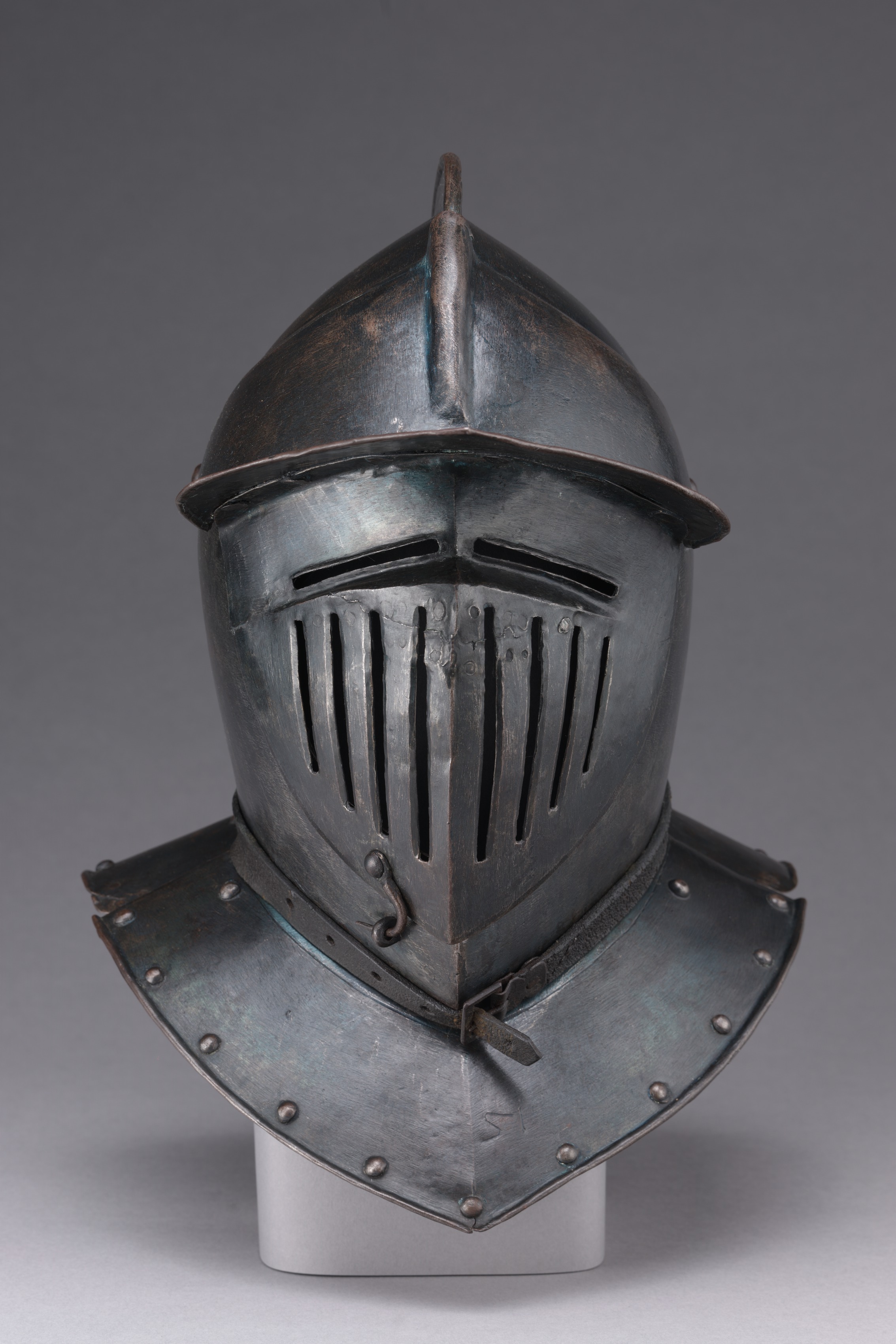
As Chief Fabric Deconstructionist for Zoey Fashion Lab, my role is to dissect historical artifacts not as relics, but as raw material for narrative and form. The subject of this analysis—a Cuirassier’s helmet from early 17th-century Austria, likely Graz—presents a formidable challenge and an extraordinary opportunity. Originally blued steel, now oxidized to a deep, uneven black, and fitted with aged leather straps, this object is far more than a piece of armor. It is a compressed narrative of power, protection, and the passage of time. For our avant-garde design philosophy, which seeks to fuse the structural DNA of the past with the disruptive energy of the future, this helmet is a primary source. We will not replicate it; we will extract its genetic code—its material logic, its silhouette, and its emotional weight—and re-engineer it into a new, living strand of fashion DNA.
Material Memory: From Blued Steel to Blackened Narrative
The technical specification of the helmet—steel, originally blued, now black—is the first and most critical point of deconstruction. The bluing process was not merely decorative; it was a functional oxidation that protected the metal from rust while imbuing it with a deep, lustrous indigo hue. Over four centuries, this intentional patina has been overtaken by a secondary, organic oxidation, resulting in the current matte black. For Zoey Fashion Lab, this is a profound lesson in material temporality.
Our avant-garde interpretation will not use steel. Instead, we will translate this process into textile engineering. We will develop a proprietary fabric that undergoes a controlled, chemical patination. Imagine a base of high-tenacity nylon or carbon-fiber-infused silk, initially dyed a deep, saturated midnight blue. Through a process of heat, pressure, and selective chemical treatment, sections of the fabric will be “corroded” into a matte, charcoal black, mimicking the helmet's historical transformation. The result is a textile that wears its own history, where the transition from blue to black is not a flaw but a deliberate, evolving design element. This fabric will be used for structural panels—shoulder yokes, sculptural collars, and articulated sleeves—that reference the armor’s protective geometry but move with the fluidity of the body.
The leather straps, now cracked and softened by centuries of handling, offer a second material narrative. They represent the interface between the rigid and the organic, the metal and the flesh. In our collection, this will be echoed through the use of vegetable-tanned leather that is intentionally distressed and then re-saturated with natural waxes and oils. The straps will not be functional closures but decorative, tension-bearing elements that wrap the body, creating a visual and tactile dialogue between the hard, patinated textile and the soft, yielding leather. They will be cut in asymmetrical, almost calligraphic shapes, referencing the straps’ original function while subverting it into an aesthetic of controlled decay.
Silhouette and Structure: The Architecture of Protection Reimagined
The Cuirassier’s helmet is defined by its closed, protective volume—a dome that encases the skull, a visor that obscures the face, and a neck guard that shields the throat. Its silhouette is one of impenetrable strength and anonymity. For our avant-garde line, we will deconstruct this volume into a series of modular, wearable sculptures that protect and reveal simultaneously.
The helmet’s dome will be translated into a cowl or a hood, but not one that simply covers the head. We will create a structure using our patinated textile, reinforced with flexible, lightweight boning (perhaps a bio-resin or recycled aluminum). This cowl will be engineered to stand away from the head, creating a dramatic, negative space around the face. It will be asymmetrical, with one side rising higher, echoing the helmet’s peak, and the other falling lower, mimicking the neck guard. The visor will be reinterpreted as a detachable, semi-transparent veil made from a laser-cut, micro-perforated version of the same fabric. This veil will obscure the face in shadow, offering the wearer a sense of anonymity and power, while the perforations allow for breath and a fragmented view of the skin beneath. It is a veil of armor, not of concealment, but of selective revelation.
The neck guard, originally a rigid flange, will become a sculptural collar that extends over the shoulders. We will use a combination of our patinated fabric and molded, recycled polymer sections that mimic the helmet’s fluted ridges. This collar will not be a single piece but a series of overlapping, articulated segments, allowing for movement while maintaining a powerful, armored silhouette. The entire ensemble—hood, veil, and collar—will be connected by the distressed leather straps, which will be used as visible, structural seams. The straps will not be hidden; they will be the exoskeleton of the garment, a deliberate reference to the original helmet’s construction.
Avant-Garde Synthesis: The New DNA Strand
The reference to a “New DNA Strand” is the core of this analysis. The Cuirassier’s helmet is not a template to be copied; it is a genetic sequence that we are splicing into the living organism of contemporary fashion. The original DNA—steel, leather, protection, war, hierarchy—is being mutated. The steel becomes a fabric that remembers its own history. The leather becomes a decorative, tension-bearing element. The protective volume becomes a modular, revealing architecture.
The final garment will be a statement on the duality of protection. In the 17th century, this helmet protected the wearer from physical harm. In our avant-garde interpretation, it protects the wearer’s identity, their space, and their narrative. It is a piece that demands attention, not through brute force, but through its intellectual and material complexity. The wearer becomes a modern cuirassier, not on a battlefield of steel and gunpowder, but on the front lines of personal expression and social interaction.
This is not a costume. It is a new species of garment, born from the deconstruction of a historical artifact. For Zoey Fashion Lab, this helmet provides the blueprint for a collection that is both deeply rooted in material history and radically forward-looking. The blued steel that turned black is now a fabric that speaks of time. The leather straps that held metal together now hold a silhouette together. The helmet that once hid a face now frames it in a new, powerful light. This is the work of the Chief Fabric Deconstructionist: to find the future hidden in the past, and to weave it into a new, living strand of fashion DNA.