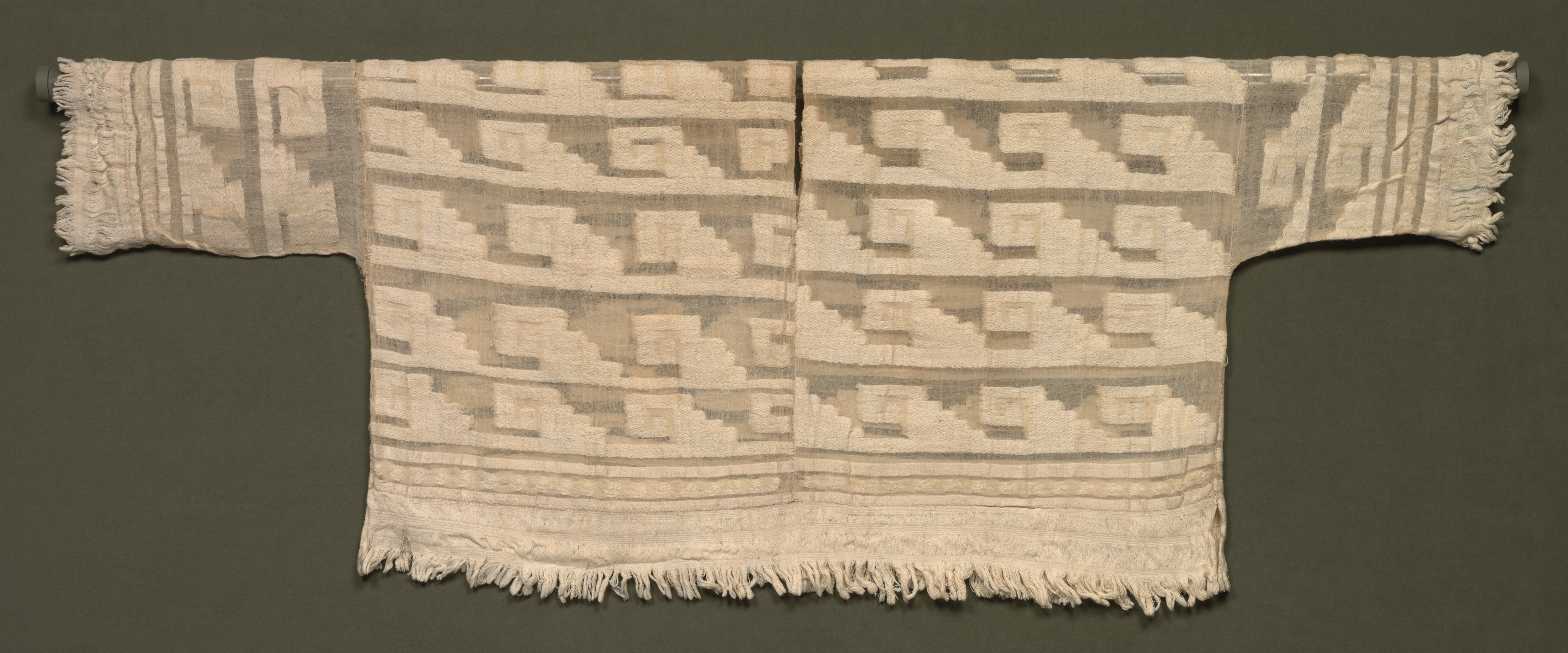
Deconstructing the Avant-Garde: A Fabric Analysis of the Chimú-Inka Tunic for Zoey Fashion Lab
As the Chief Fabric Deconstructionist for Zoey Fashion Lab, I approach every artifact not as a relic, but as a radical blueprint. The subject of this analysis—a tunic from Peru, attributed to the Chimú or Chimú-Inka cultures (12th-16th century)—is a masterclass in how material constraints can birth aesthetic rebellion. Composed of white cotton, constructed through plain weave, and adorned with supplementary weft brocading, this garment transcends its ceremonial origins to speak directly to the ethos of Avant-garde design. It is a silent witness to cultural collision, as referenced in the Archive Resonance, and a testament to how pre-Columbian textiles anticipated the deconstructive, textural, and conceptual principles that define modern fashion’s most radical expressions.
Material as Manifesto: White Cotton and the Politics of Purity
The choice of white cotton is neither accidental nor merely functional. In the Chimú-Inka context, cotton—particularly the naturally white variety—was a material of profound significance. It was not dyed or disguised; its inherent luminosity was celebrated. For Zoey Fashion Lab, this is a foundational Avant-garde gesture: the rejection of ornamentation for ornamentation’s sake. The white cotton acts as a blank canvas, a “zero degree” of textile that forces the eye to engage with structural and textural nuance rather than chromatic distraction.
In contemporary Avant-garde design, white is often used to strip away cultural signifiers, creating a universal, almost sterile canvas upon which form can be radicalized. Here, the white cotton does the opposite: it amplifies the cultural specificity of the weave and brocading. The absence of color becomes a presence, a space where the viewer must confront the material’s physicality—its weight, its drape, its tactile honesty. For our lab, this suggests a directive: use material purity not as a retreat from meaning, but as a platform for heightened sensory engagement. The tunic’s white cotton is not empty; it is a reservoir of potential, a deliberate choice that foregrounds structure over surface.
Structural Subversion: Plain Weave as a Radical Grid
The plain weave—the simplest, most fundamental interlacing of warp and weft—might seem antithetical to Avant-garde ambition. Yet, in the hands of Chimú artisans, this grid becomes a site of discipline and deviation. The plain weave provides a stable, predictable foundation—a “ground” that is both literal and conceptual. It is the rule against which the supplementary weft brocading will break.
For Zoey Fashion Lab, this duality is essential. Avant-garde fashion often plays between the banal and the extraordinary, using the familiar as a foil for the disruptive. The plain weave is the uniform, the everyday, the structural baseline. It is the “zero” in a system of ones. By adhering to this simple structure, the Chimú weavers created a tension that is profoundly modern: the tension between order and chaos, between the expected and the unexpected. When we deconstruct a garment, we must identify its “plain weave”—the core construction that, when disrupted, creates meaning. The tunic teaches us that the most radical interventions arise from a deep respect for the underlying system.
Supplementary Weft Brocading: The Decorative as Disruptive
The supplementary weft brocading is where the tunic’s Avant-garde soul resides. Unlike structural weaves that alter the fabric’s integrity, supplementary wefts are added—overlaid—onto the plain weave ground. They do not change the base fabric’s function; they embellish it. Yet, in this tunic, the brocading is not mere decoration. It is a deliberate, controlled disruption that introduces pattern, texture, and symbolic weight.
The patterns—likely geometric abstractions of animals, deities, or cosmological motifs—are not painted or printed; they are woven into the fabric’s surface, becoming part of its physical body. This is a key Avant-garde principle: the integration of meaning into material, rather than its application as a superficial layer. The brocading creates a tactile topography, a relief that invites touch and interrogation. For our lab, this suggests a move away from digital printing or surface-level embellishment toward techniques that embed narrative into the fabric’s very structure.
Furthermore, the supplementary weft allows for a kind of “negative space” design. The white ground remains visible, creating a dialogue between the added and the subtracted, the figure and the ground. This is a lesson in restraint: the most powerful Avant-garde statements often come from knowing when not to add. The Chimú weavers understood that the brocading’s impact derives from its isolation against the plain weave. In our collections, we must similarly consider the relationship between the disruptive element and the foundational structure, ensuring that neither dominates but both resonate.
Cultural Collision and the Archive Resonance
The Archive Resonance reference reminds us that this tunic exists at a nexus of cultural exchange—Chimú, Inka, and eventually Spanish colonial influences. The Chimú were conquered by the Inka, and their textile traditions were absorbed and transformed. This tunic may be a product of that synthesis, a Chimú technique executed under Inka patronage, or a hybrid form that anticipates the colonial period. The “silent witness” of such artifacts is the record of these collisions.
For the Avant-garde, cultural collision is a generative force. The tunic embodies a principle we must adopt: innovation arises from the friction between traditions. The Chimú-Inka weavers did not reject their heritage; they layered new meanings onto established forms. Similarly, Zoey Fashion Lab must approach historical textiles not as static objects to be replicated, but as dynamic systems to be interrogated and recontextualized. We can extract the logic of the supplementary weft—the addition of a narrative layer to a stable base—and apply it to contemporary materials, digital technologies, or even conceptual frameworks.
Avant-Garde Application: From Tunic to Tomorrow
How does this 12th-16th century tunic inform a forward-facing, Avant-garde collection? The answer lies in its principles, not its appearance. We must avoid mere mimicry of Chimú motifs; instead, we should adopt their methodological radicalism.
First, the tunic teaches us to embrace material honesty. White cotton, plain weave—these are not limitations but provocations. Our lab should explore how “simple” materials can be elevated through precise, intentional intervention. Second, the supplementary weft brocading models a technique of “controlled chaos”—adding without destroying, embellishing without obscuring. This can translate into modern textile manipulations: laser-cut overlays, bonded appliqués, or even digital embroidery that respects the garment’s underlying geometry.
Third, the tunic’s cultural hybridity encourages us to create collections that are palimpsests—texts written over, erased, and rewritten. We can layer references from multiple eras and geographies, allowing them to collide and generate new meanings. Finally, the tunic’s ceremonial function—its role as a marker of status, identity, and cosmology—reminds us that Avant-garde fashion is never purely aesthetic. It is a statement of being, a declaration of values. Our designs must carry this weight, using deconstruction not as an end in itself, but as a means to reveal deeper truths about material, culture, and the human form.
Conclusion: The Tunic as a Radical Blueprint
This Chimú-Inka tunic is not a historical curiosity; it is a living document of Avant-garde principles. Its white cotton plain weave is a manifesto of purity, its supplementary weft brocading a lesson in disruptive integration, and its cultural context a testament to the power of collision. For Zoey Fashion Lab, this analysis is a call to action: to deconstruct not just garments, but the assumptions that underpin them. We must see every thread, every weave, every stitch as a potential site of rebellion. The tunic whispers across centuries: to be Avant-garde is to honor the past by breaking its rules with precision and purpose.