Deconstructing the Hwarot: An Avant-Garde Reimagining for Zoey Fashion Lab
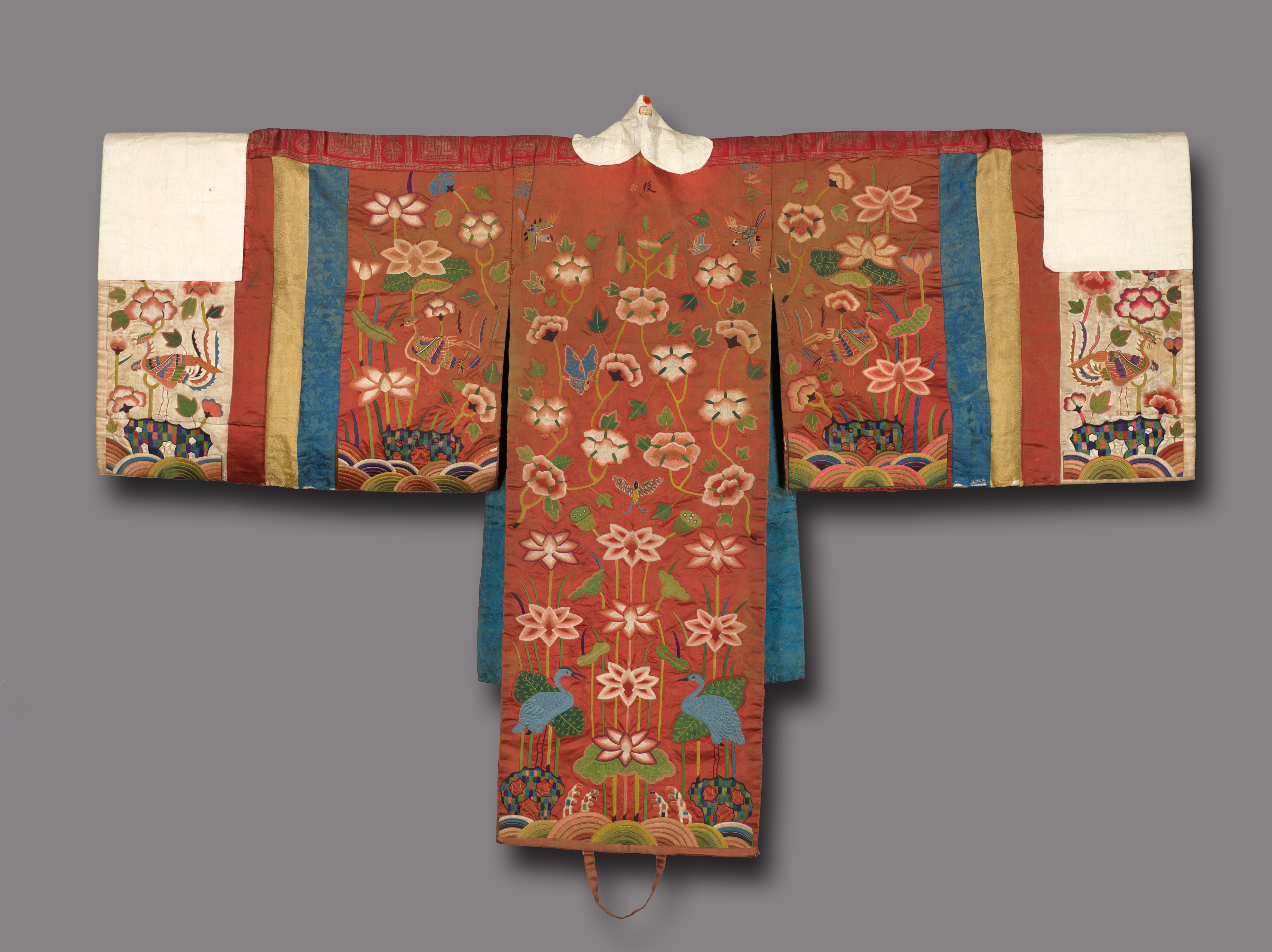
As the Chief Fabric Deconstructionist for Zoey Fashion Lab, I am tasked with dissecting historical garments not merely as artifacts, but as living DNA—blueprints for radical reinterpretation. The subject of this analysis is the Hwarot, a Korean bridal robe from the Joseon dynasty (1392–1910). This garment, traditionally worn by royal and noble women during wedding ceremonies, is a masterpiece of symbolic weight and technical precision. Our approach, guided by the "New DNA Strand" style, seeks to extract its core genetic code—its structural logic, material hierarchy, and narrative tension—and splice it into an avant-garde framework. The goal is not to replicate, but to mutate tradition into a form that challenges contemporary notions of bridal wear, ceremony, and identity.
Material Memory: Silk, Satin, and the Subversion of Texture
The Hwarot’s primary material is silk in a satin weave. This choice is fundamental. Satin’s high-luster surface, achieved by floating warp threads over multiple wefts, creates a mirror-like finish that reflects light and status. In the Joseon context, this sheen symbolized purity, wealth, and the auspiciousness of the union. For Zoey Fashion Lab, we must interrogate this surface. The satin weave is not merely a backdrop; it is a field of potential disruption.
Our avant-garde deconstruction begins by fracturing the satin’s uniformity. Traditional Hwarot silk is pristine, unblemished. We propose a process of controlled degradation: laser-etching the satin to create micro-perforations that mimic the passage of time, or applying heat to induce localized shrinkage, creating puckered, scar-like textures. This is not destruction for its own sake, but a dialogue with impermanence. The bride’s garment, traditionally a symbol of eternal union, becomes a testament to the fragility of that promise. The satin’s reflective surface is now interrupted by voids and distortions, forcing the eye to confront both the ideal and its decay.
Furthermore, we will layer the satin with non-traditional materials. Consider embedding recycled metallic threads or biodegradable polymer filaments into the weave, creating a hybrid fabric that glows with an otherworldly, almost digital luminescence. This juxtaposition of ancient silk with futuristic elements speaks to the bride as a nexus of past and future, a living archive of heritage and a harbinger of what is to come.
Embroidery as Code: From Symbolic Motifs to Abstract Gestures
The Hwarot is renowned for its intricate embroidery, which is not decorative but narrative. Traditional motifs include phoenixes (symbolizing marital bliss), peonies (wealth and honor), and lotus blossoms (purity and rebirth). These are stitched in silk threads, gold-wrapped threads, and occasionally seed pearls, creating a raised, tactile surface. For Zoey Fashion Lab, we treat this embroidery as encoded data—a visual language that must be translated, not copied.
Our avant-garde approach involves deconstructing the motifs into abstract fragments. Instead of a full phoenix, we will extract its wing shape, its feather pattern, and render them as geometric, algorithmic forms. Using a combination of hand-stitching and robotic embroidery, we can create a chaotic yet intentional scatter of these fragments across the robe. The peony’s petals become overlapping, translucent circles; the lotus transforms into a series of concentric, interrupted lines. This is not a loss of meaning, but a multiplication of interpretation.
We also introduce material dissonance. Where the original used silk and gold, we will incorporate conductive thread, fiber optics, and recycled plastic filaments. Imagine a section of the robe where the phoenix’s tail is rendered in glowing, fiber-optic threads that pulse with a slow, heartbeat-like rhythm. This transforms the garment from a static symbol into a responsive, living interface. The bride becomes a performer, her movements triggering light and shadow, her body a canvas for a dynamic, ever-changing narrative. The embroidery is no longer a fixed story; it is a generative code that rewrites itself with every gesture.
Paper Edging: The Fragile Boundary Between Garment and Artifact
One of the most distinctive features of the Hwarot is the paper edging applied to the neckline and sleeves. This is not merely a trim; it is a structural and conceptual boundary. Traditionally, paper was used to stiffen and protect the silk edges, but it also served as a surface for calligraphy or auspicious symbols, often hidden from view. This element is a treasure for deconstruction.
For Zoey Fashion Lab, the paper edging becomes a site of radical intervention. We will replace the traditional mulberry paper with a custom, biodegradable composite that includes embedded seeds, microchips, or conductive ink. The paper is no longer a passive stiffener; it is an active agent. Imagine the neckline paper embedded with wildflower seeds. After the ceremony, the bride can plant the edging, allowing the garment to literally bloom into a garden, symbolizing the growth of the union. Alternatively, the paper could contain QR codes or NFC tags that link to digital archives of the couple’s story, turning the garment into a portable, interactive memory.
We also destabilize the edging’s function. Traditionally, it provides a firm, clean line. We will cut the paper into jagged, asymmetrical shapes, or layer it in overlapping, collage-like forms. The neckline, once a symbol of modesty and containment, becomes an unstable, porous border. This reflects the avant-garde ethos of dissolving boundaries—between garment and environment, between bride and world, between tradition and innovation. The paper edging, once a protective shell, is now a threshold of transformation.
The New DNA Strand: Synthesis and Mutation
The "New DNA Strand" style is not about nostalgia; it is about mutation, hybridization, and emergence. Our deconstructed Hwarot is a chimeric garment—part historical artifact, part futuristic interface, part living organism. The satin’s fractured surface, the abstracted embroidery, and the active paper edging are not separate elements; they are interdependent genes that recombine to produce a new species of bridal robe.
This garment challenges the bride to reconsider her role. She is no longer a passive vessel for tradition, but an active co-creator of meaning. The robe’s responsive embroidery, its biodegradable elements, and its digital layers invite her to perform her identity in real-time. The ceremony becomes a site of experimentation, not just celebration. The Hwarot, once a symbol of fixed social order, becomes a tool for deconstructing that order.
For Zoey Fashion Lab, this analysis is a blueprint. The next step is to prototype these interventions, testing the limits of silk, thread, and paper. We will collaborate with textile engineers, digital artists, and botanists to bring this vision to life. The result will not be a costume, but a provocation—a garment that asks: What does it mean to be a bride in an age of flux? How can tradition be honored without being imprisoned? The answer lies in the deconstruction and reconstruction of the Hwarot’s DNA, one thread, one stitch, one seed at a time.