Deconstructing the Morion: A Technical and Symbolic Analysis for Zoey Fashion Lab
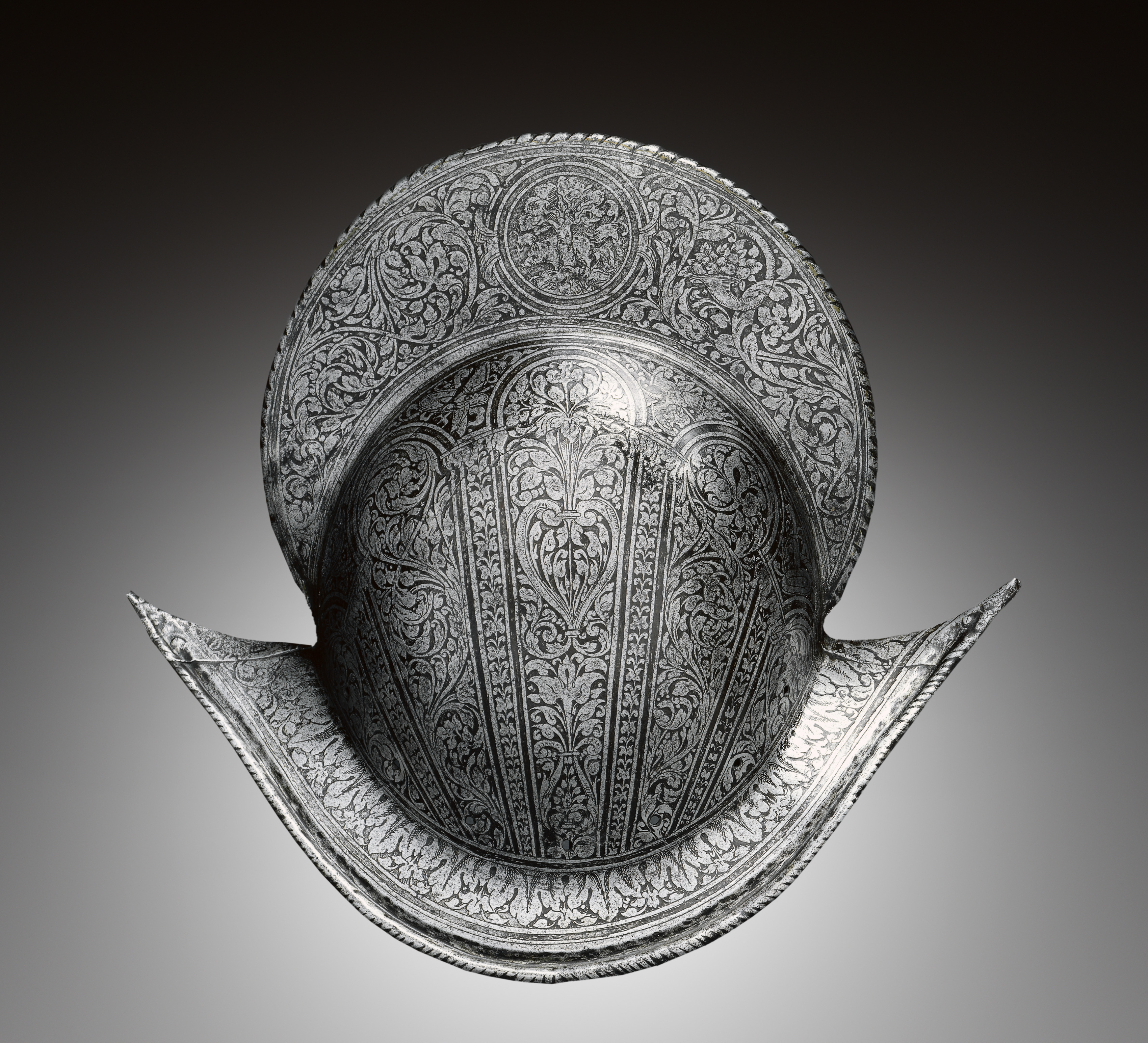
Zoey Fashion Lab, as the Chief Fabric Deconstructionist, I present an in-depth analysis of the Morion, a steel helmet originating from North Italy in the late 16th Century. This piece, characterized by its etched floral motif and a medallion on its comb depicting a boar beneath an oak tree, is more than a historical artifact—it is a New DNA Strand for avant-garde fashion. By deconstructing its materiality, symbolism, and cultural resonance, we can extract a blueprint for a collection that fuses Renaissance martial elegance with radical, future-facing design.
Material and Technical Analysis: The Steel as a Canvas
The Morion’s primary material—steel—is a paradox of strength and malleability. In the late 16th century, North Italian armorers were renowned for their ability to forge steel into both protective and decorative forms. The etched floral motif, likely achieved through acid or tooling, transforms the helmet’s surface into a living garden. This interplay between hard metal and organic design is critical: it suggests a duality that avant-garde fashion can exploit. For Zoey Fashion Lab, this steel becomes a New DNA Strand—a metaphor for structural integrity layered with ephemeral beauty. The etching process, which removes material to create depth, mirrors deconstruction techniques in fashion: cutting, slashing, and layering to reveal hidden textures. The floral motif, with its intricate petals and vines, offers a template for laser-cut leather or metalized fabric overlays, where the negative space becomes as significant as the positive.
The medallion on the comb—a boar under an oak tree—is a microcosm of narrative power. The boar, a symbol of ferocity and resilience in Renaissance heraldry, contrasts with the oak, representing endurance and wisdom. This juxtaposition of aggression and stability is a rich vein for avant-garde design. The medallion’s placement on the comb, the helmet’s structural spine, emphasizes a focal point that draws the eye upward. In fashion, this translates to a crown-like silhouette or a central motif on a garment’s back or shoulder, creating a visual anchor that commands attention. The etching’s precision—likely achieved by master craftsmen—demands a similar meticulousness in fabric manipulation, whether through hand-stitched embroidery or 3D-printed elements.
Symbolic and Cultural Context: The Morion as a New DNA Strand
The Morion was not merely a piece of armor; it was a status symbol, worn by elite infantry and officers during a period of shifting power dynamics in Italy. The late 16th century saw the rise of mercenary armies and the decline of feudal chivalry, making the Morion a relic of a transitional era. Its etched decorations, often commissioned by wealthy patrons, imbued it with personal and political meaning. The boar under the oak tree, for instance, may reference a specific family crest or a mythic battle, linking the wearer to a lineage of strength. For Zoey Fashion Lab, this historical weight becomes a New DNA Strand—a conceptual thread that weaves past and present into a cohesive narrative. The avant-garde style thrives on such collisions: the Morion’s martial origins can be repurposed as a commentary on modern power structures, resilience, or the fragility of identity.
The floral motif, while decorative, also carries subtext. In Renaissance culture, flowers symbolized transience and beauty—a memento mori for the battlefield. This duality—life and death, protection and vulnerability—is fertile ground for deconstruction. By extracting the boar-and-oak medallion as a central emblem, we can create a recurring motif in the collection: perhaps a jacquard weave or a laser-engraved leather patch. The oak tree’s roots, which anchor the boar, suggest a grounding force, while the boar’s aggressive stance implies forward momentum. This tension can inform silhouettes: structured, armored shoulders (the oak) paired with flowing, organic drapes (the boar’s wildness).
Avant-Garde Interpretation: Translating the Morion into Fabric and Form
To translate the Morion’s essence into an avant-garde collection, we must first deconstruct its physical components. The steel’s weight and rigidity can be reinterpreted through structural textiles: bonded neoprene, sculpted leather, or metal-mesh fabrics that mimic armor’s protective quality without sacrificing movement. The etched floral motif, with its intricate lines, can be abstracted into digital prints or heat-pressed foil that catches light like polished steel. The medallion’s boar and oak tree should be rendered as a 3D-printed or embroidered appliqué, perhaps on a garment’s collar or cuff, to create a tactile focal point that references the helmet’s comb.
The Morion’s silhouette—a high, rounded dome with a brim and comb—lends itself to headwear and shoulder architecture. For Zoey Fashion Lab, consider a series of helmets-as-accessories crafted from carbon fiber or resin, etched with floral patterns using CNC routing. Alternatively, the comb’s vertical line can inspire a central seam on a coat or dress, with the medallion positioned at the nape or sternum. The brim, which once deflected sword blows, can be reimagined as a wide, asymmetrical collar or a peplum hem, offering both protection and drama. The overall aesthetic should be industrial yet organic: think raw edges, exposed seams, and hardware that echoes rivets and hinges, softened by the floral motifs.
New DNA Strand: A Conceptual Framework for the Collection
The Morion as a New DNA Strand implies a genetic code that can be spliced, mutated, and recombined. In this collection, the helmet’s elements become modular building blocks. The etched floral motif can be isolated as a repeating pattern on sheer organza or bonded leather, creating a visual rhythm that evokes the armor’s surface. The boar-and-oak medallion can be deconstructed into abstract shapes: the boar’s tusks as angular lapels, the oak’s branches as trailing ribbons. The steel’s reflective quality can be captured through liquid metallic finishes or iridescent laminates that shift color with movement, mimicking the play of light on etched metal.
Functionally, the Morion’s role as head protection can be subverted into wearable architecture—a cape that wraps around the shoulders like a shield, or a bodice with boning that mimics the comb’s structure. The avant-garde ethos demands that we challenge traditional garment logic: a skirt may be constructed from layered steel-mesh panels, each etched with a different floral element, while a top features a single, oversized medallion at the back, visible only when the wearer turns. This interplay of concealment and revelation echoes the Morion’s dual nature—a protective shell with hidden beauty.
Conclusion: The Morion as a Blueprint for Radical Design
In conclusion, the Morion from North Italy, late 16th Century, is not a relic but a New DNA Strand for Zoey Fashion Lab’s avant-garde exploration. Its steel, etched with floral motifs and a boar-and-oak medallion, offers a rich vocabulary of materials, symbols, and forms. By deconstructing its technical precision and cultural significance, we can forge a collection that marries the martial with the floral, the rigid with the fluid, the historical with the futuristic. This analysis provides a foundation for translating the Morion’s essence into garments that are both armor and art, challenging the wearer to confront power, identity, and time itself. As Chief Fabric Deconstructionist, I recommend immediate prototyping of key elements—the medallion motif, the etched floral pattern, and the comb-inspired silhouette—to begin splicing this DNA into a living, breathing collection.