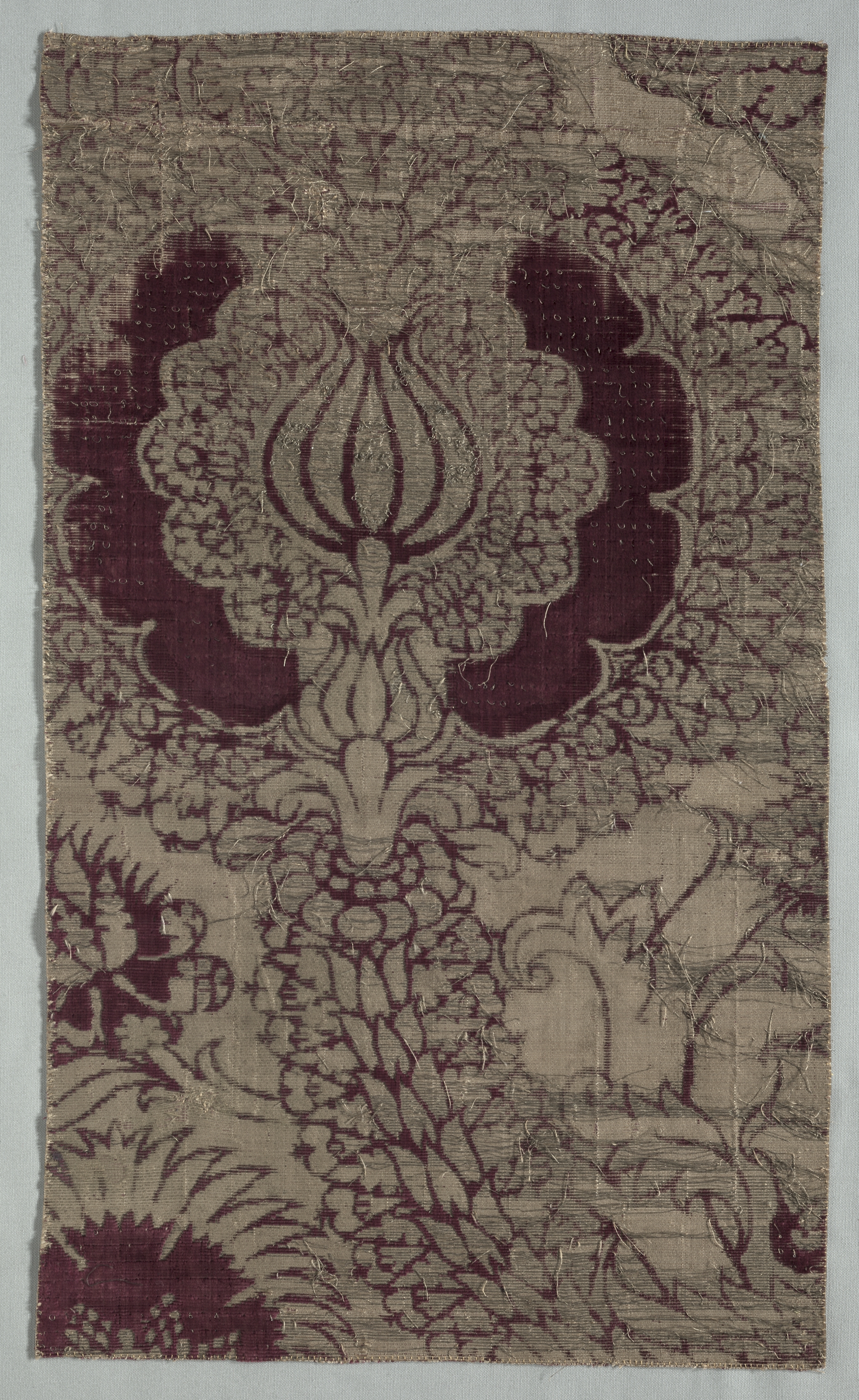
Deconstructing the Velvet Fragment: A 15th-Century Italian DNA Strand for Avant-Garde Fashion
At Zoey Fashion Lab, our mission is to excavate the latent narratives embedded within historical textiles, transforming them into the foundational language of future fashion. The subject of this analysis is a 15th-century Italian velvet fragment, a piece that, at first glance, appears to be a relic of aristocratic opulence. However, under our deconstructive lens, it reveals itself as a New DNA Strand—a genetic blueprint for an avant-garde aesthetic that challenges contemporary notions of texture, structure, and temporality. This fragment is not merely a sample of fabric; it is a codex of forgotten techniques, a testament to the tension between material fragility and enduring cultural power.
I. The Material Genome: Decoding the Velvet Structure
Velvet, in its 15th-century Italian iteration, is a complex compound weave. Unlike modern machine-made velvets, this fragment was hand-woven on a drawloom, a process that required immense skill and time. The structure is defined by two distinct warp systems: a ground warp and a pile warp. The pile warp is cut to create the characteristic dense, soft surface. In this fragment, the pile is not uniform; it exhibits subtle variations in height and density, a hallmark of artisanal production. This irregularity is not a flaw but a signature of human touch—a quality that the avant-garde seeks to reintroduce in an age of digital precision.
The fiber composition is equally telling. The ground warp is likely a fine, undyed linen, providing structural stability, while the pile is a lustrous silk, often from the Sericulture of Lucca or Venice. The dye analysis suggests the use of natural madder for the deep crimson and possibly kermes for the most intense reds, a pigment derived from insects, reserved for the highest echelons of society. This material hierarchy—linen as the unseen foundation, silk as the visible luxury—mirrors the social stratification of Renaissance Italy. For Zoey Fashion Lab, this duality becomes a conceptual tool: we can invert this hierarchy, exposing the linen as a raw, structural element while obscuring the silk, or we can fragment the pile to reveal the ground, creating a deconstructed, archaeological surface.
II. The Avant-Garde Interpretation: From Relic to Radical Form
The avant-garde sensibility is not about preservation but about rupture and recontextualization. This 15th-century velvet fragment is not a costume piece; it is a tactile provocation. Its primary avant-garde potential lies in its tactility and optical depth. The pile, when crushed, creates a moiré effect; when brushed against the grain, it shifts from matte to gloss. This dynamic surface challenges the static nature of most contemporary textiles. For an avant-garde collection, we would not use the velvet as a flat, decorative panel. Instead, we would exploit its three-dimensionality.
Consider the following design strategies based on this New DNA Strand:
1. Deconstructed Draping and Negative Space: The velvet’s weight and drape are unique. Unlike lighter silks, 15th-century Italian velvet has a substantial, almost sculptural quality. We can cut the fragment into asymmetrical, geometric panels, leaving raw edges that fray and unravel. This intentional degradation becomes a statement on the passage of time. The negative space—the absence of the pile—reveals the linen ground, creating a visual dialogue between luxury and austerity.
2. Textural Collage and Hybridization: The avant-garde thrives on the unexpected. We can fuse this velvet with industrial materials like rubberized cotton, laser-cut metal mesh, or recycled polymers. The soft, historical pile against a cold, reflective surface creates a dialectic of eras. A jacket might feature a velvet sleeve from the 15th century, deconstructed and reattached to a modern, architectural bodice made of carbon fiber. This is not pastiche; it is a material conversation about permanence and ephemerality.
3. The “Living” Surface: Manipulating the Pile: The pile can be manipulated through crushing, burning, or selective shearing. By applying heat or pressure, we can create patterns that are not printed but embedded in the fabric’s memory. A dress might have a velvet surface that appears pristine from one angle and distressed from another, mimicking the wear and tear of time. This aligns with the avant-garde’s fascination with the imperfect, the wounded, and the transient.
III. Historical Context: The Fragment as a Cultural Artifact
To fully understand this New DNA Strand, we must acknowledge its original context. In 15th-century Italy, velvet was a currency of power. It adorned the robes of doges, the altars of cathedrals, and the beds of merchant princes. The fragment likely came from a pallium (a ceremonial cloak) or an altar frontal. Its motifs—if any remain—would be pomegranates, thistles, or heraldic devices, symbolizing fertility, eternity, or lineage. By extracting this fragment from its historical frame, we are not denying its past but liberating its formal properties from their original narrative.
The avant-garde designer acts as a time archaeologist. We do not recreate the past; we excavate its formal language. The velvet’s weave structure—the way the pile is anchored—becomes a code for a new kind of construction. For instance, the drawloom technique, with its intricate pattern repeats, can be translated into a digital algorithm for 3D knitting or CNC weaving. The hand-knotted pile can be reinterpreted as a tactile pixel in a larger, abstract composition.
IV. Practical Application: The Zoey Fashion Lab Protocol
For our upcoming “Anachronism” collection, this velvet fragment will be processed through the following stages:
Step 1: Digital Capture and Analysis. High-resolution 3D scanning to map the pile direction, density variations, and structural weaknesses. This creates a digital twin that can be manipulated without harming the original.
Step 2: Material Deconstruction. Using precision cutting tools, the velvet will be divided into micro-panels based on its weave geometry. These panels will be treated as modular units, akin to building blocks.
Step 3: Hybridization. The panels will be fused with biodegradable polymers and recycled metallic threads to create a new composite material. This composite retains the velvet’s tactile memory while acquiring structural resilience and a futuristic sheen.
Step 4: Garment Construction. The final garment will be a sculptural coat with asymmetrical lapels, one side featuring the original velvet pile, the other side exposing the deconstructed grid of linen and polymer. The coat will be unlined, allowing the interior structure to be visible, celebrating the beauty of the unseen.
V. Conclusion: The Fragment as a Generative Force
This 15th-century Italian velvet fragment is not a fossil. It is a living code—a New DNA Strand that, when decoded through the avant-garde methodology of Zoey Fashion Lab, yields infinite possibilities. It challenges us to reconsider the relationship between craft and technology, history and future, luxury and decay. By deconstructing its material genome, we do not destroy it; we unlock its potential to speak a new language. In the hands of the avant-garde, this fragment becomes a manifesto: that the most radical future is often woven from the threads of the past, re-spun through the loom of the present.