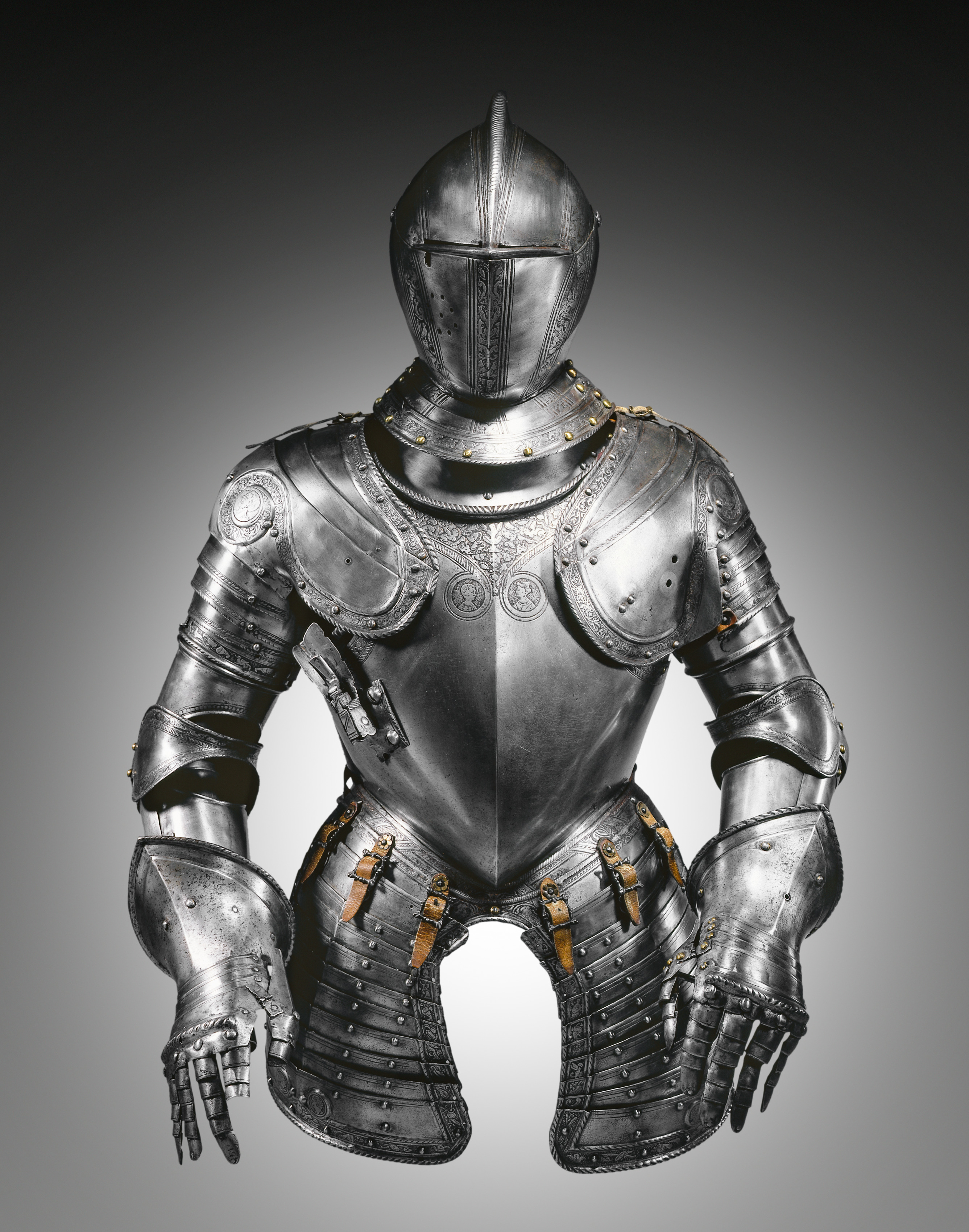
Deconstructing the Brescian Field Half-Suit: An Avant-Garde Analysis for Zoey Fashion Lab
As Chief Fabric Deconstructionist at Zoey Fashion Lab, my role is to dissect historical artifacts not merely as relics of the past, but as living blueprints for radical, forward-thinking design. The subject of this analysis—a half-suit of armor for the field, attributed to North Italy, likely Brescia, circa the 16th century—presents a uniquely potent foundation for avant-garde exploration. Crafted from steel with etched decorative bands and roundels, this object is far more than a protective garment; it is a manifesto of structural integrity, ritualized violence, and sculptural form. For the Zoey Fashion Lab, this armor is not a costume to be replicated, but a new DNA strand to be spliced into the genetic code of contemporary fashion. We will deconstruct its technical, symbolic, and material language to extract a blueprint for a collection that challenges the boundaries of wearability, protection, and identity.
Technical Deconstruction: The Steel as a Textile
At first glance, steel and fabric seem antithetical. Yet, the 16th-century armorer approached steel as a master tailor approaches cloth. The half-suit—comprising a breastplate, backplate, pauldrons, and tassets—was articulated through a system of rivets, sliding rivets, and leather straps, creating a second skeleton that allowed for a surprising range of motion. For the avant-garde designer, this articulation is a critical lesson in kinetic construction. The etched decorative bands are not mere embellishment; they are structural seams, guiding the eye along the lines of force and movement. The roundels, often found at the shoulder or elbow, function as pivot points, junctions where rigid plates meet flexible leather. In Zoey Fashion Lab’s context, we translate these elements into a new textile language: laser-cut steel mesh fused with high-tenacity nylon webbing, creating a material that is simultaneously rigid and fluid. The etched bands become 3D-printed polymer lattices that mimic the visual rhythm of the original engraving while allowing for breathability and drape. The roundels are reimagined as magnetic or snap-fastened modular components, allowing the wearer to reconfigure the armor’s silhouette—a direct nod to the historical armor’s adaptability for different combat scenarios.
The half-suit’s asymmetry—protecting the torso and shoulders while leaving the lower legs and arms more exposed—is a strategic choice. This is not full coverage; it is targeted protection. For the avant-garde collection, this translates into a deconstructed silhouette where protective elements are deliberately placed on the body’s core—chest, shoulders, and hips—while the limbs are clad in transparent or sheer materials, creating a tension between vulnerability and strength. The steel’s surface, with its etched decorative bands, becomes a canvas for digital printing that replicates the patina of age, oxidation, and wear, turning the armor into a living archive of its own history.
Symbolic Deconstruction: The Armor as Identity
The 16th-century field half-suit was not just functional; it was a status symbol and a projection of idealized masculinity. The etched bands often depicted classical motifs, mythological scenes, or heraldic devices, transforming the wearer into a living monument. For the Zoey Fashion Lab, this symbolic layer is the most potent material. We ask: What does it mean to wear armor today? In an era of digital warfare, climate anxiety, and social fragmentation, the armor becomes a metaphor for psychological and emotional protection. The etched decorative bands are recontextualized as narrative tattoos—stories of resilience, trauma, and transformation embedded into the garment’s surface. The roundels, historically emblems of rank, become interactive digital screens that display biometric data, social media feeds, or abstract art, turning the wearer into a walking broadcast station.
The Brescian origin is significant. Brescia was a center of arms production, known for its pragmatic yet ornate style. This duality—functionality meeting opulence—is the core of the avant-garde ethos. We deconstruct the armor’s symbolic weight by inverting its traditional gender associations. The half-suit, designed for a male knight, is reimagined on a non-binary or feminine form, with the breastplate sculpted to accommodate different body types. The etched bands, once symbols of martial prowess, are now embroidered in metallic thread on sheer organza, creating a ghostly echo of the original steel. The roundels are transformed into oversized, asymmetrical shoulder pads made of carbon fiber and resin, referencing the armor’s protective function while subverting its historical context.
Material Alchemy: The New DNA Strand
The most radical deconstruction lies in the material itself. Steel, as a material, is heavy, cold, and unyielding. For Zoey Fashion Lab, we propose a new composite material that retains the visual and tactile memory of steel while being lightweight, flexible, and sustainable. This new DNA strand is a biodegradable metal alloy infused with recycled steel fibers, bonded to a base of organic cotton or hemp canvas. The etched decorative bands are replicated using laser ablation on a thin layer of aluminum, creating a surface that catches light like the original but can be crushed, folded, or pleated like fabric. The roundels are cast in bio-resin embedded with crushed steel shavings, creating a speckled, meteor-like texture that references the armor’s history of battle and wear.
This material alchemy extends to the construction process. The half-suit’s articulated joints—the sliding rivets and leather straps—are reimagined as 3D-printed flexible hinges that allow the garment to move with the body, creating a second skin that is both protective and expressive. The etched bands are no longer static; they are thermochromic, changing color in response to body heat or environmental temperature, turning the armor into a living organism. The roundels become solar-powered light sources, emitting a soft, ethereal glow that transforms the wearer into a beacon in the dark—a modern knight of the digital age.
Conclusion: The Armor as a Blueprint for the Future
The 16th-century half-suit of armor from Brescia is not a relic to be preserved in a museum; it is a living document of human ingenuity, fear, and aspiration. For Zoey Fashion Lab, it provides a new DNA strand that we can splice into the fabric of avant-garde fashion. By deconstructing its technical articulation, symbolic weight, and material presence, we extract a blueprint for a collection that is protective, narrative, and transformative. The steel becomes a textile, the etched bands become digital tattoos, and the roundels become interactive portals. This is not nostalgia; it is alchemy. We take the armor’s essence—its structural logic, its ritualistic power, its material memory—and forge it into something that speaks to the anxieties and aspirations of the 21st century. The result is a fashion that is not just worn, but inhabited—a second skeleton that protects, reveals, and redefines the self. This is the future of fashion, and it begins with a half-suit of armor from Brescia.