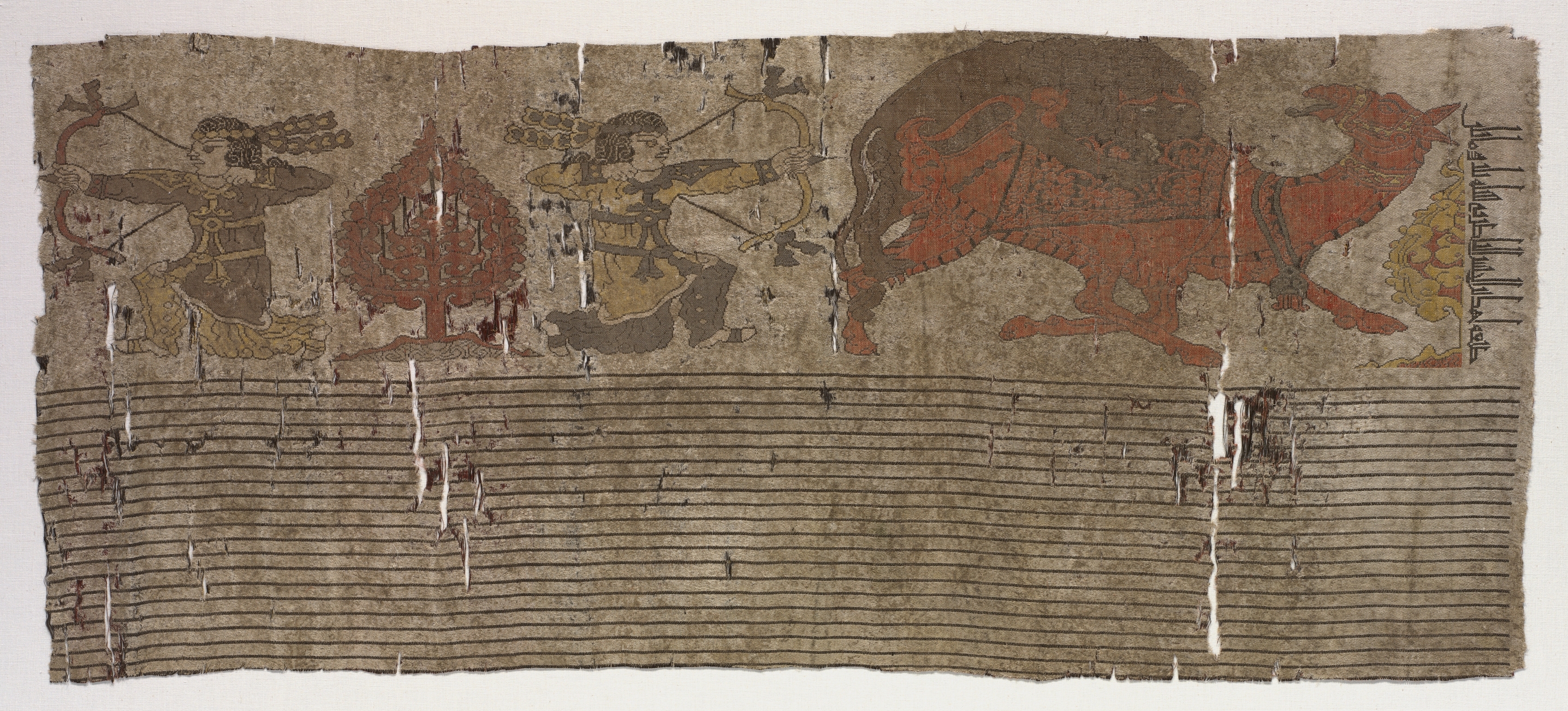
Deconstructing the Nomadic Code: A Zoey Fashion Lab Analysis of the Iranian Silk Lampas Panel
At Zoey Fashion Lab, we do not merely observe textiles; we interrogate them. We deconstruct their physicality, their history, and their silent language. The subject of this analysis—a Silk Lampas weave panel from Iran, depicting a Hunters and Camel scene with an inscription—presents a profound opportunity. It is not a relic to be preserved in a vitrine. It is a New DNA Strand, a genetic blueprint for an avant-garde aesthetic that challenges the very definition of luxury and heritage. This report details our deconstruction and proposes a radical, forward-facing interpretation for the Zoey Fashion Lab collection.
Technical Deconstruction: The Lampas Weave as Architectural Framework
The panel’s technical foundation is the lampas weave, a complex, compound structure that marries a ground weave with a pattern weave, often using silk for both. This is not a simple print or embroidery; it is a woven architecture. The silk threads, lustrous and strong, create a fabric with a distinct, almost three-dimensional surface. The pattern is not applied; it is intrinsic to the structure. For our lab, this represents a core principle: form is function, and pattern is structure. An avant-garde garment cannot be a mere canvas for decoration; the decoration must be the garment’s skeleton.
We propose a deconstruction of the weave itself. Imagine a garment where the lampas panel is not used as a whole. Instead, we isolate the structural threads. The warp threads, typically hidden, become exposed, creating a sheer, skeletal network. The weft threads, carrying the color and pattern, are allowed to float and fray, creating a deliberate, controlled chaos. This is not damage; it is architectural reveal. A jacket, for example, could feature the intact lampas panel as a rigid, structured bodice, while the sleeves are formed from the deconstructed warp threads, creating a ghostly, translucent echo of the original pattern. The camel and hunters become spectral, their forms suggested rather than stated—a nod to memory and the erosion of time.
Iconographic Deconstruction: The Hunt, the Camel, and the Inscription
The imagery—a hunting scene with a camel—is deeply rooted in Persian courtly and nomadic traditions. The hunt symbolizes mastery, power, and the cycle of life and death. The camel represents endurance, trade, and the harsh beauty of the desert. The inscription, likely a poetic verse or a royal title, adds a layer of textual authority. For the avant-garde, these elements are not to be reproduced literally. They are semiotic fuel.
The Hunters: We reimagine them not as historical figures but as archetypes of pursuit. Their forms can be abstracted into sharp, angular lines—a directional pattern that mimics the trajectory of an arrow or the sweep of a falcon’s wing. This pattern could be laser-cut into leather or bonded onto a neoprene base, creating a high-contrast, kinetic print. The hunter is no longer a person; he is a vector of intention.
The Camel: The camel’s silhouette is iconic but heavy. Our deconstruction focuses on its hump and gait. The hump becomes a sculptural volume—a dramatic, exaggerated shoulder pad or a structural bustle. The gait, a slow, deliberate rhythm, is translated into a repeating, asymmetrical pleat that runs down a skirt or a pair of wide-legged trousers. The camel is not depicted; it is embodied in the garment’s movement and silhouette.
The Inscription: This is perhaps the most potent element. The inscription is a code. For our lab, it is not to be read but to be re-encoded. We will extract the calligraphic strokes and transform them into a binary or geometric pattern. The curves of the letters become a series of arcs and angles. The text is rendered illegible, becoming a pure, abstract pattern—a visual cipher that speaks of hidden knowledge. This pattern can be embroidered in metallic thread on a sheer base, or it can be used as a heat-transfer pattern on a synthetic fabric, creating a futuristic, almost digital, texture. The inscription’s authority is subverted; it becomes a secret language for the wearer.
Avant-Garde Synthesis: The New DNA Strand
The final garment is not a costume. It is a hybrid organism. We propose a three-piece ensemble that merges the historical weight of the lampas with the forward momentum of the avant-garde.
1. The Armor Bodice: Constructed from the intact lampas panel, reinforced with a lightweight, flexible resin. The bodice is shaped like a modern corset, but its surface is the historical hunt scene. The camel’s hump is exaggerated into a single, dramatic shoulder piece. The bodice is closed not with laces but with magnetic clasps that mimic the shape of the inscription’s letters. This piece is a relic of power, worn as a second skin.
2. The Deconstructed Skirt: A floor-length skirt made from multiple layers. The top layer is a sheer, translucent silk organza, onto which the deconstructed warp threads are hand-stitched in a chaotic, web-like pattern. Beneath this, a second layer of matte, black neoprene is laser-cut with the abstracted hunter pattern. The skirt’s hem is asymmetrical, mimicking the camel’s gait. The overall effect is one of controlled disarray—a textile ruin that is meticulously engineered.
3. The Inscription Veil: A long, hooded cape or veil made from a high-tech, heat-sensitive fabric. The re-encoded inscription pattern is printed using a thermochromic ink. When the wearer’s body heat activates the fabric, the pattern shifts from a subtle gray to a vibrant, metallic gold. The inscription becomes a living, breathing element—a dynamic cipher that responds to the wearer’s presence. This veil is both a shield and a statement, a nod to the hidden power of the original text.
Conclusion: The Future of Heritage
This Iranian Silk Lampas panel is not an end; it is a beginning. At Zoey Fashion Lab, we see it as a New DNA Strand—a genetic code that can be spliced, mutated, and re-expressed. The avant-garde is not about rejecting the past; it is about re-contextualizing it with radical intent. The hunt becomes a direction. The camel becomes a volume. The inscription becomes a secret. The resulting garment is a conversation between centuries, a wearable artifact that honors its origins while defiantly stepping into the future. This is not fashion as decoration. This is fashion as deconstruction, analysis, and rebirth. This is the Zoey Fashion Lab methodology.