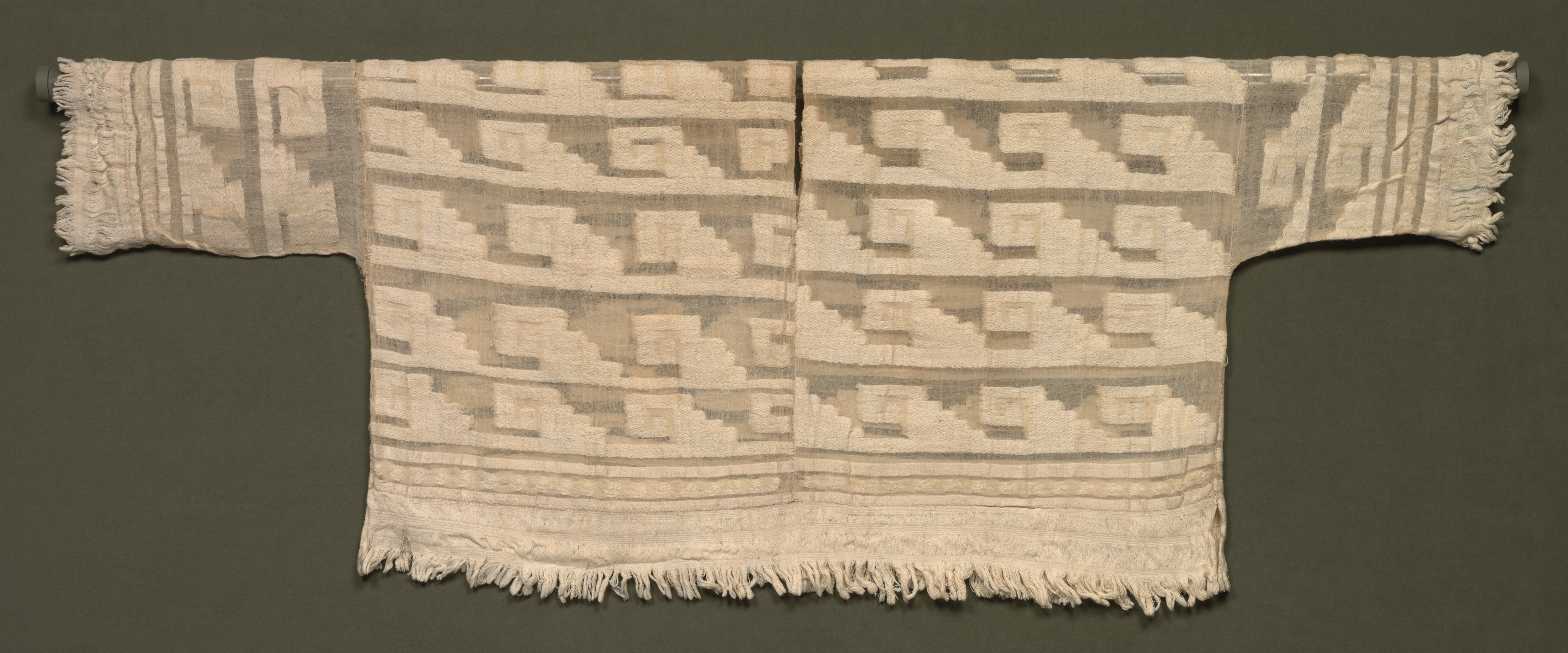
Deconstructing the Chimú-Inka Tunic: An Avant-Garde Analysis for Zoey Fashion Lab
At Zoey Fashion Lab, our mission is to unearth the radical potential embedded within historical textiles, transforming them into catalysts for avant-garde design. The subject of this analysis—a Chimú or Chimú-Inka tunic from Peru, dating from the 12th to 16th century—presents a profound case study. Crafted from white cotton using plain weave with supplementary weft brocading, this garment is far more than a relic. It is a dense archive of cultural negotiation, technical mastery, and symbolic power. For the avant-garde designer, it offers a blueprint for deconstructing form, subverting material expectations, and reimagining the body as a site of cosmic and political resonance.
Materiality and the Politics of Plain Weave
The tunic’s foundation—white cotton in a plain weave—initially appears deceptively simple. However, for the Chimú and Inka societies, cotton was a material of immense significance. Unlike the high-status vicuña or alpaca wools reserved for the nobility, cotton was a democratically accessible yet technically demanding fiber. Its cultivation and preparation required sophisticated knowledge of coastal ecology. The plain weave structure, while basic, provides a neutral, stable ground—a blank canvas—that allows the supplementary weft brocading to command absolute attention.
From an avant-garde perspective, this choice of base material is a deliberate act of restraint. It challenges the contemporary obsession with complex, multi-layered fabrications. The tunic demonstrates that true innovation lies not in complexity of weave, but in the tension between the minimal and the maximal. The white cotton ground becomes a field of potential, a void waiting to be activated. In our practice at Zoey Fashion Lab, this suggests a radical reduction: stripping away ornament to reveal the power of the structural matrix. The plain weave is not a limitation; it is a philosophical stance, a declaration that the garment’s narrative is embedded in its construction, not its surface.
Supplementary Weft Brocading: A Grammar of Power and Adornment
The true genius of this tunic resides in its supplementary weft brocading. This technique, where extra weft threads are woven into the ground fabric to create raised, discontinuous patterns, is a form of controlled disruption. It does not alter the underlying structure but superimposes a second, independent layer of design. This is a metaphor for cultural encounter: the Chimú, conquered by the Inka, did not lose their identity but rather wove it into the fabric of the new empire. The brocading becomes a visual language of resistance and adaptation.
For the avant-garde, this technique offers a model for surface modulation. The brocaded patterns—likely geometric abstractions of birds, fish, or stepped motifs—are not merely decorative. They are a coding system, a form of non-verbal communication that speaks to cosmological order, social hierarchy, and territorial claims. The raised wefts create a tactile topography, inviting touch and demanding a slow, deliberate gaze. In an era of digital printing and instant gratification, the brocaded tunic insists on the primacy of the handmade, the time-bound, and the intentional. Our design lab can translate this into avant-garde applications: using laser-cut felt or heat-bonded synthetics to mimic the raised, additive quality of brocading, or employing conductive threads to embed electronic patterns that respond to the wearer’s movement.
The Tunic as a Site of Cultural Collision
The tunic’s origin—Chimú or Chimú-Inka—places it at a critical juncture of cultural collision. The Chimú civilization, centered on the north coast of Peru, was renowned for its sophisticated textile arts, particularly its mastery of featherwork and intricate brocading. When the Inka Empire expanded into Chimú territory in the late 15th century, a process of syncretism began. The Inka imposed their own administrative and religious systems, but they also absorbed and repurposed Chimú artistic traditions. This tunic likely embodies this negotiation: it may retain Chimú design motifs, but its form—a sleeveless, knee-length tunic—adheres to the standardized Inka garment for elite males.
This cultural hybridity is a powerful resource for the avant-garde. It demonstrates that identity is not fixed but is constantly being reconstituted through material practice. The tunic is not a pure expression of one culture but a composite, a palimpsest of influences. For Zoey Fashion Lab, this inspires a methodology of intentional anachronism: deliberately mixing historical references, geographical origins, and technical processes to create garments that defy linear chronology. An avant-garde tunic might combine the structural simplicity of the Chimú-Inka form with the brocading technique, but rendered in industrial felt and neon thread, or woven with recycled plastic fibers. The result is a garment that speaks to multiple times and places simultaneously, challenging the viewer to decode its layers.
Archive Resonance: Echoes of the 16th-17th Century
The archive note references the resonance of objects and paintings from the 16th to 17th centuries, a period of intense global exchange following European contact. While this tunic predates that era, its survival and eventual placement in a museum archive make it a participant in that later conversation. The tunic becomes a silent witness to the violence of colonization, the extraction of Andean treasures, and the subsequent recontextualization of indigenous art within Western frameworks of “art” and “artifact.”
For the avant-garde designer, this archive resonance is a call to decolonize the design process. It demands that we acknowledge the power dynamics embedded in our sources. We cannot simply extract the tunic’s visual language without also confronting its history of dispossession. Our practice must be one of critical appropriation: honoring the technical and symbolic intelligence of the original makers while refusing to replicate the colonial gaze. This might involve collaborating with contemporary Andean weavers, using the tunic as a starting point for dialogue rather than a template for imitation. It also means questioning the very category of “tunic” as a Western garment, and exploring how the Chimú-Inka form—with its square silhouette, side slits, and neck opening—challenges our assumptions about tailoring and fit.
Avant-Garde Applications: From Archive to Runway
How then, does Zoey Fashion Lab translate this analysis into avant-garde design? First, we embrace the tunic’s structural minimalism as a radical gesture. In an industry obsessed with hyper-tailoring and complex draping, the tunic’s simple, rectangular form is a provocation. It suggests that the garment is not a second skin but a mobile architecture, a frame for the body that can be worn, draped, or even deconstructed. We can explore oversized proportions, asymmetrical openings, and modular components that allow the wearer to reconfigure the garment.
Second, we reinterpret the supplementary weft brocading as a system for surface intervention. Instead of weaving, we might use appliqué, embroidery, or digital printing to create raised, layered patterns that disrupt the flat plane of the fabric. The patterns themselves can be abstracted from Chimú motifs—stepped frets, zigzags, and stylized creatures—but rendered in unexpected materials: reflective mylar, hand-painted silicone, or recycled metal mesh. The goal is to preserve the technique’s additive, tactile quality while pushing it into new material territories.
Finally, we engage with the tunic’s cultural narrative as a design element. The garment becomes a vehicle for storytelling, not about a distant past, but about contemporary issues of migration, hybridity, and identity. An avant-garde tunic might incorporate QR codes that link to oral histories of Chimú weavers, or use color-changing dyes that respond to the wearer’s body heat, symbolizing the living, evolving nature of tradition. The tunic is not a costume; it is a critical instrument that interrogates the very notion of authenticity.
Conclusion: The Tunic as a Radical Proposition
The Chimú-Inka tunic is not a relic to be preserved behind glass. It is a radical proposition for the future of fashion. Its plain weave ground, its supplementary weft brocading, its cultural hybridity, and its archive resonance all offer lessons for the avant-garde designer. At Zoey Fashion Lab, we see this garment as a call to deconstruct, disrupt, and reimagine. By engaging with its material intelligence and its complex history, we can create garments that are not merely wearable but are acts of cultural critique. The tunic teaches us that the most profound innovations often emerge from the simplest structures, and that the most powerful designs are those that carry the weight of multiple worlds. In the hands of the avant-garde, this ancient textile becomes a blueprint for a new, more conscious, and more radical fashion.