Deconstructing Authority: The Lord Chancellor's Burse as Avant-Garde DNA
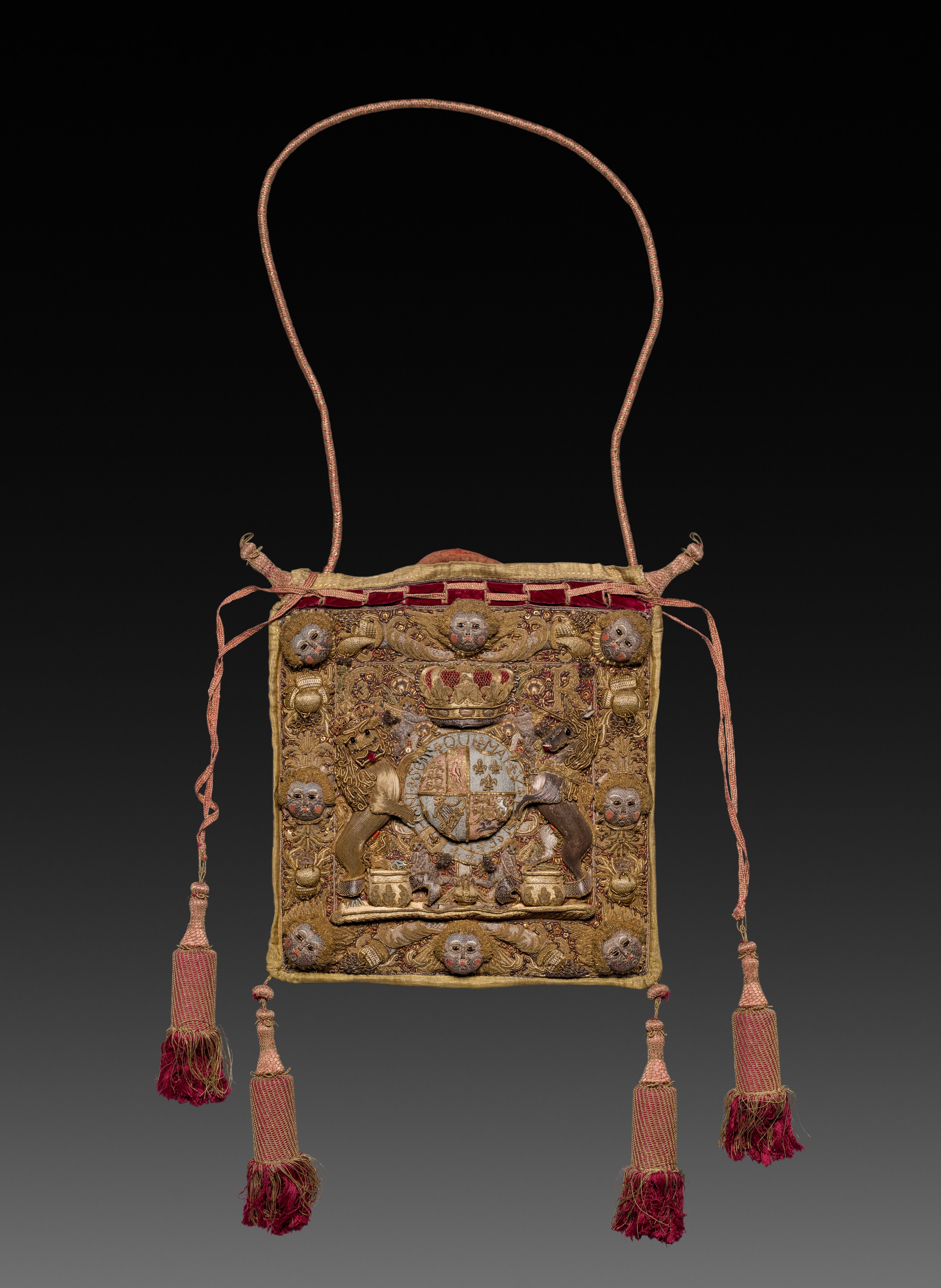
At Zoey Fashion Lab, we do not merely study garments; we dissect them as encoded artifacts of power, ritual, and material culture. The object under analysis—the Lord Chancellor's Burse (Purse) bearing the Royal Cypher and Coat of Arms of George III, crafted in 18th-century England—presents a fascinating paradox. It is an object of supreme institutional authority, yet its construction and symbolism offer a rich substrate for avant-garde reinterpretation. This analysis will deconstruct the Burse’s technical DNA, its political semiotics, and its potential to inform a new, disruptive fashion language.
I. Technical Autopsy: The Anatomy of Opulence
The Burse is not a purse in the modern sense; it is a ceremonial bag, a portable emblem of the Lord Chancellor’s office. Its technical construction is a masterclass in hierarchical materiality. The primary substrate is red silk velvet, a fabric historically associated with royalty, cardinalate, and judicial authority. The deep crimson hue, achieved through costly kermes or cochineal dyes, signifies both blood and sovereignty. The velvet’s pile, soft yet dense, creates a surface that absorbs and reflects light unevenly, lending a sense of depth and gravity.
Upon this velvet field, silk embroidery, goldwork, pearls, black beads, and sequins are applied with meticulous precision. The goldwork is not merely decorative; it is structural. Using techniques such as or nué (shaded goldwork) and couching, the embroiderers created the Royal Cypher (GR for Georgius Rex) and the full Coat of Arms. The gold thread, often wrapped around a silk core, catches light with a metallic sheen that contrasts with the velvet’s absorbent texture. The pearls—tiny, luminous spheres—are stitched in patterns that outline the lion and unicorn of the royal crest, their organic luster introducing a soft, almost feminine counterpoint to the martial heraldry.
The inclusion of black beads and sequins is particularly telling. These elements introduce a note of mourning or solemnity, perhaps referencing the weight of judicial responsibility. The sequins, likely made of silver or tin, are cut into small circles and sewn at their centers, creating a subtle shimmer. The pendant tassels, composed of twisted silk and gold bullion, serve as kinetic elements—they sway with the movement of the Lord Chancellor, adding a percussive, auditory dimension to the visual spectacle. Every material choice is deliberate: each thread, bead, and tassel is a node in a network of power.
II. Semiotic Dissection: The Coat of Arms as a DNA Strand
The Burse’s iconography is a dense, layered text. The Royal Cypher “GR” is a monogram that collapses the king’s identity into a graphic signature. The Coat of Arms, with its quartered shields, supporters (lion and unicorn), and motto (“Dieu et mon droit”), is a heraldic code that encodes dynastic lineage, territorial claims, and divine right. In our lab, we treat this as a genetic sequence—a strand of cultural DNA that can be spliced, mutated, and re-expressed in contemporary form.
The lion (England) and unicorn (Scotland) are not just animals; they are archetypes of power and purity. The unicorn, chained, symbolizes a tamed wildness—a metaphor for the state’s control over nature. The pearls, stitched in rows, mimic the chain. The black beads, interspersed among the gold, introduce a binary code of light and dark, life and death. This is not mere ornament; it is a visual language of authority that communicates without words.
Consider the pendant tassels. They are not merely decorative; they are symbolic appendages that extend the Burse’s reach. In ceremonial use, they would brush against the Lord Chancellor’s robes, creating a tactile and auditory connection between the object and the body. This interplay of material and motion is crucial for our avant-garde reinterpretation.
III. Avant-Garde Transmutation: From Ceremonial Relic to Fashion DNA
Zoey Fashion Lab’s methodology is to extract the core structural and symbolic principles from historical artifacts and re-engineer them into new forms. For the Lord Chancellor’s Burse, we identify three key strands for mutation:
1. The Velvet as a Canvas for Power Projection: The red silk velvet is not just a fabric; it is a political skin. In our avant-garde collection, we propose reimagining this velvet as a digitally printed surface that incorporates the heraldic motifs but in a fragmented, glitch-like manner. The coat of arms becomes a deconstructed QR code, readable only by those who know its history. The velvet itself could be laser-cut into latticework, revealing a second layer of iridescent organza beneath—a play on opacity and transparency that mirrors the dual nature of justice (public and private).
2. Goldwork as Exoskeletal Structure: The gold thread embroidery is a form of surface architecture. In our design, we would replace traditional goldwork with 3D-printed metallic filaments that follow the same curvilinear patterns but extend outward from the garment’s surface. These filaments could be kinetic, responding to the wearer’s movement via micro-motors, creating a living, breathing coat of arms. The pearls would be replaced by biodegradable, lab-grown pearls that contain embedded LED lights, pulsing in sync with the wearer’s heartbeat—a literal “pulse of power.”
3. Tassels as Propulsive Appendages: The pendant tassels are dynamic counterweights. For our avant-garde interpretation, we would scale them up into wearable sculptures—long, weighted cords that trail from the shoulders or hips, embedded with fiber-optic threads that change color based on the wearer’s biometric data (stress levels, temperature, etc.). These tassels become nervous system extensions, transforming the ceremonial object into a responsive, living interface.
IV. Conclusion: The Burse as a Blueprint for Power’s New Aesthetic
The Lord Chancellor’s Burse is not a relic to be preserved in a glass case. It is a blueprint for how authority is materialized. At Zoey Fashion Lab, we see in its red velvet, gold thread, and pearl-studded heraldry a proto-cybernetic system—a network of signs and materials designed to command attention, respect, and obedience. By deconstructing its technical and symbolic DNA, we can reimagine power not as a static emblem but as a fluid, interactive, and critically self-aware performance.
The avant-garde fashion of tomorrow will not reject history; it will re-sequence it. The Burse’s DNA—its velvet, its gold, its pearls, its tassels—becomes the raw material for a new vocabulary of authority, one that questions, subverts, and ultimately redefines the very concept of sovereign power. In the lab, we call this “Heraldry 2.0.” The Lord Chancellor’s purse is no longer a bag; it is a generative algorithm for the future of fashion.