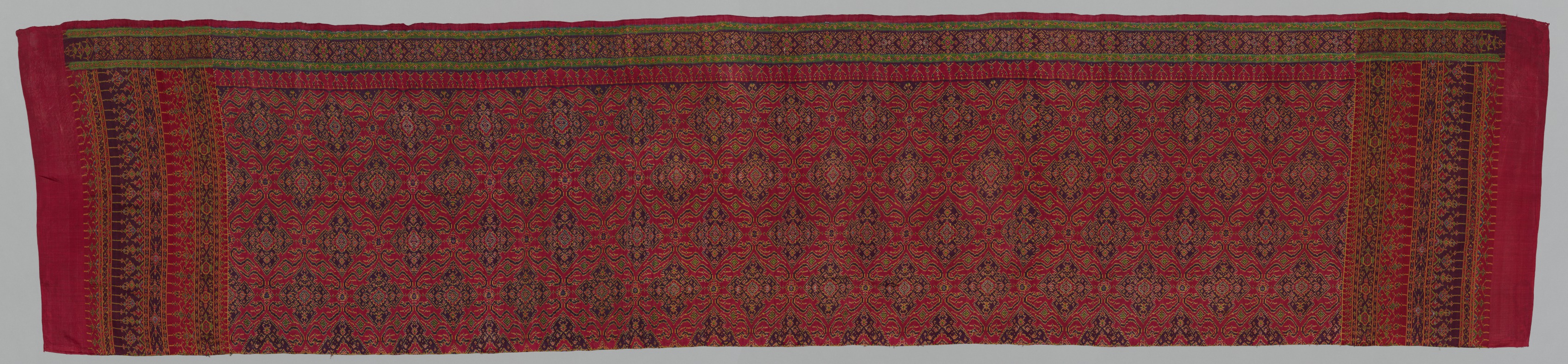
Technical Deconstruction & Material Resonance
The presented artifact—one half of a traditional sampot skirt cloth—is a profound study in constrained elegance. Its technical foundation is a silk tabby weave, the most fundamental interlacing of warp and weft. This simplicity is the strategic canvas for the complex artistry of weft ikat. The pattern was not printed or embroidered but conceived in the threads themselves prior to weaving. Individual weft (horizontal) threads were meticulously bound and resist-dyed in sections to create the precise, blurred-edged motifs. The weaver then faced the exacting task of aligning these pre-dyed weft threads during weaving to manifest the intended geometric and figurative patterns. The result, as seen here, is a field of sophisticated, slightly undulating forms, a testament to a profound understanding of material behavior and spatial planning. The use of silk is critical; its fine tensile strength and luminous quality allowed for high thread counts, enabling intricate detail and a luxurious drape essential to the garment's function and status.
Archive Resonance: The Silent Dialogue of Form
The archival note references a broader dialogue between "器物与绘画" (artifacts and paintings) as witnesses to cultural collision and aesthetic integration. This sampot fragment actively participates in this silent conversation. Its geometric precision—likely featuring rhomboids, key patterns, and stylized flora or fauna—echoes the sacred cosmologies and protective symbols found in Cambodian temple bas-reliefs. The ikat technique itself is a form of textile painting, where the dyed threads are the pigments and the loom is the brush. The "blur" inherent to ikat is not a flaw but a signature, a haptic vibration that distinguishes it from the hard edge of a printed or woven-in pattern. This artifact stands at a specific historical crossroads: the 19th to early 20th century in Cambodia was a period of profound political and cultural shifts, including French colonial influence. The sampot retains its traditional technical and symbolic language, yet its very preservation and journey into a contemporary archive speaks to its transition from a lived garment to a cultural cipher, ready for reactivation.
Avant-Garde Proposition: The Zoey Fashion Lab Intervention
For Zoey Fashion Lab, this half-sampot is not a relic but a generative prototype. Its condition—a fragment—liberates it from the obligation of wholeness and invites radical re-contextualization. The avant-garde ethos does not mimic; it converses, dissects, and re-engineers the core principles of the source material.
Conceptual Framework: Asymmetry, Negative Space, and the Fragment as Whole
The most immediate provocation is the artifact's state of being half. We reject the impulse to reconstruct or complete. Instead, we champion the fragment as the complete statement. This aligns with avant-garde principles of asymmetry, deconstruction, and the beauty of the incomplete. The single panel becomes a self-contained universe of pattern and history.
Material & Technique Transposition
Ikat, Re-engineered: We preserve the philosophy of resist-dyeing but explode its application. Imagine warp ikat on technical fabrics like laminated silk or recycled polyester filaments, creating rigid, architectural forms. Or, double ikat (where both warp and weft are dyed) executed with laser-cut resist bindings on neon-dyed hemp, achieving hyper-precise, pixelated patterns that only resolve when the garment is in motion.
Silk, Re-contextualized: We honor silk's legacy by juxtaposing it with antithetical materials. The delicate, historic ikat panel could be suspended within a cage of recycled aluminum chainmail, or laminated between sheets of clear bio-plastic, transforming it into a protective breastplate. The contrast between the organic, cultural "skin" and the industrial, contemporary "armor" creates a powerful narrative on preservation and exposure.
Form & Function: From Skirt to Architecture
The sampot's original function as a wrapped lower garment is a starting point for radical silhouette exploration. The half-panel suggests asymmetry.
Proposal 1: The Mono-Panel Draped Construction. Use the exact dimensions and pattern layout of the artifact as a blueprint for a single, statement panel. This panel is attached at only one shoulder or the waist, allowing the rest to drape, fold, or be secured by the wearer in variable ways—a sculptural obi, a trailing cape-pant, a wrapped bodice. The negative space of the body becomes as important as the clothed area.
Proposal 2: Digital Dissection & Amplification. Scan the ikat pattern at high resolution. Fragment its motifs further, isolating a single geometric cluster. This cluster is then algorithmically tessellated and scaled, printed via sustainable dye-sub onto a single, continuous length of fabric (e.g., peace silk or Piñatex). This fabric is then cut on the bias and engineered into a spiral-cut garment—a dress or jumpsuit where the historic pattern, now magnified and distorted, wraps the body in a new, dynamic relationship, creating optical movement and a direct lineage from hand-tied dye bonds to digital code.
Conclusion: The New Resonance
This 19th-20th century Cambodian silk ikat fragment offers Zoey Fashion Lab a masterclass in pre-industrial precision and symbolic depth. Our avant-garde analysis moves beyond aesthetic appropriation. We engage in a technical séance, summoning the principles of the weaver's art—the strategic resist, the embrace of the blurred line, the dialogue between structure and motif—and transposing them into a contemporary material and philosophical lexicon. The final creation will not look like the sampot. Instead, it will resonate with its same fundamental frequency: one of meticulous craft, cultural intelligence, and a bold statement written on cloth. We are not reviving a skirt; we are amplifying its silent witness into a declarative, future-facing dialogue on beauty, heritage, and innovation.