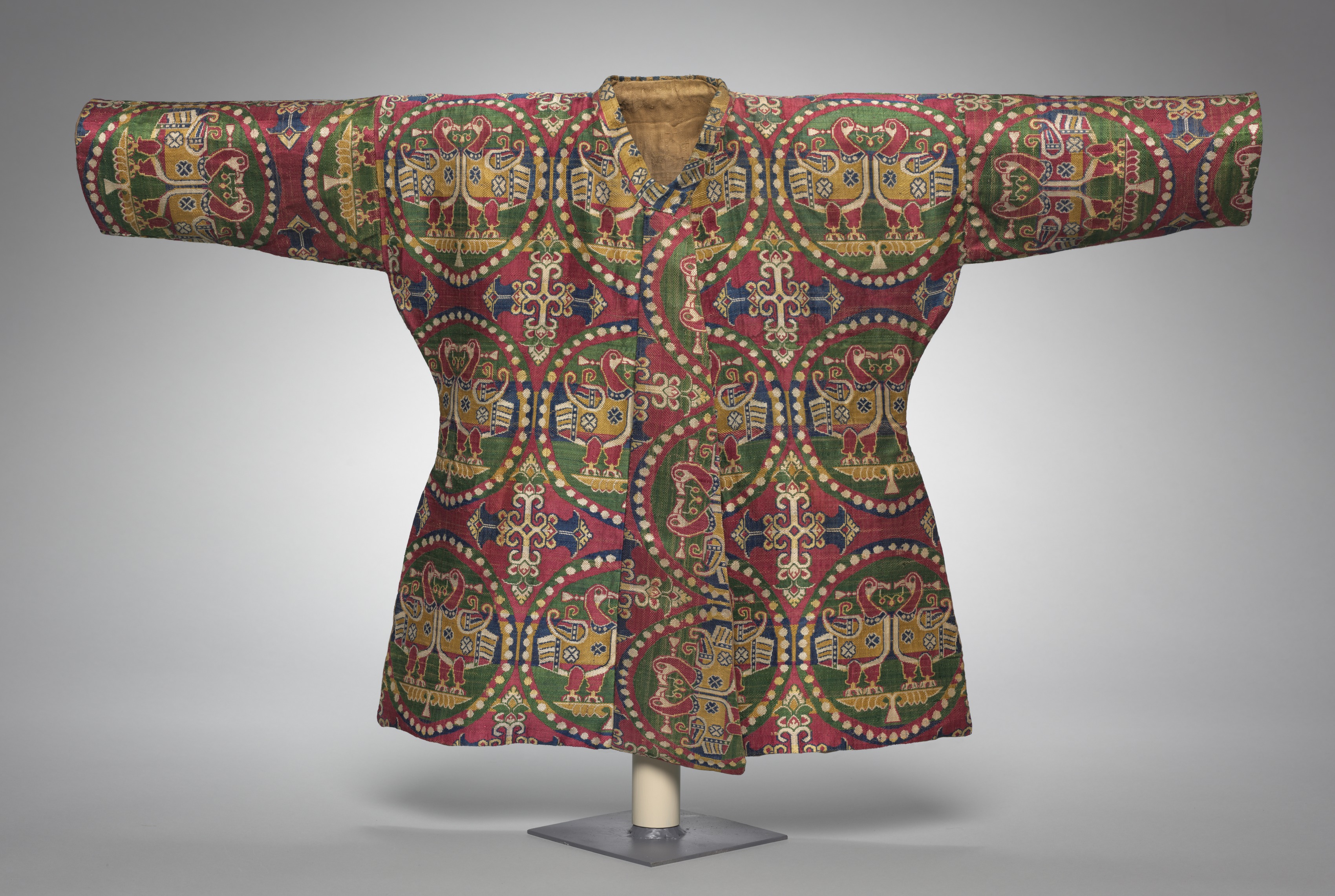
Deconstructing the Avant-Garde: A Technical and Cultural Analysis of the Sogdian Child’s Coat with Ducks in Pearl Medallions
Introduction: The Intersection of Heritage and High Fashion
At Zoey Fashion Lab, the role of the Chief Fabric Deconstructionist is to dissect not merely the physical threads of a garment, but the narrative woven into its very structure. The subject of this analysis—a Child’s Coat with Ducks in Pearl Medallions, originating from Sogdia (present-day Uzbekistan) and constructed using a weft-faced compound twill weave (samite) in silk—presents a profound paradox. It is an artifact of ancient Central Asian luxury, yet its design language and technical execution resonate with the principles of avant-garde fashion. This analysis will deconstruct the garment’s materiality, its symbolic lexicon, and its structural DNA, revealing how a 7th- to 8th-century textile can inform and challenge contemporary design philosophy.
Technical Mastery: The Samite Weave as a Precursor to Modern Structuralism
The coat is executed in weft-faced compound twill weave, commonly known as samite. This is a complex, warp-faced technique in which multiple sets of weft threads—often in different colors—are woven over a foundation warp to create intricate, polychrome patterns. From a deconstructionist perspective, the samite weave is a pre-industrial algorithm. It requires a premeditated, almost computational approach to thread placement, where each weft float is a deliberate decision in a binary system of coverage and exposure.
For the Zoey Fashion Lab, this technique is a direct ancestor of modern jacquard weaving and digital textile printing. The avant-garde relevance lies in its structural honesty. Unlike printed patterns, which sit on the surface, the ducks and medallions in this coat are intrinsic to the fabric’s architecture. The weft threads do not merely depict the design; they are the design. This aligns with avant-garde principles of exposing construction, celebrating materiality, and rejecting superficial ornamentation. A contemporary designer might reinterpret this by laser-cutting the samite structure or by using metallic wefts to create a similar interplay of light and density, but the core lesson remains: the pattern is the structure, not an addition to it.
Symbolic Lexicon: Ducks, Pearl Medallions, and the Avant-Garde Narrative
The central motif—ducks within pearl medallions—is not merely decorative. In Sogdian culture, ducks were associated with water, fertility, and the soul’s journey, while pearl medallions (a motif borrowed from Sasanian Persia) symbolized royalty, protection, and the cosmos. The duck’s presence in a child’s coat suggests a talismanic function: a wish for the child’s safe passage through life’s currents, enclosed within the protective circle of the medallion.
From an avant-garde standpoint, this is a masterclass in symbolic compression. The coat does not explain its meaning; it presents it as a visual code. The duck is stylized to the point of near-abstraction, its form reduced to a silhouette of wings and a beak, while the pearl medallion is a geometric frame that both contains and amplifies the image. This is analogous to the work of designers like Rei Kawakubo or Yohji Yamamoto, who use garment shapes and motifs as visual haiku—dense, layered, and open to interpretation. The child’s coat, in its original context, was a wearable poem. In a modern avant-garde collection, such motifs would be deconstructed further: the duck might be fragmented across seams, the pearl medallion might become a cutout or a structural hole, challenging the viewer to reassemble the narrative.
Cultural DNA: The New Strand of Avant-Garde Heritage
The reference to a “New DNA Strand” in the garment’s provenance is critical. This suggests that the coat is not a static artifact but a living genetic code that can be spliced into contemporary design. The Sogdian Silk Road was a network of exchange—not just of goods, but of techniques, motifs, and philosophies. The child’s coat embodies this hybridity: its silk is Chinese, its weave structure is Byzantine-influenced, its motifs are Persian and local. This is the original globalism.
For the avant-garde, this hybridity is a blueprint. The coat teaches us that innovation arises from cultural collision, not purity. A Zoey Fashion Lab deconstruction would extract this DNA: the use of a child’s garment as a canvas for adult-level complexity; the integration of protective symbolism into fashion; the deliberate mixing of influences. A contemporary reinterpretation might use a child’s coat silhouette—short, rounded, oversized—as a base, but construct it from recycled silk, incorporating digital embroidery that mimics the pearl medallions while commenting on the fragility of cultural heritage in a globalized world. The “new DNA” is the recognition that tradition is not a relic but a mutable code.
Materiality and Wear: The Child’s Body as Avant-Garde Canvas
One of the most avant-garde aspects of this coat is its intended wearer. A child’s garment, particularly in a luxury textile like samite, challenges the notion of fashion as solely adult-centric. The coat is small, but its technical ambition is monumental. This juxtaposition—monumental technique applied to a miniature scale—is a hallmark of avant-garde design. It forces the viewer to reconsider scale, proportion, and the relationship between the garment and the body.
The silk itself, though now aged and possibly fragile, would have been luminously reflective, with the pearl medallions catching light as the child moved. The weft-faced structure would have created a ribbed, almost sculptural surface. In deconstruction, we note that the coat’s functionality (warmth, protection) is inseparable from its aesthetic. This is a key avant-garde principle: form and function are not separate but co-dependent. A modern iteration might use a waterproof, high-tech silk or a biodegradable polymer that mimics the samite structure, questioning the ethics of luxury and the lifecycle of a garment designed for a rapidly growing child.
Conclusion: Reconstructing the Future from the Past
The Child’s Coat with Ducks in Pearl Medallions is not a historical curiosity; it is a design manifesto from the 8th century. Its samite weave prefigures digital patterning, its symbolic language anticipates minimalist storytelling, and its cultural hybridity models a global aesthetic that the avant-garde continues to explore. For Zoey Fashion Lab, this garment is a new DNA strand—a code that, when deconstructed and reassembled, can inform collections that are both deeply rooted and radically forward. The coat’s lesson is clear: the avant-garde is not about rejecting the past, but about re-reading it with fresh eyes, finding in ancient threads the blueprint for tomorrow’s silhouettes.