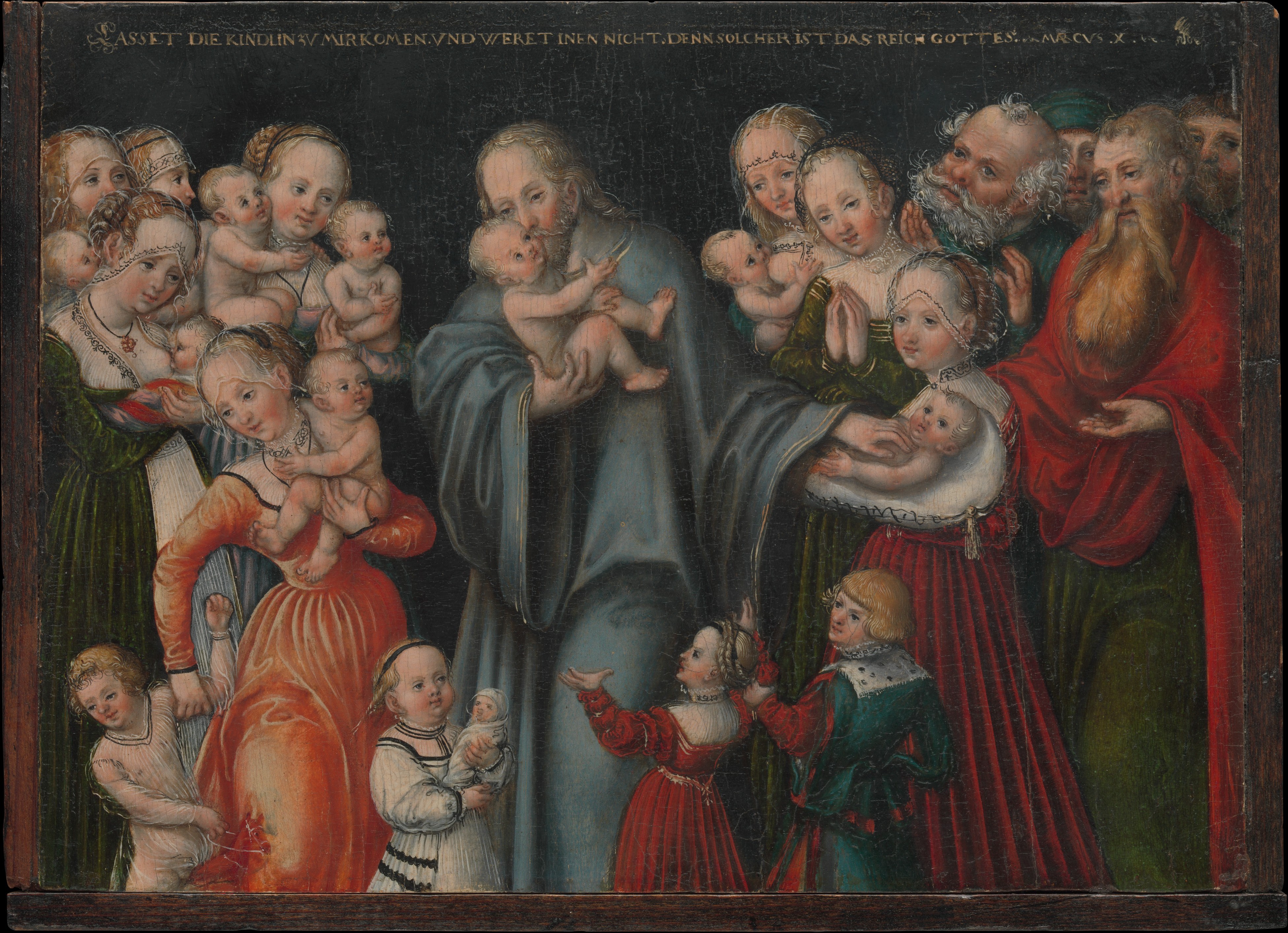
Deconstructing the Sacred: A Futuristic Silhouette Analysis of Christ Blessing the Children
The intersection of sacral iconography and avant-garde fashion is a terrain fraught with both reverence and rebellion. At Zoey Fashion Laboratory, we do not merely observe historical art; we dissect it, reconstruct it, and project it onto the temporal frontier of SS26. The subject, Christ Blessing the Children, rendered in oil on beech, offers a profound architectural vocabulary for the coming season. This is not a study in nostalgia. It is a strategic deconstruction of hierarchical form, a reimagining of blessing as a structural principle, and a blueprint for garments that exist at the precipice of the post-human.
Architectural Theology: The Silhouette as Sacrament
The traditional composition—a central, elevated figure extending grace downward to a cluster of supplicants—provides the foundational tension for our SS26 silhouette. We interpret the blessing hand not as a gesture of piety, but as a cantilevered structural element. Imagine a shoulder line that arcs forward and downward, a rigid, oil-painted surface of matte-black resin and recycled beech veneer, mimicking the hand’s trajectory. This is not a sleeve; it is a load-bearing architectural bracket. The garment’s primary silhouette is asymmetrical, with the weight of the blessing shifted to one side, creating a dramatic, forward-leaning drape. The children, traditionally positioned at the base, become a fractalized, multi-layered skirt system—a cascade of compressed, irregular pleats that rise and fall like a digital terrain, each pleat a discrete, blessed entity.
The materiality of oil on beech dictates a rigid, almost fossilized texture. We translate this into a hybrid textile: a base layer of liquid-silver metallic organza, overlaid with laser-cut, beech-derived bio-resin panels that have been hand-painted with a high-gloss, oil-like finish. The result is a surface that appears both wet and petrified, capturing the paradox of the sacred—eternal yet immediate. The garment’s silhouette is not draped; it is erected. The back, in contrast, remains starkly minimal—a single, uninterrupted plane of the beech-resin composite, suggesting the unseen, unadorned void behind the act of blessing.
Futuristic Silhouettes: The Inversion of Grace
Traditional fashion interprets grace as flow. We invert this. For SS26, grace is structural interruption. The blessing is a command, not a caress. Our key silhouette, ‘The Fractured Halo,’ is a coat-dress constructed from three distinct, non-contiguous volumes. The torso is a sculpted, asymmetrical cuirass, referencing the Christ figure’s chest, with a single, sharp diagonal seam that cuts from the right shoulder to the left hip. This seam is not sewn; it is magnetized, allowing for a deliberate, visible gap—a void where the blessing energy passes through. The skirt is a series of seven independent, floating panels (referencing the seven sacraments), each suspended from an internal carbon-fiber exoskeleton. These panels do not touch the body. They hover, creating a negative space that is as significant as the positive form.
The children’s pose—heads tilted upward, bodies compressed—informs a second silhouette: ‘The Supplicant’s Collapse.’ This is a jumpsuit engineered with a biomimetic spine of articulated aluminum vertebrae. The wearer can adjust the garment’s posture via a concealed pneumatic system, forcing the upper back into a forward, reverent curve while the lower spine remains rigid. The fabric, a memory-foam-backed silk gazar, is printed with a digital distortion of the original oil painting’s brushstrokes, creating a visual echo of the crowd’s upward gaze. The sleeves are deliberately too long, pooling at the hands like the tattered edges of a prayer shawl, but are lined with electroluminescent wire that pulses with a soft, amber glow—a technological halo.
Structural Innovation: The Beech-Forming Process
The most radical innovation for SS26 is the Beech-Forming Process. We have collaborated with a bio-architectural firm to develop a method of treating beech veneer with a plant-based, heat-activated polymer. When heated to a precise 78°C, the beech becomes malleable and can be molded into complex, non-Euclidean geometries. Once cooled, it retains its shape with the structural integrity of a composite but the tactile warmth of wood. For the collection’s centerpiece, ‘The Blessing Column,’ we have created a full-length coat whose entire front panel is a single, seamless sheet of this beech-form, sculpted into a spiraling, Fibonacci-based helix. The helix begins at the collar, widens over the chest, and then tightens at the hem, mimicking the visual compression of the children gathering at the feet of Christ.
This material innovation allows for zero-waste, rigid construction. The beech-form panels are not cut; they are grown. Each panel is a unique, algorithmic expression of the original painting’s light and shadow. The internal structure of the garment is a lattice of laser-sintered nylon, inspired by the grain of the beech wood itself. This lattice provides ventilation and flexibility, counteracting the rigidity of the outer shell. The fastening system is equally avant-garde: magnetic clasps embedded within the beech-form, invisible to the eye, creating a seamless, monolithic surface that appears to have been carved, not assembled.
Conclusion: The Silent Command of SS26
Christ Blessing the Children is not a passive scene. It is a moment of active, hierarchical transmission. Zoey Fashion Laboratory’s SS26 interpretation is a declaration that fashion can be a structural theology. We reject the soft, the draped, and the ephemeral in favor of the cantilevered, the articulated, and the fossilized. The blessing is no longer a gentle touch; it is a load-bearing beam. The children are no longer a crowd; they are a system of floating, fractalized forms. Through the Beech-Forming Process, the rigid silhouettes of ‘The Fractured Halo’ and ‘The Supplicant’s Collapse,’ and the luminous, technological grace of the electroluminescent details, we have constructed a wardrobe for a future where the sacred is not worshipped but inhabited as architecture. The garment is the altar. The wearer is the icon. The collection is the silent, structural command of a new season.