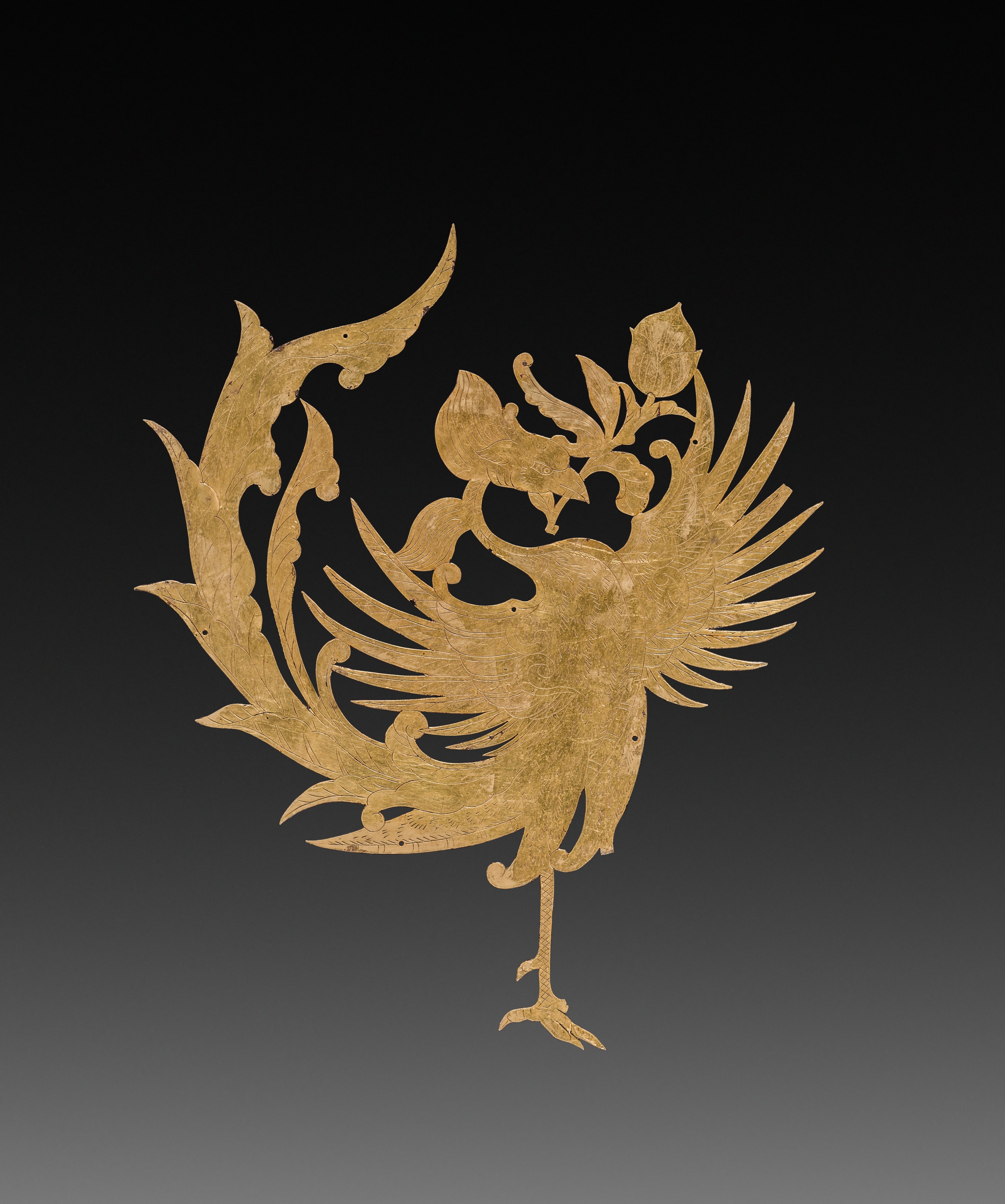
Deconstructing the Tang Dynasty Phoenix: An Avant-Garde Analysis of Beaten Gold and Chased Detail
At Zoey Fashion Lab, our mandate is to dismantle the historical artifact, stripping it of its conventional reverence to expose the raw, subversive potential within. The subject before us—a textile ornament of a Phoenix, originating from China’s Tang dynasty (618-907), crafted from beaten gold with chased detail—represents not merely a relic of imperial splendor, but a radical blueprint for avant-garde fashion. This analysis, framed by the Archive Resonance’s reference to “器物与绘画” (objects and paintings) as “无声见证” (silent witnesses) of cultural collision, will deconstruct the phoenix ornament through three lenses: material transgression, symbolic subversion, and temporal dislocation. We will argue that this Tang-dynasty piece, in its technical and iconographic essence, prefigures the avant-garde’s obsession with deconstruction, hybridity, and the reclamation of the ornamental as a site of resistance.
Material Transgression: Beaten Gold as a Challenge to Fabric Norms
The technical specification—beaten gold with chased detail—immediately positions this ornament as a material anomaly. Gold, by its nature, is a metal of permanence, weight, and value, antithetical to the ephemeral, pliable, and often disposable nature of textile. In the Tang dynasty, such a phoenix would have been affixed to a silk garment, creating a deliberate tension between the flowing, organic fabric and the rigid, metallic appliqué. This is not a harmonious integration; it is a material transgression. The beaten gold, hammered into thin, leaf-like sheets, mimics the softness of fabric while retaining its metallic hardness—a paradox that the avant-garde has long exploited.
In contemporary terms, this technique foreshadows the work of designers like Issey Miyake, who manipulated pleats to create rigid yet fluid forms, or Iris van Herpen, who uses 3D-printed metal to mimic organic textile structures. The chased detail—the intricate, hammered patterns that catch and refract light—introduces a tactile and visual disruption. Where fabric absorbs light, gold reflects it, creating a surface that demands attention, that refuses to recede into the background of the garment. For the avant-garde, this is a critical move: the ornament does not decorate; it interrupts. It challenges the viewer to reconsider the hierarchy of textile versus metal, soft versus hard, ephemeral versus eternal.
Furthermore, the process of beating gold is inherently destructive. The metal is repeatedly struck, thinned, and reshaped, a violent act that transforms a precious ingot into a fragile, almost paper-like form. This echoes the avant-garde’s fascination with deconstruction—the deliberate breaking down of materials to reveal their essence. The Tang artisan, through hammering, created a surface that is both resilient and vulnerable, a duality that resonates with the modern fashion designer’s exploration of wear, tear, and the passage of time. The ornament, then, is not a static symbol of perfection, but a record of its own making, a testament to the force required to bring it into being.
Symbolic Subversion: The Phoenix as a Queer and Post-Colonial Icon
The phoenix, in Tang dynasty iconography, is a symbol of empress, virtue, and cosmic harmony. Paired with the dragon (representing the emperor), it reinforced the patriarchal and hierarchical order of imperial China. Yet, the avant-garde eye sees the phoenix differently: as a creature of fire, rebirth, and gender ambiguity. The phoenix is both male and female, singular and collective, a being that transcends binary classification. In this light, the Tang ornament becomes a proto-queer artifact, a silent witness to the possibility of identities that defy rigid categorization.
The Archive Resonance’s reference to “文化碰撞” (cultural collision) between the 16th and 17th centuries—the era of global trade and missionary exchange—further complicates the phoenix’s meaning. During the Tang dynasty, China was a cosmopolitan empire, with the Silk Road facilitating a flow of goods, ideas, and aesthetics from Central Asia, Persia, and beyond. The phoenix, while indigenous to Chinese mythology, absorbed influences from the Persian Huma bird and the Indian Garuda. This hybridity is the very essence of the avant-garde: the refusal to remain pure, the embrace of cross-cultural contamination. The beaten gold ornament, then, is not a pristine symbol of Chinese identity, but a site of cultural negotiation, a testament to the fact that even imperial symbols are forged through encounter and exchange.
For a contemporary fashion label like Zoey, this phoenix can be recontextualized as a post-colonial emblem. It challenges the Western fashion system’s tendency to exoticize or orientalize non-European motifs. Instead of being a passive object of aesthetic consumption, the phoenix asserts its own agency: it is a creature of fire that burns through colonial narratives, demanding to be seen on its own terms. The ornament’s gold, a material associated with wealth and power, can be reclaimed as a symbol of resistance—a refusal to be commodified or flattened into a stereotype. The avant-garde designer might reimagine this phoenix not as a delicate appliqué, but as a bold, oversized armor piece, a statement of defiance against the erasure of non-Western histories.
Temporal Dislocation: The Ornament as a Time-Traveling Object
The phrase “Archive Resonance” suggests that objects from the past vibrate with meanings that only become audible in the present. The Tang phoenix ornament, when viewed through an avant-garde lens, is a time-traveling object. It exists simultaneously in the 7th century and the 21st, its beaten gold surface reflecting both the candlelight of a Tang palace and the LED glare of a modern runway. This temporal dislocation is a core strategy of the avant-garde: to rip an object from its historical context and force it to speak to contemporary concerns.
The chased detail—the intricate, repetitive hammering that creates patterns of feathers and flames—becomes a metaphor for the rhythm of history. Each strike of the hammer is a moment, a gesture, a breath. The ornament encodes time within its surface, much like a garment encodes the labor of its maker. For the avant-garde fashion designer, this invites a rethinking of the garment as a palimpsest—a surface upon which multiple histories are written and rewritten. The phoenix ornament, when detached from its original garment and reattached to a deconstructed, asymmetrical, or deliberately unfinished piece, creates a rupture in linear time. It insists that the past is not dead, but alive and active in the present.
Moreover, the phoenix’s association with rebirth aligns perfectly with the avant-garde’s cyclical destruction and renewal of fashion. Every season, designers burn down the old to make way for the new. The phoenix ornament, in its material and symbolic essence, embodies this process. It is born from fire (the beating and annealing of gold), dies (when removed from its original context), and is reborn (when reimagined in a new design). This cycle is not merely aesthetic; it is a political and philosophical stance. The avant-garde uses the phoenix to argue that fashion is not about novelty, but about transformation—the constant reworking of existing forms to create new meanings.
Conclusion: A Blueprint for Avant-Garde Practice
The Tang dynasty phoenix ornament, in its beaten gold and chased detail, is far more than a historical artifact. It is a manifesto in metal. It teaches the avant-garde designer that ornament is not decoration, but disruption. It demonstrates that materials can be transgressed, symbols can be subverted, and time can be dislocated. For Zoey Fashion Lab, this analysis serves as a call to action: to take the silent witness of the past and amplify its voice in the present. The phoenix, once a symbol of imperial harmony, becomes a symbol of creative insurrection. It is not a relic to be preserved, but a spark to be fanned into flame. In the hands of the avant-garde, the beaten gold phoenix rises again—not as a tribute to the Tang dynasty, but as a challenge to the very foundations of fashion itself.