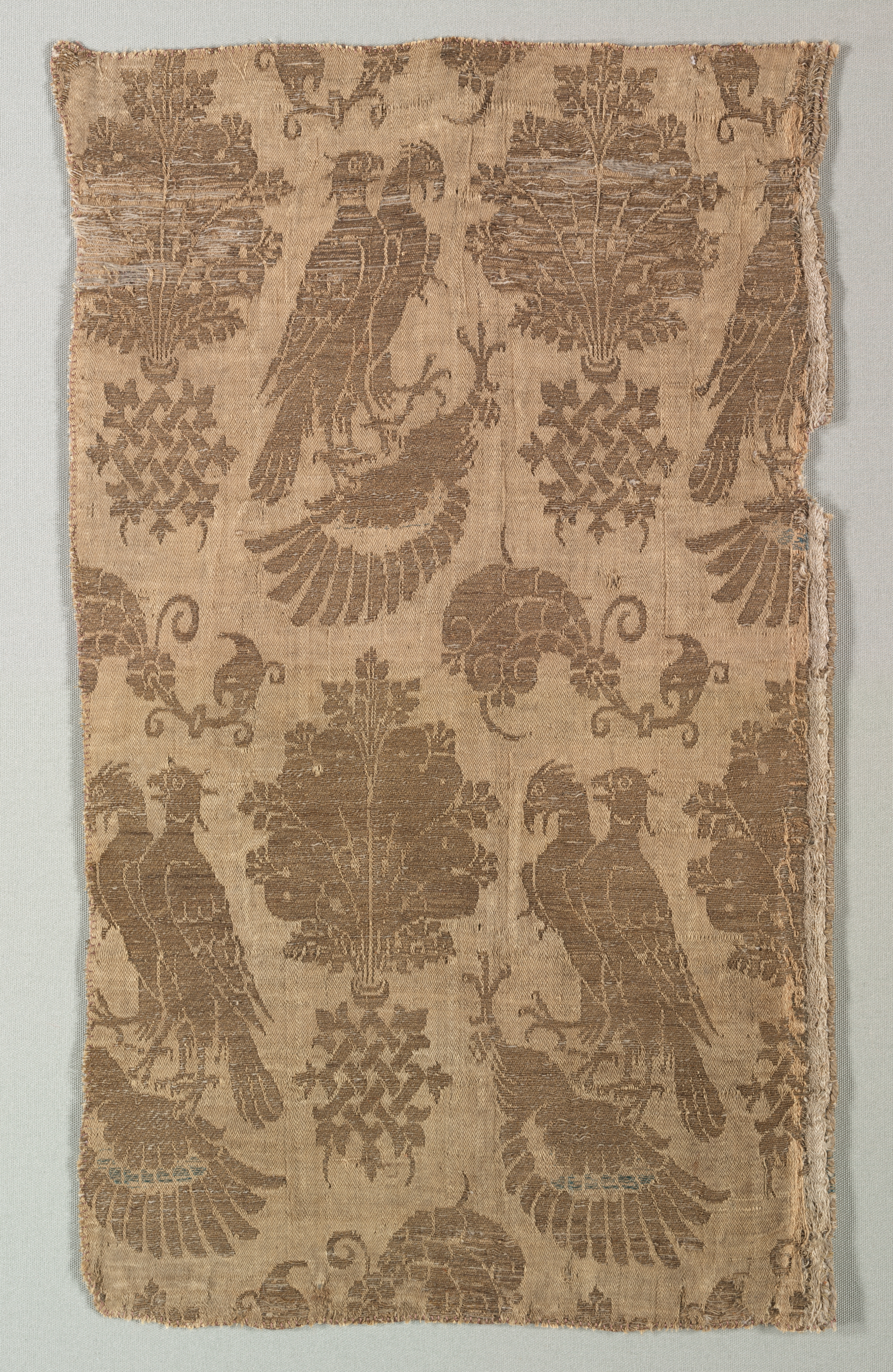
Deconstructing the Medieval Gaze: The Gold-Patterned Silk with Falcons and Heraldry
At Zoey Fashion Lab, we do not merely observe historical textiles; we interrogate them, dissecting their materiality to extract the latent narratives that pulse beneath their woven surfaces. Our latest subject is a fragment of extraordinary provenance: a gold-patterned silk featuring falcons and heraldic motifs, originating from Italy in the last third of the 14th century. This is not a relic to be preserved under glass. It is a living archive of power, predation, and transcendence—a document of a world where the sacred and the savage intertwined in the loom. Our analysis, guided by the poetic tension of the “Mirror with Split-Leaf” reference—where polished silver and cold stone become dual faces of a single truth—will reveal how this fabric embodies an avant-garde collision between opulent surface and profound narrative depth.
Technical Architecture: The Lampas Weave as a Dual Reality
The technical foundation of this textile is its lampas weave, a sophisticated structure that combines two distinct interlacing systems. In the 14th century, Italian weavers, particularly in Lucca and Venice, mastered this technique to create sumptuous, multi-layered fabrics. The lampas weave is not a single cloth; it is a dialogue between a ground weave and a pattern weave, often using a silk warp and a weft of gold thread. For Zoey Fashion Lab, this duality is the first point of deconstruction. The ground weave—typically a plain or twill structure—provides the tactile, matte foundation. The pattern weave, executed with gold thread, rises above it, creating a shimmering, raised design.
This technical stratification mirrors the conceptual split of the “Mirror with Split-Leaf.” The ground weave is the “cold stone slab”—the stable, silent, structural reality. The gold pattern is the “polished silver mirror”—the reflective, dazzling, and deceptive surface. The lampas weave thus becomes a material metaphor for the medieval worldview, where the earthly and the divine, the mortal and the eternal, coexisted in a constant, tensile relationship. The gold thread, often made from gilded silver or animal membrane wrapped around a silk core, was not merely decorative; it was a statement of cosmic order. It caught the candlelight in a dark hall, transforming the wearer into a living icon, a moving heraldic emblem.
Iconography of Power: Falcons, Heraldry, and the Hunt
The motifs on this silk are not arbitrary. The falcon, a bird of prey, is a potent symbol in 14th-century European culture. It represents nobility, martial prowess, and the unyielding pursuit of a goal. In the context of heraldry, the falcon often signified a family’s claim to sovereignty, their ability to strike from above, to dominate. The heraldic devices—likely stylized shields, crests, or geometric partitions—anchor the falcon within a specific lineage. This is not a generic bird; it is the totem of a house. The pattern repeats in a rigid, symmetrical grid, a hallmark of lampas weaving, where the pattern is bound by the constraints of the loom’s harness system.
Yet, within this rigidity, there is a dynamic tension. The falcon is depicted in mid-stoop, wings folded, talons extended—a frozen moment of violent grace. The heraldic shields are static, geometric, eternal. This juxtaposition creates a narrative of action versus permanence. The fabric becomes a battlefield where the living, predatory force of the falcon is trapped within the unyielding architecture of heraldic law. This is the avant-garde reading: the fabric does not simply celebrate power; it reveals its constraints. The gold thread, which should signify triumph, also highlights the paradox of the noble class—their freedom is an illusion, bound by the very symbols that define them.
Material Memory: Gold Thread as a Bridge Between Worlds
The gold thread in this textile is not a passive element. It is an active agent of memory. In the 14th century, gold thread was a luxury so extreme that it was often recycled from older textiles or even from melted-down coins. This particular silk, with its intricate gold patterning, would have been worn by a member of the highest aristocracy—perhaps a prince, a cardinal, or a military commander. The fabric would have been seen at tournaments, diplomatic receptions, and religious ceremonies. It would have absorbed the sweat of the hunt, the incense of the cathedral, the dust of the road.
For Zoey Fashion Lab, the gold thread is also a carrier of light and time. Under the microscope, the gold surface reveals micro-scratches, tarnishing, and wear. These are not flaws; they are the textile’s autobiography. The “polished silver mirror” of the original reference is now dimmed, pitted with age. The “cold stone slab” of the ground weave has softened, frayed. This degradation is not a loss but an accumulation. The fabric has become a palimpsest, where the original intention—to dazzle—is now layered with the reality of decay. This is the ultimate avant-garde gesture: the textile refuses to be static. It ages, it changes, it tells a new story with every passing century.
Avant-Garde Resonance: The Split-Leaf Mirror as a Design Philosophy
The reference to the “Mirror with Split-Leaf” provides a crucial interpretive lens. The mirror, with its polished silver face and its reverse side carved with split-leaf motifs, embodies a dualistic aesthetic. One side is pure reflection, surface, and light. The other is narrative, depth, and texture. Our gold-patterned silk operates in the same space. The front—the gold pattern—is the mirror, reflecting the glory of its owner. The reverse—the silk ground—is the stone slab, carrying the structural truth of the weave, the labor of the weaver, the mortality of the material.
In an avant-garde context, we can imagine this fabric as a garment that reveals its own construction. A coat cut from this silk might be lined with a contrasting, matte fabric, forcing the wearer to consider the inside as much as the outside. A dress might feature deliberate, jagged hems where the gold thread is left to fray, exposing the silk core. The heraldic patterns could be distorted, stretched, or fragmented, breaking the rigid symmetry. The falcon, once a symbol of control, could become a ghost—a trace of its former self, hovering in a field of decay.
This is the radical potential of the 14th-century textile for the 21st-century designer. It is not a source of nostalgia but a catalyst for deconstruction. By understanding the lampas weave, the iconography of power, and the material memory of gold, we can create garments that are not just clothes but philosophical statements. They speak of the tension between surface and substance, between the desire for immortality and the inevitability of decay. They are mirrors that reflect not only the wearer but the entire system of belief that produced them.
Conclusion: The Fabric as a Living Archive
The gold-patterned silk with falcons and heraldry is far more than a historical artifact. It is a living archive of medieval ambition, technical mastery, and existential contradiction. For Zoey Fashion Lab, it serves as a blueprint for an avant-garde practice that refuses to separate beauty from meaning. The lampas weave teaches us that luxury is a layered construct. The falcon and heraldry remind us that power is always performative. The gold thread whispers of a time when light was currency and fabric was a form of prayer.
In the final analysis, this textile is the perfect embodiment of the “Mirror with Split-Leaf” resonance: a shimmering surface that, when examined closely, reveals the cold, enduring truth of its own making. It is both a celebration and a critique, a monument and a ruin. At Zoey Fashion Lab, we will not preserve it. We will reanimate it, cut it, re-weave it, and force it to speak to our own age of digital surfaces and fragmented identities. The falcon will fly again, but this time, it will carry the weight of history on its gilded wings.