Deconstructing the Sacred: The Sutra Cover as a Blueprint for SS26 Avant-Garde Architecture
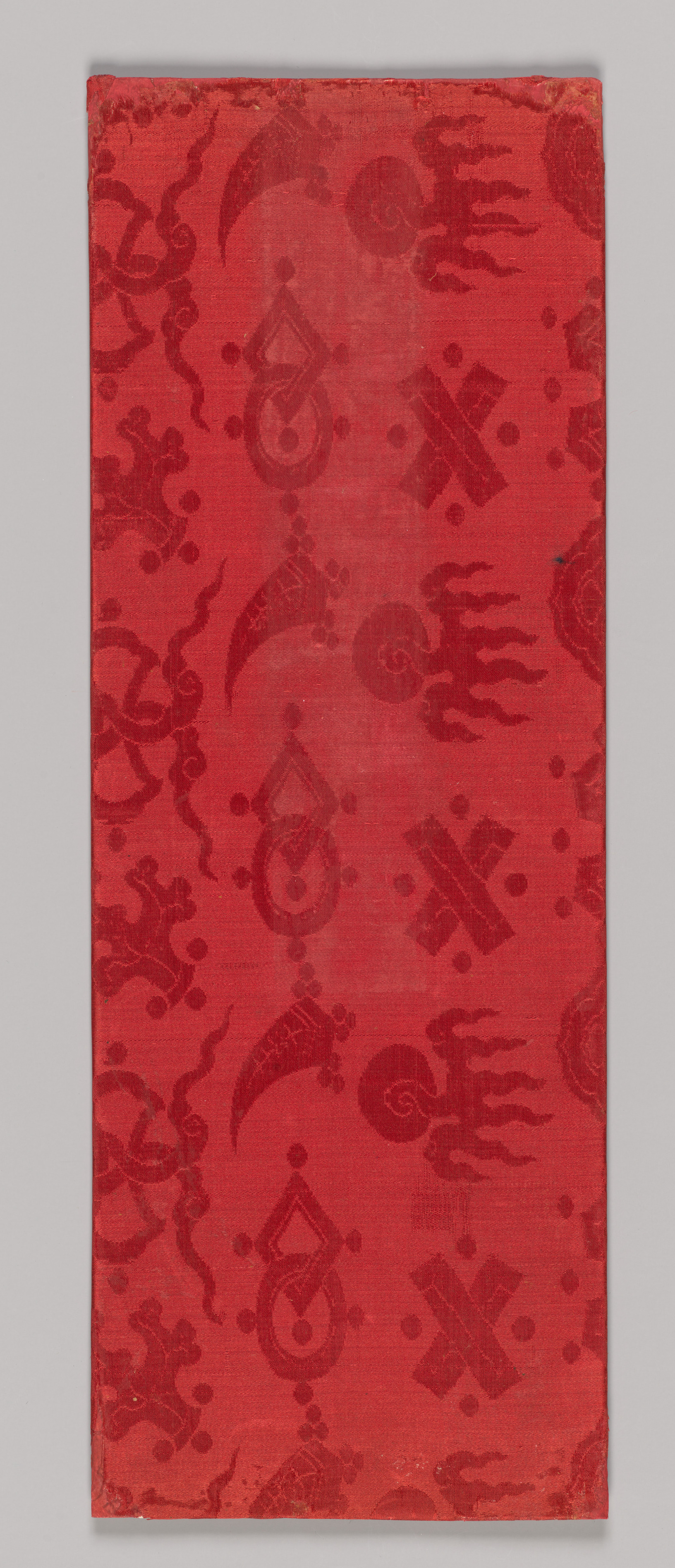
In the relentless pursuit of sartorial transcendence, the Zoey Fashion Laboratory dissects the intersection of the sacred and the speculative. The subject of this definitive analysis is the Sutra Cover with Auspicious Symbols, a textile artifact of profound cultural and structural significance from China, rendered in lustrous silk satin damask. This is not a mere historical relic; it is a generative matrix for the SS26 season, a blueprint for deconstructing the spiritual into the material. The Laboratory’s mandate is to extract from this cover a lexicon of futuristic silhouettes and structural innovations that defy conventional garment logic, transforming the sacred into a manifesto of radical form.
The Material Dialectic: Silk Satin Damask as a Structural Membrane
Silk satin damask is a paradox. On one hand, it embodies opulence, weight, and a luminous surface that captures light like a liquid mirror. On the other, its woven structure—a reversible pattern of warp and weft—offers a dualistic tension between rigidity and fluidity. For the avant-garde, this material becomes a structural membrane, not a passive drape. The satin’s sheen can be manipulated through asymmetric pleating and geometric folding, creating sharp, architectural planes that recall origami or folded metal. The damask’s reversible nature allows for a binary garment: one side presents the auspicious symbols in high relief, while the reverse offers a matte, abstracted pattern. This duality is central to the SS26 silhouette, where the garment becomes a transformative sculpture, shifting in perception as the wearer moves.
The auspicious symbols themselves—whether the endless knot, the lotus, or the conch—are not mere decoration. They are structural anchors. The Laboratory proposes to deconstruct these motifs into three-dimensional modules, extruding them from the fabric’s surface as tactile, wearable architecture. Imagine a shoulder silhouette where the endless knot is reimagined as a continuous loop of satin, forming a self-supporting collar that spirals around the neck without visible seams. The lotus becomes a layered, petal-like sleeve, each petal cut from the damask and heat-set to hold a permanent, futuristic curve. This is not embroidery; it is structural extrusion, where the symbol dictates the form.
Futuristic Silhouettes: The Sutra as a Second Skin and a Monument
The SS26 collection demands silhouettes that oscillate between the second skin and the monumental sculpture. The sutra cover, typically a flat, rectangular object, is reimagined as a modular bodysuit that begins as a tight, second-skin base in matte silk jersey, layered with floating panels of the damask. These panels are not sewn but magnetized or tensioned along the body’s kinetic lines—spine, shoulders, hips—allowing them to float and shift with movement. The auspicious symbols, when translated into laser-cut, high-relief appliqués, become exoskeletal armor that protects and reveals simultaneously. The silhouette is asymmetric by design: one arm sheathed in a full, sculpted sleeve of damask, the other bare, emphasizing the tension between the sacred and the exposed.
For the more dramatic statement, the sutra cover is scaled up into a cape or a train that functions as a wearable screen. The damask is stretched over a carbon-fiber frame that mimics the cover’s original rectangular form, but now it is suspended from the shoulders like a futuristic banner. The auspicious symbols are applied in phosphorescent silk thread, glowing faintly in low light, creating a luminous, spiritual aura. The silhouette is rigid and vertical, breaking the human form into a living icon. This is not about comfort; it is about presence—the wearer becomes a walking sutra, a vessel of encoded meaning.
Structural Innovation: From Flat Cover to 3D Garment Architecture
The core innovation for SS26 lies in the transformation of the flat cover into a three-dimensional garment system. The Laboratory rejects traditional pattern cutting; instead, we employ parametric design software to map the auspicious symbols onto a geodesic grid of the body. The damask is not cut but folded and pleated along these grid lines, creating honeycomb-like structures that provide inherent volume without padding. The satin’s natural stiffness, when combined with strategic heat-setting and resin bonding, allows for self-supporting peaks and valleys. The result is a garment that stands away from the body, creating negative space that is as important as the fabric itself.
Another breakthrough is the modular clasp system inspired by the sutra cover’s original binding. The cover was likely secured with a cloth tie or a jade button. The Laboratory reinterprets this as a magnetic, adjustable closure that allows the garment to be reconfigured in multiple ways. A single piece can be a shroud, a cape, or a sculpted top, depending on how the magnets are aligned. The auspicious symbols themselves become interlocking components: the endless knot motif is cast in lightweight, matte-black titanium and used as a functional hinge at the shoulder or hip. This is wearable engineering, where every decorative element has a structural purpose.
Deconstructive Aesthetics: The Sacred Unraveled
Deconstruction in the avant-garde is not about destruction; it is about revelation. The sutra cover’s sacred nature is honored by unraveling its materiality. The Laboratory proposes raw, frayed edges along the damask’s selvedges, exposing the silk threads as delicate, organic tendrils that contrast with the rigid, futuristic forms. The auspicious symbols are partially obscured by translucent layers of organza, suggesting that the spiritual is never fully visible, always partially veiled. The garment’s interior is as finished as the exterior, with the damask’s reverse pattern exposed in strategic areas—under the arm, along the spine—creating a hidden narrative for the initiated.
Asymmetry is pushed to its extreme: one side of the garment is heavily structured with the damask’s symbols in high relief, while the other is a minimalist, matte silk jersey that clings to the body. This dichotomy speaks to the duality of the sacred and the profane, the ancient and the futuristic. The color palette is monochromatic but textural: deep indigo, charcoal, and ivory, allowing the satin’s sheen and the symbols’ relief to create the visual drama. The final silhouette is a living paradox: rigid yet fluid, ancient yet extraterrestrial, sacred yet deconstructed.
Conclusion: The Sutra as a Manifesto for SS26
The Sutra Cover with Auspicious Symbols is not a costume piece; it is a philosophical and structural manifesto for the SS26 season. By deconstructing its flat form into a three-dimensional, modular system, the Zoey Fashion Laboratory redefines the garment as a wearable, interactive artifact. The silk satin damask becomes a medium for architectural exploration, the auspicious symbols become functional components, and the silhouette becomes a dialogue between the sacred and the speculative. This is not fashion as adornment; it is fashion as structural philosophy, a blueprint for a future where garments are not worn but inhabited. The Laboratory’s definitive analysis confirms: the sutra cover is the ultimate source code for avant-garde couture in the coming season.