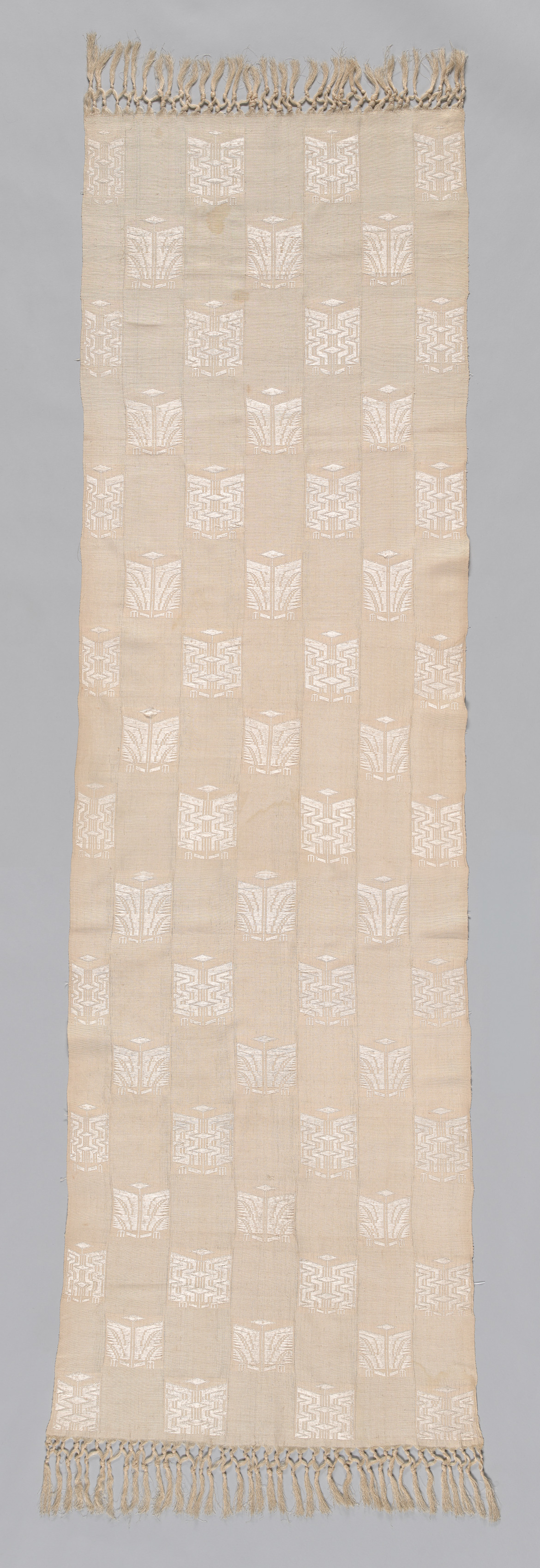
Deconstructing the Lamba Landy Fotsy: A Silk Paradox in the Avant-Garde Archive
At Zoey Fashion Lab, our practice of fabric deconstruction is not merely about unraveling threads; it is about excavating the layered narratives embedded within textile matrices. The subject of this analysis—one half of a pair of Lamba Landy Fotsy shawls from Madagascar—presents a profound paradox. It is a relic of 16th-17th century trade networks, yet its material composition and cultural resonance speak directly to the avant-garde’s obsession with hybridity, material subversion, and temporal collapse. This shawl is not a passive artifact; it is a deconstructionist manifesto woven in silk.
Material Anomalies: The Silk Duality
The technical specification of this shawl reveals a startling fusion: Bombyx mori (the domesticated mulberry silkworm) and Borocera cajani (the wild Madagascar silkworm, known locally as landibe). This is not a simple blend. It is a deliberate, strategic juxtaposition of two radically different silk ecologies.
Bombyx mori represents the pinnacle of controlled, industrialized sericulture. Its filament is uniform, lustrous, and infinitely fine—a silk of imperial command, imported into Madagascar via Indian Ocean trade routes. In contrast, Borocera cajani is a wild silk, harvested from cocoons spun in the forests of the highlands. Its fiber is coarse, irregular, and possesses a natural, earthy sheen that resists the perfect gloss of its domesticated cousin. The landibe silk is a material of resistance; it is unpredictable, textured, and deeply tied to the Malagasy landscape.
In the avant-garde context, this duality is explosive. The shawl becomes a material dialogue between the global and the local, the controlled and the wild. The weaver did not attempt to mask the difference. Instead, the two silks are interwoven in a pattern that accentuates their contrast—the smooth, reflective Bombyx forming the ground, while the rugged, matte Borocera creates the geometric motifs. This is not a flaw; it is a deliberate act of material deconstruction, a refusal to homogenize. The avant-garde designer would recognize this as a precursor to Rei Kawakubo’s frayed edges or Yohji Yamamoto’s deliberate asymmetry—a celebration of irregularity as a form of truth.
Structural Dissection: The Weave as Narrative
The Lamba Landy Fotsy is traditionally a ceremonial shawl, often associated with the Merina aristocracy. Its name, “Landy Fotsy,” translates to “white silk,” yet the shawl in our archive is not purely white. It features a subtle, almost ghostly grid of indigo and ochre stripes, achieved through a resist-dye technique before weaving. This is a structural paradox: the shawl’s visual identity is built on absence—the white spaces are the result of dye being withheld.
Deconstructing the weave reveals a twill structure that is unusually dense for a silk textile. This density is not decorative; it is functional. The shawl was designed to be draped, folded, and worn in layers, creating a sculptural volume that transforms the body into a moving architecture. The avant-garde eye sees this as a precursor to Issey Miyake’s pleats or Madame Grès’s bias-cut gowns—garments that are not sewn into shape but structured by the fabric’s own tensile memory.
Furthermore, the edges of the shawl are finished with a fringed warp, left intentionally unbound. This is a deconstructionist gesture: the fabric is allowed to fray, to reveal its own construction. In the archive, this fringe is not a sign of wear but a deliberate design choice—a statement that the garment is always in a state of becoming, never fully finished. This aligns with the avant-garde philosophy of unfinish, where the garment’s life begins at the point of its apparent dissolution.
Cultural Resonance: The Archive as a Temporal Collapse
The reference text from Archive Resonance speaks of “器物与绘画” (objects and paintings) as “无声见证” (silent witnesses) of cultural collision and aesthetic fusion. This shawl is precisely such a witness. Its existence is a testament to the 16th-17th century global trade that connected Madagascar to the Ottoman Empire, India, and Europe. The Bombyx mori silk was likely imported from China via Portuguese or Arab traders, while the Borocera cajani was harvested locally. The shawl is a hybrid object, born from the violent and beautiful entanglement of colonial commerce and indigenous craft.
For the avant-garde, this hybridity is not a compromise but a creative force. The shawl’s design—a grid of intersecting lines—echoes the lamba akotofahana (the “shawl with many corners”), a form that predates European contact. Yet the use of white silk and the specific geometric motifs suggest influence from Indian patola and Persian textiles. The shawl is a palimpsest, where each cultural layer is visible, yet none dominates. This is the essence of the avant-garde: the refusal to settle into a single identity, the embrace of multiplicity.
Avant-Garde Applications: From Archive to Runway
How does this analysis inform Zoey Fashion Lab’s practice? The Lamba Landy Fotsy offers three key principles for avant-garde design:
1. Material Subversion: The deliberate pairing of Bombyx mori and Borocera cajani challenges the hierarchy of silk. In our collections, we can replicate this by combining industrial textiles with hand-loomed, irregular fibers—creating a textural dissonance that forces the viewer to question what is “luxury.”
2. Structural Unfinish: The fringed edges and resist-dye voids remind us that a garment is not a closed system. We can design pieces that are intentionally incomplete, where the wearer’s body or the passage of time completes the work. This is a participatory deconstruction, where the garment is a co-author of its own narrative.
3. Temporal Collage: The shawl’s hybrid origins—16th-century trade, local weaving, global silk—suggest a non-linear approach to time. In our designs, we can layer motifs from different eras, mixing 17th-century Madagascar patterns with 21st-century digital prints. The result is a garment that exists in multiple temporalities at once, a wearable archive.
In conclusion, the Lamba Landy Fotsy is not a relic to be preserved in glass. It is a blueprint for radical design. At Zoey Fashion Lab, we do not simply study this shawl; we unweave it, analyze its tensions, and re-weave its principles into garments that challenge the boundaries of fashion. The shawl’s silence is not passive—it is a roar of material intelligence, waiting to be decoded.