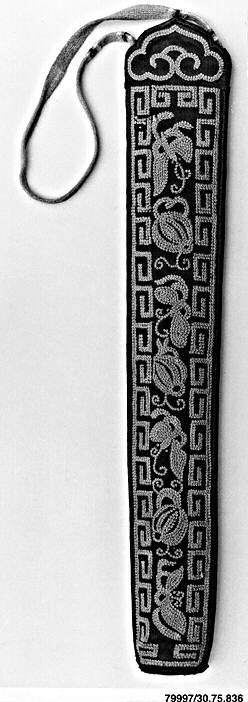
The Fan Holder: A Deconstructive Study in Silk as Structural Armature for SS26
The fan holder, an object of utilitarian grace in its native Chinese context, undergoes a radical ontological shift within the avant-garde laboratory of Zoey Fashion Laboratory for the SS26 season. No longer a mere accessory for thermal relief or performative gesture, the fan holder is reimagined as a primary structural node—a point of tension, release, and architectural articulation. This analysis dissects the fan holder as a standalone artifact of sartorial engineering, exploring how its silk composition, when liberated from its conventional role, becomes the medium for a futuristic silhouette that challenges the very boundaries of garment construction and wearability.
Deconstructing the Object: From Function to Form
The traditional Chinese fan holder, often crafted from silk, bamboo, or precious metals, is designed to cradle the folded fan, protecting its delicate leaves. In the Zoey Fashion Laboratory context, this protective shell is inverted. The holder becomes a dynamic exoskeleton, a series of articulated panels that wrap, suspend, and frame the body. The silk, typically associated with fluidity and drape, is manipulated through structural quilting, laser-cut perforations, and thermoplastic bonding. This transforms the material into a semi-rigid membrane, capable of holding its own shape while remaining lightweight enough to allow for kinetic movement. The fan holder’s original purpose—to contain—is subverted; it now contains the body, not as a cage, but as a generative scaffold for new proportions.
Futuristic Silhouettes: The Architecture of Suspension and Asymmetry
The SS26 silhouette, driven by the fan holder concept, rejects symmetrical tailoring in favor of a dynamic, off-balance geometry. Imagine a single, oversized fan holder structure, constructed from multiple layers of bonded silk, that arcs from the left shoulder, wrapping around the torso, and terminating in a sharp, cantilevered point at the right hip. This is not a garment in the traditional sense; it is a wearable architectural model. The fan holder’s original folding logic is translated into living hinges—pleats and folds that allow the silk to collapse and expand with the wearer’s breath. The silhouette is simultaneously armored and ethereal, a paradox of rigid geometry and soft materiality.
Further exploration yields a deconstructed fan holder corset. Instead of a continuous fabric, the corset is composed of discrete, fan-shaped silk panels, each connected by magnetic clasps or articulated metal joints. These panels can be adjusted to create varying degrees of volume and tension, allowing the wearer to reconfigure the silhouette from a narrow, sculpted form to a sprawling, asymmetrical wing. The fan holder’s original axial pivot point is recontextualized as a rotational joint at the waist, enabling the lower half of the garment to swing and twist independently of the upper body. The result is a silhouette that is perpetually in flux, a kinetic sculpture that responds to the wearer’s movement.
Material Alchemy: Silk as Structural Skin
The selection of silk for this structural innovation is not arbitrary. Silk’s inherent tensile strength, when combined with resin-infused layers or heat-set pleating, allows it to function as a self-supporting membrane. The fan holder’s silk is treated with a matte, ceramic-like finish, achieved through a proprietary coating process that mimics the texture of glazed porcelain. This finish creates a visual tension between the organic origins of the silk and the futuristic, almost industrial aesthetic of the garment. The material becomes a hybrid entity: part textile, part architectural surface.
In one iteration, the fan holder is deconstructed into a series of unfolded silk ribbons, each embedded with micro-fiber optic threads. These ribbons are arranged in a radial pattern around the neck, mimicking the opening of a fan. The fiber optics pulse with a soft, ambient light, controlled by a wearable micro-controller embedded in the holder’s base. This transforms the garment into a responsive interface, where light and shadow become integral to the silhouette. The silk, once a passive material, becomes an active participant in the narrative of the garment.
Structural Innovation: The Fan Holder as Wearable Mechanism
The fan holder’s structural innovation lies in its modularity. The core component is a central hub, a 3D-printed biopolymer ring that mimics the traditional fan holder’s pivot. From this hub, multiple silk arms extend, each terminating in a magnetic connector. These arms can be attached to various points on a base garment—a sheer silk bodysuit, for example—or can be worn independently as a standalone harness. The arms are pre-stressed with internal shape-memory alloys, allowing them to snap into predetermined positions when released. This creates a self-erecting structure, a garment that assembles itself upon activation.
The fan holder’s folding logic is also applied to the garment’s compressibility. At the end of its wear, the entire structure can be collapsed into a compact, disc-like form, no larger than the original fan holder. This transformative capability challenges the notion of permanence in fashion. The garment is not a fixed object but a temporary architectural intervention, as ephemeral as the act of opening a fan. The wearer becomes a mobile curator, activating and deactivating the structure at will.
Contextualizing the Avant-Garde: A Dialogue with Tradition and Future
This analysis situates the fan holder within a lineage of deconstructive fashion, from Rei Kawakubo’s sculptural forms to Iris van Herpen’s 3D-printed exoskeletons. However, the Zoey Fashion Laboratory approach diverges by foregrounding the object’s cultural DNA. The fan holder is not merely a formal inspiration; it is a conceptual anchor that grounds the futuristic silhouette in a specific material and historical tradition. The silk, sourced from Suzhou, carries with it centuries of weaving expertise. The fan holder’s geometry, inspired by the folding of a Chinese fan, references a language of gesture and ritual.
The SS26 collection does not aim to replicate the fan holder; it transubstantiates it. The garment becomes a critical commentary on the relationship between protection and exposure, containment and liberation. The fan holder, originally a tool for preserving a delicate object, is now a tool for preserving the wearer’s agency over their own silhouette. It is a prosthetic for self-definition, a mechanism for constructing identity in a fragmented, post-digital world. The fan holder, in this context, is no longer an accessory. It is the genesis of a new sartorial language—one where silk becomes steel, and the fan becomes a fortress of the self.