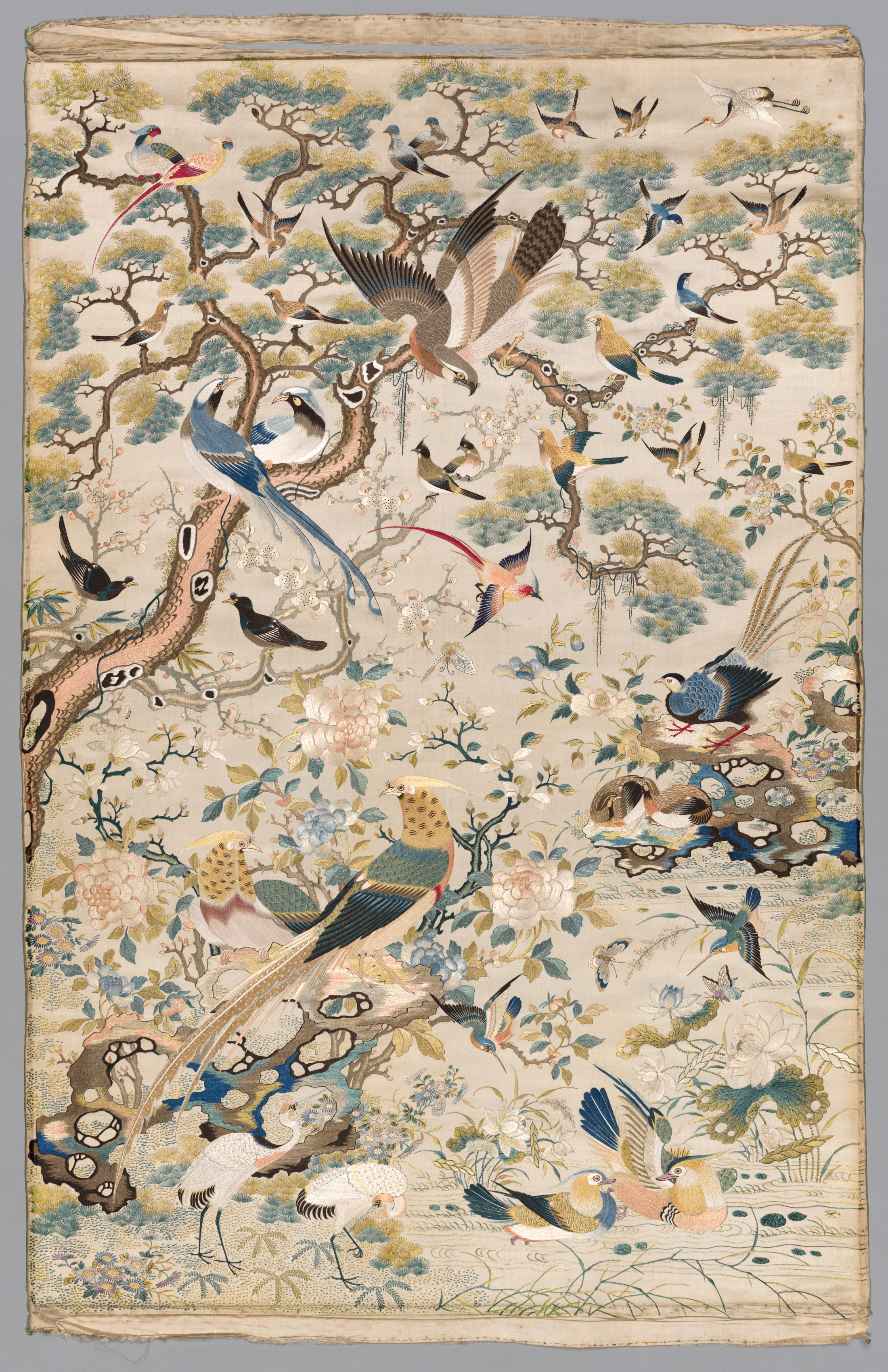
Technical Deconstruction & Historical Reference: The Qing Dynasty Satin Embroidered Panel
The provided artifact, a Qing dynasty polychrome silk embroidery on a satin weave ground, serves as our primary genomic sequence. Our task is not to replicate its phenotype but to isolate its core nucleotides—the fundamental codes of its construction and meaning—and recombine them into an avant-garde expression. The satin weave base is our first data point. This technique, perfected in China, produces a surface of unparalleled luminosity, a canvas of captured light. It is not merely fabric; it is a prepared field of potential energy. Upon this, the polychrome silk embroidery operates as a complex, multi-threaded program. Each stitch is a vector of color and direction, building forms through sheer accumulation of tactile code. The subject—a myriad of birds—is not a simple pastoral scene. In Qing iconography, especially in the context of courtly or luxurious textiles, it symbolizes harmony, prosperity, and a meticulously ordered natural world. Each bird species likely carried specific auspicious connotations, creating a dense semantic network within the visual splendor.
Core Genetic Isolates for the New DNA Strand
From this historical genome, we extract the following active sequences for our laboratory synthesis:
1. The Luminosity Code (Satin Weave Principle): The core takeaway is the engineering of light interaction. The satin weave’s long floats create a specular surface. In avant-garde translation, this becomes a directive to prioritize surface behavior over static pattern. We are coding for fabrics that change, reflect, absorb, or emit light as a primary characteristic.
2. The Tactile Data Cloud (Embroidery Principle): Embroidery is additive construction. It builds texture and image through cumulative, non-woven means. Our interpretation moves from pictorial representation to topographic mapping. Stitches become data points in a three-dimensional matrix, creating landscapes on the body that are meant to be read by touch as much as by sight.
3. The Myriad as System (Avian Subject Principle): The "myriad" is key. It is not a single bird but an ecosystem, a chaotic yet balanced flock. This translates to a design philosophy of modularity, individuality within uniformity, and swarm intelligence. The unit (a single bird, a single motif) is simple, but its infinite repetition and variation create overwhelming, intelligent complexity.
Proposed Avant-Garde Synthesis: The Aviary Exoskeleton
Collection Title: Swarm Logic
1. Structural Manifestation: The Luminous Field
Replace the traditional satin silk with advanced polymer-based textiles engineered for photonic control. Imagine a base fabric of thermochromic satin that shifts hue with body temperature, revealing the wearer’s thermal map—a personal, living climate. Alternatively, use a micro-prismatic laminate on a technical satin, creating garments that fracture ambient light into spectral patterns that move with every gesture. The luminosity is no longer passive; it is reactive and performative, making the garment an interface with its environment.
2. Textural Manifestation: The Embodied Data Cloud
The polychrome embroidery is deconstructed into a language of pure texture and dimensional coding. Using ultrasonic welding, 3D printing, and programmable looms, we build up surfaces not with silk threads, but with fused polymers, silicone capillaries, and conductive yarns.
• Topographic Embroidery: Stitch paths are dictated by biometric data or urban mapping data, creating raised, textural ridges on the garment that correspond to non-visual information streams—a city's traffic flow or a heartbeat rhythm rendered in tactile relief.
• The "Feather" as Module: Instead of embroidering bird forms, we create millions of individual, laser-cut feather scales from recycled polyester film and upcycled silk off-cuts. These are attached using a proprietary, flexible algorithm—denser at stress points on the garment, sparse at the periphery—creating a garment that mimics avian plumage in its structure: lightweight, protective, and dynamically fluid. Each scale is a pixel in a larger, moving image.
3. Conceptual & Aesthetic Manifestation: The Swarm Silhouette
The "myriad of birds" inspires the silhouette and movement philosophy. Garments are constructed from interlocking, modular components.
• Flocking Behavior Draping: Imagine a coat comprised of hundreds of individual, feather-inspired tiles connected by magnetic joints or elastic threads. As the wearer moves, the tiles shift, overlap, and separate, creating a kinetic surface that breathes and flows like a flock in flight. The silhouette is never static; it is a moment in a continuous process of reconfiguration.
• The Auspicious Code as Print: The specific auspicious meanings of the Qing birds are translated into a contemporary symbolic language. Using generative AI algorithms, we feed the historical meanings (prosperity, longevity, harmony) and visual forms of the birds into a digital crucible. The output is not a picture of a bird, but a complex, abstract pattern—a "cryptographic auspicious print"—that encodes the old meanings in a new, non-literal visual syntax, printed onto our reactive luminous fields.
4. The Complete Organism: Wearable Ecosystem
The final pieces in the Swarm Logic collection are not merely garments; they are wearable ecosystems. A dress may feature a luminous, thermochromic base layer (the engineered satin field). Upon it, a topographic embroidery of a sonar map of a coral reef is rendered in clear silicone (the tactile data cloud). Over this, a detachable jacket of magnetic, iridescent "feather" tiles completes the system, allowing the wearer to engage with their environment through dynamic shape-shifting. The myriad is realized as a layered, interactive system of light, information, and form.
Conclusion: From Museum Artifact to Living System
The Qing dynasty embroidery provides the ancient, elegant source code. Our avant-garde mandate is to compile this code on a modern machine. We move from representation to simulation—from depicting a flock of birds to creating a garment that behaves with the principles of a flock. We transmute passive symbolism into active interaction, static beauty into dynamic process, and historical craft into speculative bio-tech. The result honors the original’s complexity and ambition while forging a completely new DNA strand for Zoey Fashion Lab: one where clothing is a luminous, intelligent, and responsive second skin, forever in flux.