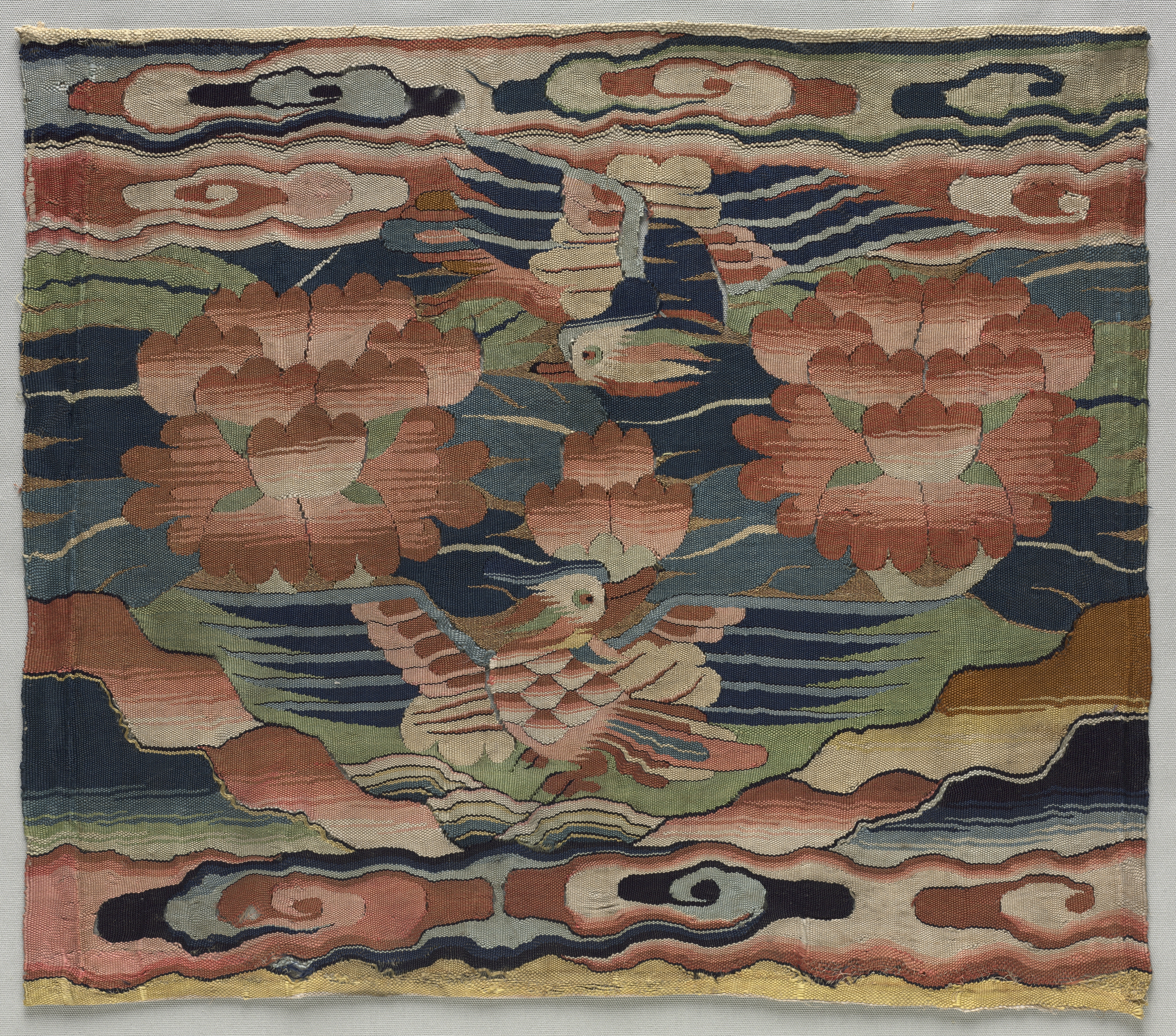
Deconstructing the Buzi: Ming Dynasty Rank Badge as Avant-Garde Textile
At Zoey Fashion Lab, our mission is to excavate historical artifacts and reimagine their structural, symbolic, and tactile languages for the contemporary avant-garde. The subject of this analysis—a Ming dynasty (1368–1644) rank badge (buzi)—is not merely a relic of imperial bureaucracy. It is a complex, woven document of power, nature, and technical mastery. Executed in silk slit tapestry weave (kesi), this badge embodies a paradox: it is both a rigid symbol of hierarchical order and a fluid, almost painterly expression of natural forms. Our deconstruction will dissect its technical DNA, symbolic architecture, and cultural resonance, proposing how this 16th–17th century artifact can inform a radical, avant-garde fashion vocabulary.
Technical Analysis: The Kesi Matrix
The kesi technique—literally “cut silk”—is the foundation of this badge’s visual and tactile identity. Unlike standard tapestry weaves, kesi employs discontinuous weft threads that are individually woven into the warp, creating sharp, color-blocked motifs without any continuous weft across the entire width. This results in a slit tapestry effect, where small vertical gaps (the “cuts”) delineate each color area. For the avant-garde designer, this technique offers a radical lesson in modular construction: the badge is not a single, uniform fabric but a mosaic of independent woven cells.
From a deconstructivist perspective, the kesi structure prefigures the work of designers like Rei Kawakubo or Martin Margiela, who celebrate exposed seams, deliberate gaps, and fragmented forms. The slits in kesi are not flaws; they are intentional articulations that allow the fabric to breathe and move, creating a dynamic interplay between positive and negative space. In a modern context, we could reinterpret these slits as strategic cutouts in a garment, revealing the body or an underlying layer. The warp threads, left visible in the slits, become a grid—a structural skeleton that challenges the surface narrative of the embroidered or woven image.
Furthermore, the silk itself is a material of dual identity: it is both luxurious and fragile, luminous and susceptible to decay. This tension between permanence and ephemerality is a core tenet of avant-garde fashion. A garment inspired by the buzi might use raw silk edges, deliberately frayed or left unfinished, to echo the kesi technique’s inherent vulnerability. The slit tapestry method also produces a reversible fabric—though the front is the primary image, the back reveals a ghostly, inverted map of the design. This duality invites exploration of inside-out construction, where the hidden logic of the weave becomes the visible aesthetic.
Symbolic Architecture: The Rank Badge as Visual Code
The Ming dynasty rank badge was a heraldic system encoded in textile. Civil officials wore badges depicting birds (e.g., cranes for first rank), while military officials wore mythical beasts (e.g., lions, qilin). The badge under analysis, likely featuring a crane or similar avian motif against a celestial backdrop of clouds, waves, and auspicious symbols, is a hieroglyph of status. For the avant-garde, this symbolic density offers a template for narrative fashion—garments that communicate complex social or personal codes through imagery.
However, our deconstruction must challenge the badge’s original function as a tool of imperial control. In the avant-garde context, we can subvert its authoritarian grammar. Instead of signifying rank, the motifs can be repurposed to signify disruption, identity, or resistance. For instance, the crane—a symbol of longevity and purity—could be fragmented, distorted, or juxtaposed with industrial elements like metal grommets or synthetic mesh. The waves and clouds, traditionally representing the cosmic order, could be rendered in asymmetrical, chaotic patterns that suggest entropy rather than harmony.
The badge’s square or rectangular format itself is a constraint—a frame that contains the imagery. Avant-garde fashion often thrives on breaking frames. A garment could incorporate multiple buzi-like patches, arranged in a non-hierarchical, collage-like manner, or the badge’s border could be deliberately distorted, stretched, or torn. The symmetry typical of Ming badges can be replaced with asymmetrical compositions that reflect the fragmented nature of contemporary identity.
Cultural Resonance: Archive Resonance and the Avant-Garde
As stated in the Archive Resonance reference, “在人类文明的长河中,器物与绘画不仅是时代技艺的结晶,更是文化碰撞与美学交融的无声见证。十六至十七世纪....” (In the long river of human civilization, artifacts and paintings are not only the crystallization of the skills of their times, but also silent witnesses to cultural collisions and aesthetic fusions. The 16th to 17th centuries...). This period, spanning the late Ming dynasty and the early global trade networks, was a time of intense cultural exchange. Silk, porcelain, and textiles traveled along the Maritime Silk Road, influencing European design (e.g., chinoiserie) while absorbing motifs from Central Asia and beyond.
For Zoey Fashion Lab, this cultural collision is the most fertile ground for avant-garde innovation. The buzi is not a static Chinese artifact; it is a hybrid object that already contains traces of foreign influence—such as the use of Persian-inspired cloud bands or Buddhist lotus motifs. By acknowledging this hybridity, we can design garments that decolonize the narrative of the buzi, presenting it not as a monolithic symbol of Chinese tradition but as a node in a global network of aesthetic exchange.
An avant-garde collection inspired by this badge might combine the kesi technique with digital fabrication, such as laser-cut slits that mimic the tapestry’s gaps, or 3D-printed “badges” that reinterpret the crane in a robotic, post-human form. The color palette—typically vibrant blues, greens, golds, and reds—can be de-saturated or inverted, using neons or metallics to create a jarring, futuristic effect. The scale of the badge can be exaggerated: a single, oversized buzi covering an entire coat, or micro-badges scattered like cryptic code across a garment.
Conclusion: From Imperial Badge to Avant-Grade Manifesto
The Ming dynasty rank badge, in its silk slit tapestry weave (kesi), is a masterpiece of technical precision and symbolic sophistication. Yet for Zoey Fashion Lab, its true value lies in its deconstructive potential. By dissecting its weave, subverting its symbols, and recontextualizing its cultural history, we can transform this imperial artifact into a radical statement for the 21st century.
The avant-garde fashion designer is not a curator of the past but a saboteur of fixed meanings. The buzi becomes a tool to question hierarchy, celebrate hybridity, and expose the raw, structural beauty of textile construction. In the hands of Zoey Fashion Lab, the rank badge is no longer a marker of status—it is a manifesto of disruption, woven in silk and cut with intention. The slits in the fabric are not gaps; they are portals through which a new, boundaryless fashion can emerge.