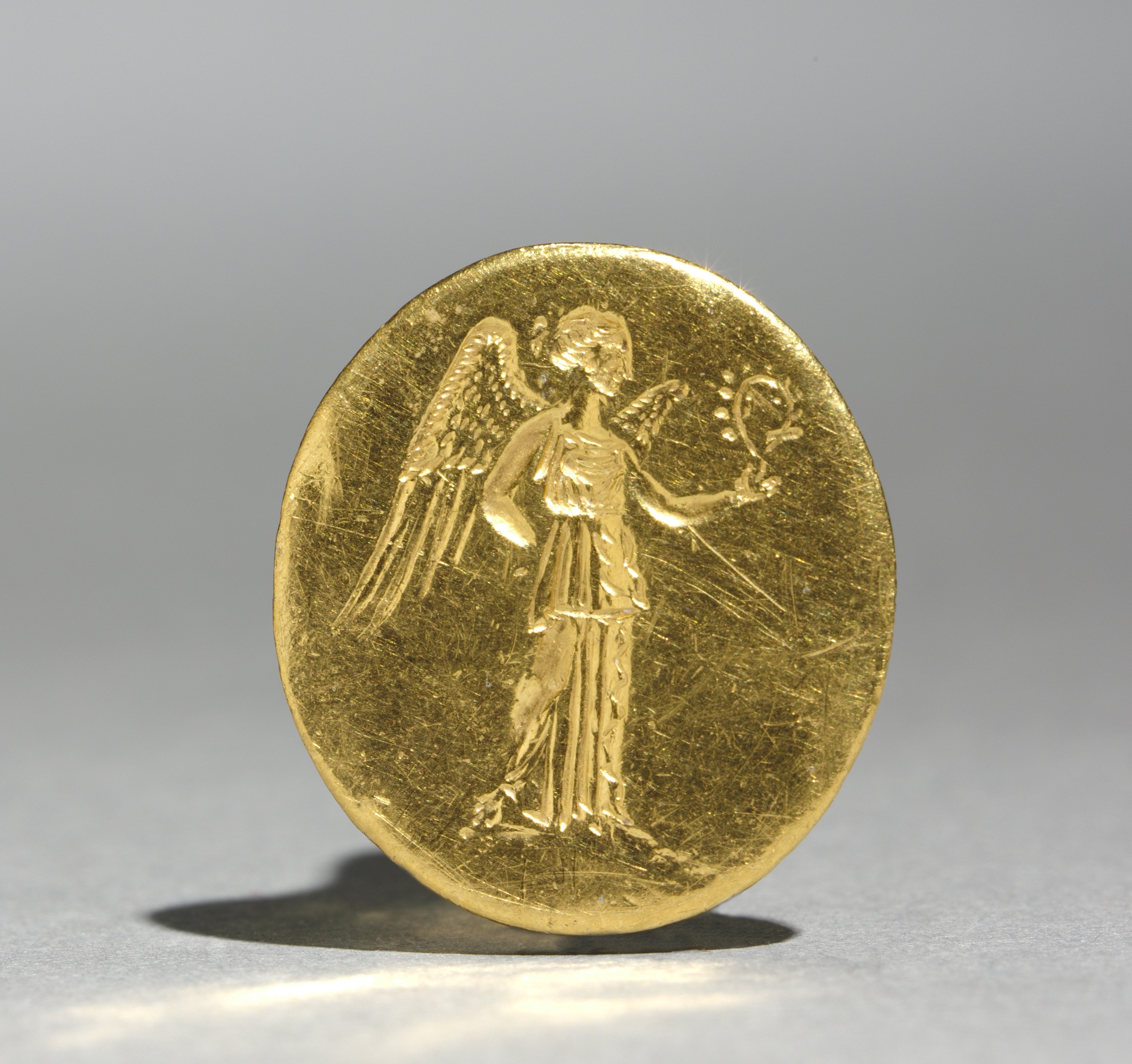
Deconstruction of the Finger Ring with Figure of Nike: An Avant-Garde Analysis for Zoey Fashion Lab
At Zoey Fashion Lab, the act of deconstruction is not merely an analytical process—it is a ritual of unmaking, a deliberate fragmentation of historical artifacts to reveal the latent energies that pulse beneath their surfaces. The subject of this analysis, a gold finger ring from ancient Greece featuring the winged figure of Nike, presents a profound opportunity to explore the tension between victory and mortality, ornament and narrative. Set against the archival resonance of the Mirror with Split-Leaf dichotomy—where one side gleams with gold-encrusted palmettes on a silver mirror, and the other bears the cold, carved relief of a sarcophagus—this ring becomes a microcosm of avant-garde fashion’s obsession with paradox. In the following deconstruction, we will dissect the ring’s material, iconography, and cultural memory, weaving them into a speculative framework for Zoey Fashion Lab’s next collection.
Materiality: Gold as a Dual Agent of Light and Weight
The ring’s primary material, gold, is a substance that has historically signified both eternal glory and temporal wealth. In ancient Greece, gold was reserved for the gods and the elite, its unblemished surface reflecting the divine radiance of Olympus. Yet, for the avant-garde designer, gold is not a static symbol; it is a material that carries the weight of its own history. The ring’s gold band, likely hammered or cast, retains the tactile memory of the artisan’s hand—a trace of human labor that contradicts the ideal of divine perfection. This duality aligns with the Mirror with Split-Leaf reference: the “gold-encrusted palmettes” on the mirror’s silver surface represent a surface-level opulence, while the “cold stone sarcophagus” on the reverse speaks to the heavy, grounded reality of death. For Zoey Fashion Lab, this ring suggests a material strategy where gold is not polished to a mirror finish but left with subtle imperfections—scratches, uneven patinas, or intentional oxidations—to evoke the passage of time. The ring’s weight, too, becomes a design element: a piece that feels substantial on the finger, reminding the wearer of the burden of victory, the cost of triumph.
Iconography: Nike as a Figure of Fleeting Movement
The figure of Nike, the Greek goddess of victory, is typically depicted in flight, her wings spread and garments billowing, capturing a moment of dynamic cessation. On a finger ring, however, this figure is compressed into a small, wearable space. The artisan must have reduced Nike’s form to essential lines—perhaps a simplified silhouette or a low-relief carving that suggests motion without fully rendering it. This compression is a key avant-garde technique: the reduction of a grand narrative into a single, potent gesture. For Zoey Fashion Lab, Nike’s presence on the ring can be interpreted not as a celebration of victory but as a meditation on its transience. The goddess is frozen in gold, her wings no longer beating but transformed into a static ornament. This recalls the Mirror with Split-Leaf’s “life narrative told in relief on a cold stone slab”—a story that is both present and petrified. The ring thus becomes a wearable memento mori, a reminder that every victory is a pause before the next struggle. In an avant-garde collection, this iconography might be distorted: Nike’s wings could be elongated into skeletal forms, or her figure could be fragmented, with only a wing or a foot remaining, suggesting a victory that is incomplete or lost.
Cultural Memory: The Ring as a Portable Archive
Finger rings in ancient Greece were often used as seals, signets, or talismans, carrying the weight of personal and political identity. A ring with Nike would have been a statement of ambition—a declaration of the wearer’s desire for success in battle, competition, or life. Yet, as an archaeological artifact, this ring has survived the collapse of the civilization that created it. It now exists in a museum or private collection, its original context erased, its meaning open to reinterpretation. This displacement is central to Zoey Fashion Lab’s avant-garde ethos. The ring is no longer a functional object but a fragment of a lost world, a piece of “archive resonance” that speaks to the fragility of cultural memory. The Mirror with Split-Leaf reference reinforces this: the mirror’s “one side” and “other side” represent a binary that the ring collapses. The ring is both the mirror’s gleaming surface and the sarcophagus’s relief, simultaneously a reflection of glory and a tombstone of history. For a fashion lab, this suggests a collection that treats garments as archives—pieces that carry the stains, tears, and repairs of their imagined pasts, inviting the wearer to become a curator of their own narrative.
Scale and Wearability: The Micro-Narrative of the Finger
The finger ring is an intimate object, worn on a part of the body that is constantly in motion—gesturing, pointing, touching. In avant-garde fashion, scale is often manipulated to challenge expectations. A ring of this nature, with its miniature Nike, forces the viewer to lean in, to examine closely, to engage in a private act of looking. This intimacy contrasts with the monumental scale of the Mirror with Split-Leaf’s sarcophagus, which demands a different kind of attention. Zoey Fashion Lab can exploit this tension by designing pieces that play with scale: oversized rings that dwarf the finger, or multiple rings stacked to create a fragmented narrative. The Nike ring, when worn, becomes a secret talisman—a victory that only the wearer knows. Its gold surface catches light as the hand moves, creating fleeting reflections that echo the goddess’s flight. In a collection, this could be translated into garments with hidden pockets, reversible fabrics, or detachable elements that reveal layers of meaning only when the wearer chooses to disclose them.
Avant-Garde Synthesis: The Ring as a Threshold Object
Ultimately, the Finger Ring with Figure of Nike is a threshold object, existing at the boundary between the sacred and the profane, the eternal and the ephemeral. For Zoey Fashion Lab, this ring is not a model to be copied but a catalyst for new forms of expression. The Mirror with Split-Leaf resonance—the clash between gleaming surface and carved depth—can be reimagined in fabric: a silk charmeuse that shines on one side and is matte on the other, or a leather garment embossed with relief patterns that tell a story of decay and rebirth. The ring’s gold can be echoed in metallic threads, gilded hardware, or foil-stamped prints that wear away over time, revealing a darker layer beneath. Nike’s wings can become structural elements in a jacket’s shoulders, or they can be deconstructed into separate, detachable brooches that the wearer can arrange at will. The ring’s ancient origin is not a constraint but a springboard—a reminder that fashion, like victory, is a fleeting moment of grace that must be seized and transformed.
In conclusion, Zoey Fashion Lab’s deconstruction of this Greek gold ring reveals a rich tapestry of contradictions: light and weight, motion and stasis, glory and mortality. By embracing the Mirror with Split-Leaf’s dual perspective, we can design a collection that honors the artifact’s past while propelling it into an avant-garde future. The ring is not a relic; it is a resonance, a vibration that continues to shape how we adorn the body with meaning.