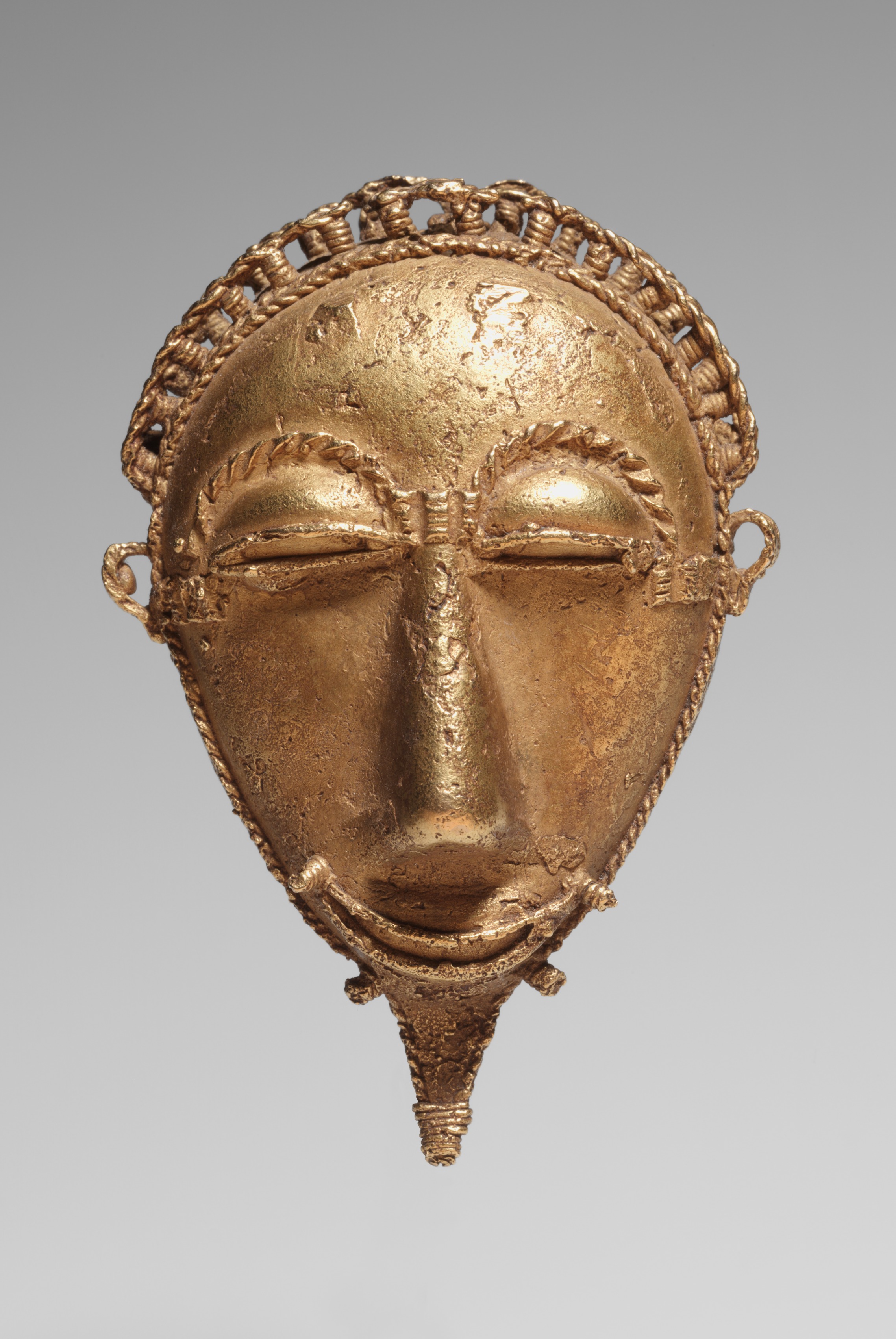
Deconstructing the Face: An Avant-Garde Analysis of the Baule-Inspired Gold Pendant
At Zoey Fashion Lab, our mandate is to interrogate the object, stripping it of its conventional context to reveal the raw, resonant core of its design language. The subject of this analysis—a gold pendant from West Africa, specifically Côte d'Ivoire, rendered in a style possibly attributed to the Baule goldsmith tradition—presents a profound challenge and opportunity. This is not merely an ornament; it is a condensed narrative, a technological marvel, and a philosophical statement. The archive resonance, referencing a "Mirror with Split-Leaf" duality, provides the perfect lens for our deconstruction. We will dissect this piece through its material, its technical execution, its cultural symbolism, and its potential for avant-garde reinvention within Zoey Fashion Lab’s aesthetic framework.
Material as Metaphor: The Alchemy of Gold
The primary material, gold, is the first and most obvious point of entry. In the Baule context, gold (ka) is not simply a precious metal; it is a substance imbued with spiritual and social potency. It represents the sun, life force, and the unbroken lineage of ancestors. The Baule, renowned for their refined goldwork, used the cire perdue (lost-wax) technique to create objects of extraordinary intricacy. For our avant-garde analysis, we must reframe gold not as a symbol of wealth, but as a medium of light and memory. The pendant’s surface is not static; it captures and refracts light, creating a dynamic interplay of shadow and brilliance. This aligns perfectly with the archive’s "silver mirror" reference—the gold functions as a mirror, reflecting not just the wearer’s physical form, but their ancestral and spiritual identity.
However, the pendant’s "Face" is not a literal portrait. It is a geometric abstraction of human features, often characterized by elongated forms, prominent foreheads, and stylized facial markings. This abstraction is a deliberate choice. The Baule goldsmith does not aim for naturalism; they aim for essence. The face becomes a symbol of the blolo bian or blolo bla—the spirit spouse from the other world, a concept central to Baule cosmology. This pendant, therefore, is a bridge between the visible and invisible, the living and the ancestral. It is a threshold object, much like the "cold stone sarcophagus" referenced in the archive, which holds a narrative of life and death within its rigid form.
Technical Virtuosity: The Lost-Wax Revolution
The technical execution is where the pendant’s avant-garde potential truly crystallizes. The lost-wax technique allows for a level of detail that defies the limitations of the material. The goldsmith carves a model in beeswax, encases it in clay, heats it to melt the wax, and then pours molten gold into the void. This process is inherently ephemeral and irreversible. Each piece is unique; the wax model is destroyed in the creation. For Zoey Fashion Lab, this process is a powerful metaphor for deconstruction and reconstruction. The pendant is not manufactured; it is born from a cycle of destruction and creation, much like our own design philosophy.
The pendant’s surface texture is a critical element. Baule goldwork often features intricate granulation, filigree, and repoussé work. The "Face" may be rendered with a smooth, polished forehead contrasting with textured, beaded hair or scarification patterns. This tactile dichotomy—smooth versus rough, light versus shadow—creates a visual rhythm that compels the viewer to touch, to engage physically. The archive’s "fragrant palm leaf pattern" suggests a similar organic complexity. The gold is manipulated to mimic natural forms—leaves, seeds, or the patterns of the human body—yet it remains unmistakably metallic and otherworldly. This tension between the organic and the industrial is a hallmark of avant-garde design.
Cultural Resonance: The Face as a Site of Power
To fully deconstruct this pendant, we must acknowledge its cultural origins without exoticizing them. The Baule people, part of the Akan cultural group, have a long history of goldworking that predates European contact. Gold was used for regalia, diplomatic gifts, and spiritual objects. A pendant of this type would likely be worn by a person of high status—a chief, a priest, or a wealthy merchant—during important ceremonies. The "Face" is not decorative; it is a signifier of authority and connection to the divine. The gold itself is considered a living substance, and the pendant becomes a conduit for spiritual energy.
In the context of the archive resonance—"one side is a smooth silver mirror with intricate gold palm leaf patterns, the other is a cold stone sarcophagus with a relief telling the story of life"—we can see a parallel. The pendant’s front (the face) is the mirror, the public persona, the radiant, living aspect. The back, often left unadorned or with a simple loop for attachment, is the sarcophagus, the unseen, the foundational support. This duality is essential. The pendant is not a single object; it is a dialectic between visibility and invisibility, presence and absence, life and the ancestral afterlife. For our avant-garde practice, we can exploit this duality by designing garments and accessories that reveal and conceal, that present a polished exterior while hinting at a complex, hidden interior.
Avant-Garde Recontextualization: From Object to System
How does Zoey Fashion Lab integrate this pendant into an avant-garde collection? We do not simply appropriate its form; we deconstruct its logic. The pendant’s design principles—abstraction, material as metaphor, technical precision, and cultural resonance—become the foundation for a new design system. Consider the following applications:
- Geometric Abstraction as a Design Language: The pendant’s stylized face can be translated into modular, geometric patterns for fabric prints, laser-cut leather, or 3D-printed accessories. The elongated forehead and scarification marks become architectural lines that structure a garment’s silhouette.
- Material Duality: The smooth/rough, light/shadow dichotomy can be replicated through contrasting fabrics—silk against raw linen, polished metal against oxidized leather. The "mirror" side of the pendant inspires reflective surfaces; the "sarcophagus" side inspires matte, textured, or distressed finishes.
- Narrative Embedding: Each piece in the collection can carry a hidden narrative, much like the pendant’s spiritual significance. A jacket might have an interior pocket embroidered with a pattern that tells a personal story, or a skirt might have a weighted hem that evokes the "cold stone" of the archive.
- Interactive Elements: The pendant’s tactile quality invites touch. We can design garments with detachable components—brooches, pendants, or clasps—that allow the wearer to reconfigure the piece, mirroring the lost-wax process of destruction and creation.
Conclusion: The Pendant as a Living Archive
This Baule-inspired gold pendant is far more than a historical artifact. It is a compressed archive of aesthetic, technical, and spiritual knowledge. Its "Face" is not a static image but a dynamic interface between the wearer, their ancestors, and the material world. For Zoey Fashion Lab, this object serves as a blueprint for avant-garde innovation. By deconstructing its materiality, technique, and cultural logic, we can create designs that are not merely fashionable but deeply resonant—objects that, like the pendant, exist as mirrors and sarcophagi, reflecting light while holding the weight of memory.
The archive resonance reminds us that every object has a dual nature. Our task, as Chief Fabric Deconstructionist, is to reveal that duality and transform it into a new, provocative language. This pendant is not an end; it is a beginning—a golden seed from which a forest of avant-garde possibilities can grow.