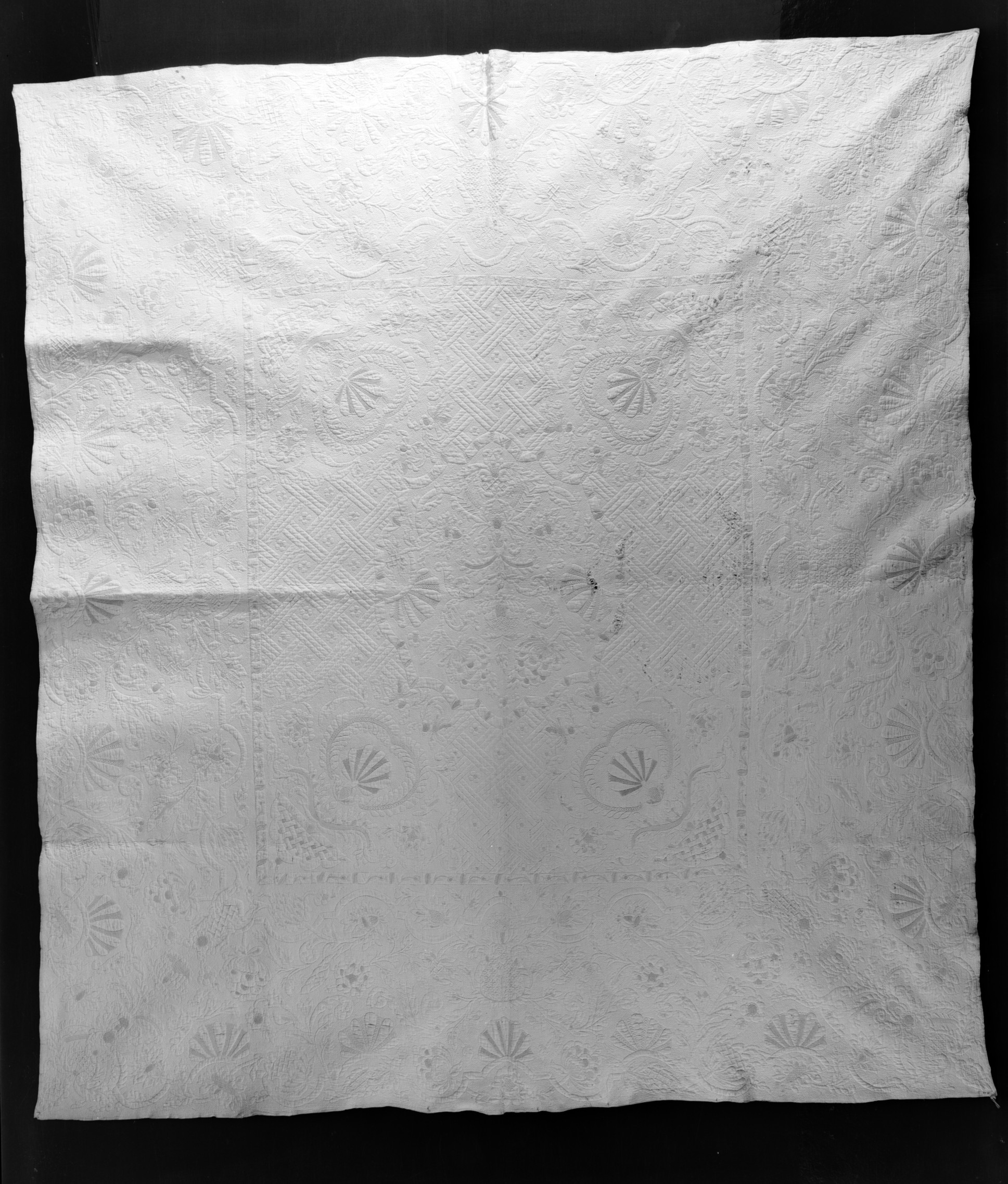
Deconstructing the Colonial Archive: The Embroidered Whitework Quilt as Proto-Futurist Armature
The British whitework quilt, meticulously hand-embroidered and stuffed with linen thread, represents a paradox of domesticity and structural rigor. For Zoey Fashion Laboratory’s SS26 avant-garde study, this artifact is not a nostalgic relic but a radical blueprint for futuristic silhouettes. The quilt’s inherent tension—between its soft, handcrafted surface and its rigid, geometric embroidery—mirrors the laboratory’s pursuit of garment architecture that defies gravity and time. This analysis deconstructs the quilt’s formal language, extracting principles for a new sartorial syntax rooted in negative space, volumetric exaggeration, and textile engineering.
I. The Whitework Paradox: Softness as Structural Discipline
At first glance, the whitework quilt epitomizes Victorian feminine craft: delicate, airy, and time-intensive. Yet its embroidery—dense satin stitches, raised chain bands, and stuffed motifs—creates a tactile topography that prefigures contemporary 3D printing. The linen thread, twisted and layered, forms ridges and hollows that resist compression. For SS26, this duality is crucial: softness becomes a structural tool, not a weakness. The quilt’s stuffed areas—often floral or geometric—act as internal buttresses, distributing tension across the fabric. Translating this to avant-garde couture, the laboratory can engineer inflated silhouettes using organic linen, where embroidered channels function as pneumatic seams. Imagine a jacket where the shoulders are not padded but stuffed with linen thread, creating a bulbous, organic armor that moves with the body. The whitework’s monochrome palette amplifies this effect; without color distractions, the eye reads only form and shadow, a prerequisite for futuristic minimalism.
II. Negative Space as Silhouette Engine
The quilt’s embroidery is not merely additive; it is subtractive by design. The stuffed motifs push the fabric outward, while the unembroidered areas collapse inward, creating a dialectic of void and volume. This is the core of avant-garde silhouette innovation. For SS26, the laboratory should invert this logic: negative space becomes the primary structure. Consider a coat where the body is an open lattice of whitework channels, with the skin as the negative field. Or a dress where the torso is a compressed grid of embroidery, expanding into a voluminous skirt of raw, unstuffed linen. The quilt’s British origin—its association with bedcovers and warmth—is subverted: the garment becomes a portable architecture that cages light and air. The stuffed elements, when scaled to human proportions, create exoskeletal ridges that redefine the wearer’s posture, forcing a robotic, deliberate gait. This is not comfort; it is controlled discomfort as a design ethos.
III. The Linen Thread Economy: From Craft to Cyber-Texture
Linen thread, a humble material, becomes a high-tech fiber in this context. Its stiffness, when embroidered densely, mimics carbon fiber or resin. The whitework technique—where the thread is pulled taut to create raised surfaces—is essentially a pre-industrial tensile system. For SS26, the laboratory can digitize this process. Using computational embroidery machines, the thread can be programmed to create gradated densities: loose enough to drape, tight enough to stand. The resulting textiles are smart by default—they respond to heat, moisture, and movement. A sleeve might be embroidered with channels that open when the arm bends, revealing raw linen underneath. This is deconstructive futurism: the garment is not finished; it is perpetually becoming. The British quilt’s symmetrical, repetitive patterns—often floral or geometric—are hacked into asymmetric, algorithmic forms. A rose motif becomes a cybernetic node; a vine becomes a wiring diagram.
IV. The Stuffed Silhouette: Volumetric Armor for the Post-Human Body
Historically, whitework quilts were layered for warmth, creating bulk without mass. For SS26, this translates into volumetric armor that exaggerates the human form. The laboratory can construct a “second skin” of stuffed linen panels, connected by exposed seams. The silhouette is not tailored to the body; instead, the body fills the garment’s internal voids. A skirt might be a toroidal ring of stuffed embroidery, hovering around the hips. A bodice could be a spine-like ridge of raised stitches, extending from neck to waist. The quilt’s white-on-white aesthetic is preserved, but its tactile aggression is amplified. The wearer becomes a walking textile sculpture, where every movement distorts the embroidery’s geometry. This is not fashion as clothing; it is fashion as habitable architecture.
V. Deconstructing the Archive: A Manifesto for SS26
The British whitework quilt is a colonial archive of female labor, domesticity, and imperial textiles. To use it for avant-garde couture is to violate its original context—and that is precisely the point. The laboratory’s SS26 collection must deconstruct this archive by extracting its structural DNA: the stuffed motif as a load-bearing element, the negative space as a silhouette generator, the linen thread as a cyber-material. The result is a futuristic silhouette that is simultaneously ancient and alien: a quilt become exoskeleton, a craft become code, a domestic object become public armor. The garments will not be worn; they will be inhabited. The whitework’s softness is a trap: it lures the eye into comfort, only to reveal a rigid, unyielding structure beneath. This is the laboratory’s signature—a deceptive softness that masks a futuristic rigor.
VI. Conclusion: The Quilt as Proto-Futurist Blueprint
In conclusion, the embroidered and stuffed whitework quilt is not a historical curiosity but a proto-futurist blueprint for SS26. Its techniques—stuffing, negative space, tensile embroidery—are precursors to contemporary textile engineering. For Zoey Fashion Laboratory, this artifact offers a radical departure from conventional tailoring. The futuristic silhouette is not about streamlining or minimalism; it is about volumetric excess, structural transparency, and material intelligence. The British quilt, with its labor-intensive craft, becomes a critique of fast fashion and a celebration of slow, deliberate construction. SS26 will be a collection of embroidered exoskeletons, stuffed armors, and negative-space architectures—a new sartorial language born from the deconstruction of a domestic archive. The whitework is not white; it is the color of future memory.