Deconstructing the Polonaise: A Futurist Manifesto for SS26
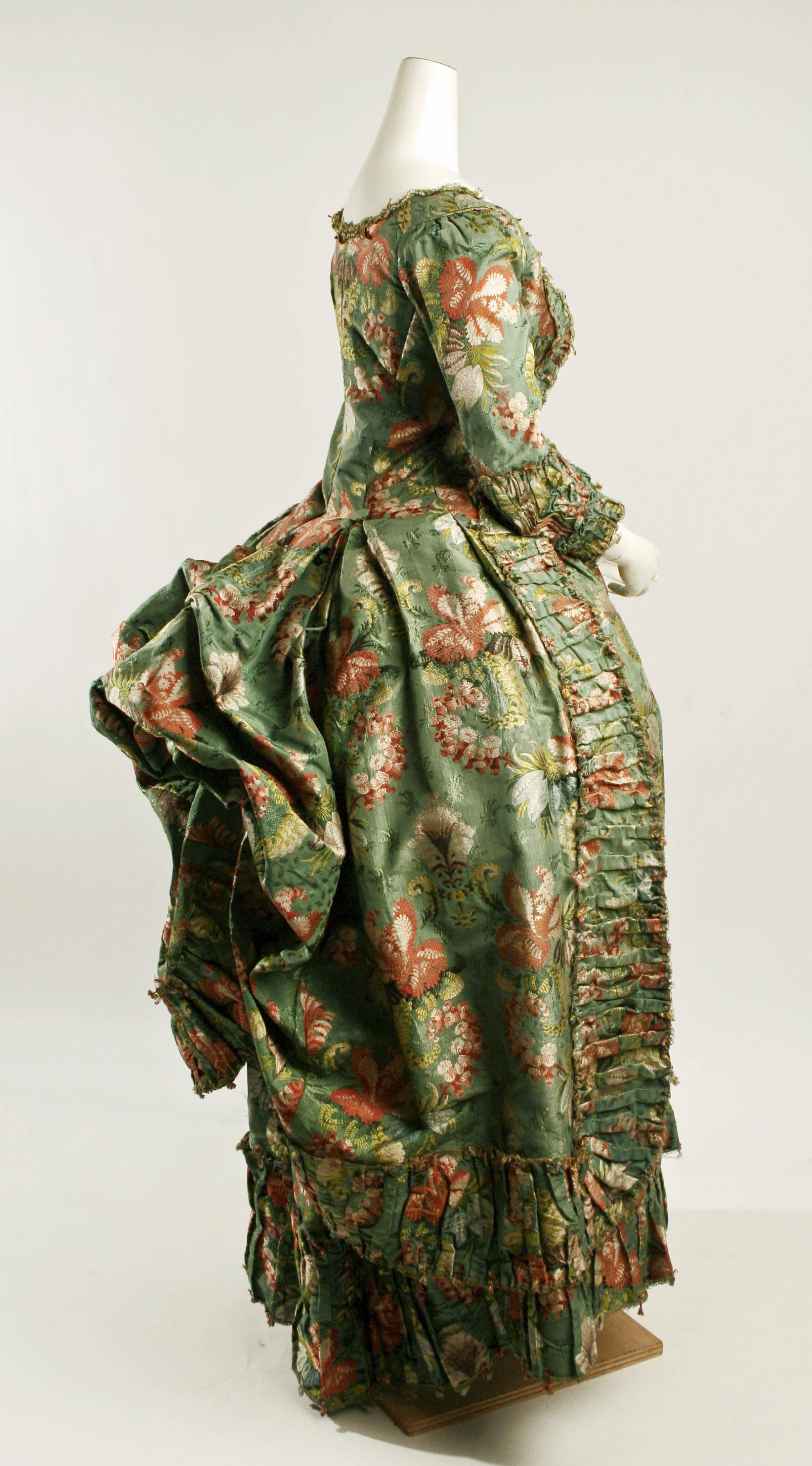
The Robe à la polonaise, a quintessential garment of 18th-century French aristocracy, is traditionally defined by its draped, lifted overskirt, creating a series of cascading puffs that reveal an underskirt. Its historical silhouette—structured yet playful, anchored in the bustle and the panier—has long been a relic of romanticized opulence. For Zoey Fashion Laboratory’s SS26 collection, we do not merely reference this historical artifact; we dissect, invert, and hybridize it through an avant-garde lens. This analysis reimagines the Polonaise not as a costume, but as a futuristic architectural shell, a deconstructive statement on volume, motion, and the tension between the natural and the engineered. The materiality of silk, once a symbol of delicate luxury, becomes the medium for radical structural innovation.
The Paradox of Silk: From Fluid to Structural
Historically, silk in the Polonaise was prized for its drape and luster—a soft, yielding surface that responded to the body’s movement. For SS26, we subvert this expectation. The silk is treated, bonded, and laser-cut to create a non-Newtonian fabric that behaves like a liquid metal when still, yet becomes rigid and self-supporting under tension. This is not the silk of the court; it is a smart material that can hold pleats, folds, and sharp geometric extrusions without internal boning. The key innovation lies in the negative-space construction: the overskirt’s iconic puffs are not formed by gathering, but by 3D-printed silicone inserts encased in the silk, allowing the garment to maintain a balloon-like volume that defies gravity. The fabric’s surface is micro-perforated with a pattern derived from the original Polonaise’s floral motifs, now reimagined as a digital lattice that breathes and refracts light, creating a shimmering, almost holographic aura.
Silhouette Re-Engineering: The Inverted Bustle and Floating Hem
The traditional Polonaise silhouette is defined by a raised back, a prominent bustle, and a hemline that lifts asymmetrically. For SS26, we invert the hierarchy of weight. The bustle is no longer at the rear; it is transposed to the front and sides, creating a series of cantilevered volumes that project outward like architectural brackets. This “inverted bustle” is constructed from a carbon-fiber skeleton wrapped in the treated silk, allowing the garment to stand away from the body by up to 20 centimeters. The hem, traditionally lifted, is now suspended mid-air via a hidden magnetic system embedded in the silk’s lining. The skirt appears to float, anchored only at the waist and a few strategic points, creating a zero-gravity aesthetic that challenges the wearer’s relationship with the ground. This is not a dress that touches the floor; it is a portable sculpture that hovers in space.
The Deconstructive Drape: Asymmetry and Exposed Understructure
Avant-garde couture thrives on the tension between the finished and the unfinished. We deconstruct the Polonaise’s drape by exposing the understructure as a deliberate design element. The gathered puffs are partially unstitched, their raw edges left to fray into a fringe that mimics digital glitches. The silk is cut on the bias in unexpected directions, creating asymmetrical panels that wrap around the torso like a second skin, but with deliberate gaps that reveal the wearer’s own body as part of the garment’s architecture. A single sleeve is elongated into a dramatic, bell-shaped extension, while the other is entirely absent, leaving the arm bare. This intentional asymmetry is not random; it follows a Fibonacci sequence of folds and pleats, each one mathematically plotted to create a dynamic visual rhythm that shifts as the wearer moves. The result is a garment that is both fractured and cohesive, a study in controlled chaos.
Structural Innovation: Modular Components and Kinetic Elements
The core of this SS26 analysis is the modular approach to the Polonaise. We reject the notion of a fixed silhouette. Instead, the garment is composed of interchangeable panels that can be reconfigured by the wearer. The silk panels are attached via magnetic clasps and micro-zip systems, allowing the overskirt to be detached, reattached, or even swapped with a secondary layer of translucent organza. The puffs themselves are kinetic modules—each one contains a small, silent motor that can inflate or deflate on command, controlled via a wearable haptic interface. This transforms the garment from a static object into a living, breathing entity that responds to the environment or the wearer’s emotional state. Imagine a Polonaise that expands its silhouette in a crowded space, or contracts to a sleek, minimal form in intimate settings. This is the future of couture: adaptive, intelligent, and deeply personal.
The Futurist Palette: Digital Silk and Neon Accents
Color plays a pivotal role in this deconstruction. The silk is dyed in a gradient that moves from deep indigo to translucent white, mimicking the digital transition from night to day. But we introduce neon accents—thin strips of electroluminescent thread woven into the seams—that pulse with a soft, bioluminescent glow. These accents trace the lines of the original Polonaise’s construction, highlighting the points of tension and release. The effect is a garment that appears to be alive with internal light, a nod to the digital age’s obsession with screens and interfaces. The traditional floral embroidery is replaced with circuit-board patterns, stitched in metallic thread that conducts a low-voltage current, powering the kinetic modules. This is not decoration; it is functionality disguised as ornament.
Wearability and the Avant-Garde Paradox
Critics of avant-garde couture often question its wearability. The Polonaise for SS26 is designed to be paradoxical: it is both unwearable in a conventional sense and yet a masterpiece of ergonomic engineering. The carbon-fiber skeleton is lightweight, the magnetic system is non-intrusive, and the silk’s treated surface is washable and durable. The garment is intended for a performance-based context—a fashion show, a gallery installation, a digital avatar—but its modular nature allows it to be adapted for a red-carpet event or a conceptual photo shoot. The wearer becomes a co-creator, manipulating the silhouette in real time. This is the ultimate expression of Zoey Fashion Laboratory’s ethos: fashion as a dialogue between history, technology, and the human form.
Conclusion: The Polonaise as a Blueprint for Tomorrow
This SS26 study of the Robe à la polonaise is not merely a reinterpretation; it is a declaration of intent. By deconstructing its historical form and rebuilding it with futuristic materials and kinetic systems, we demonstrate that even the most traditional garments can become vessels for radical innovation. The silk, once a symbol of aristocratic leisure, now becomes a medium for structural defiance. The silhouette, once constrained by the body, now transcends it. Zoey Fashion Laboratory’s avant-garde analysis proves that the past is not a cage but a springboard—a foundation upon which we can build garments that are not just clothes, but architectural experiences. The Polonaise is dead. Long live the Polonaise.