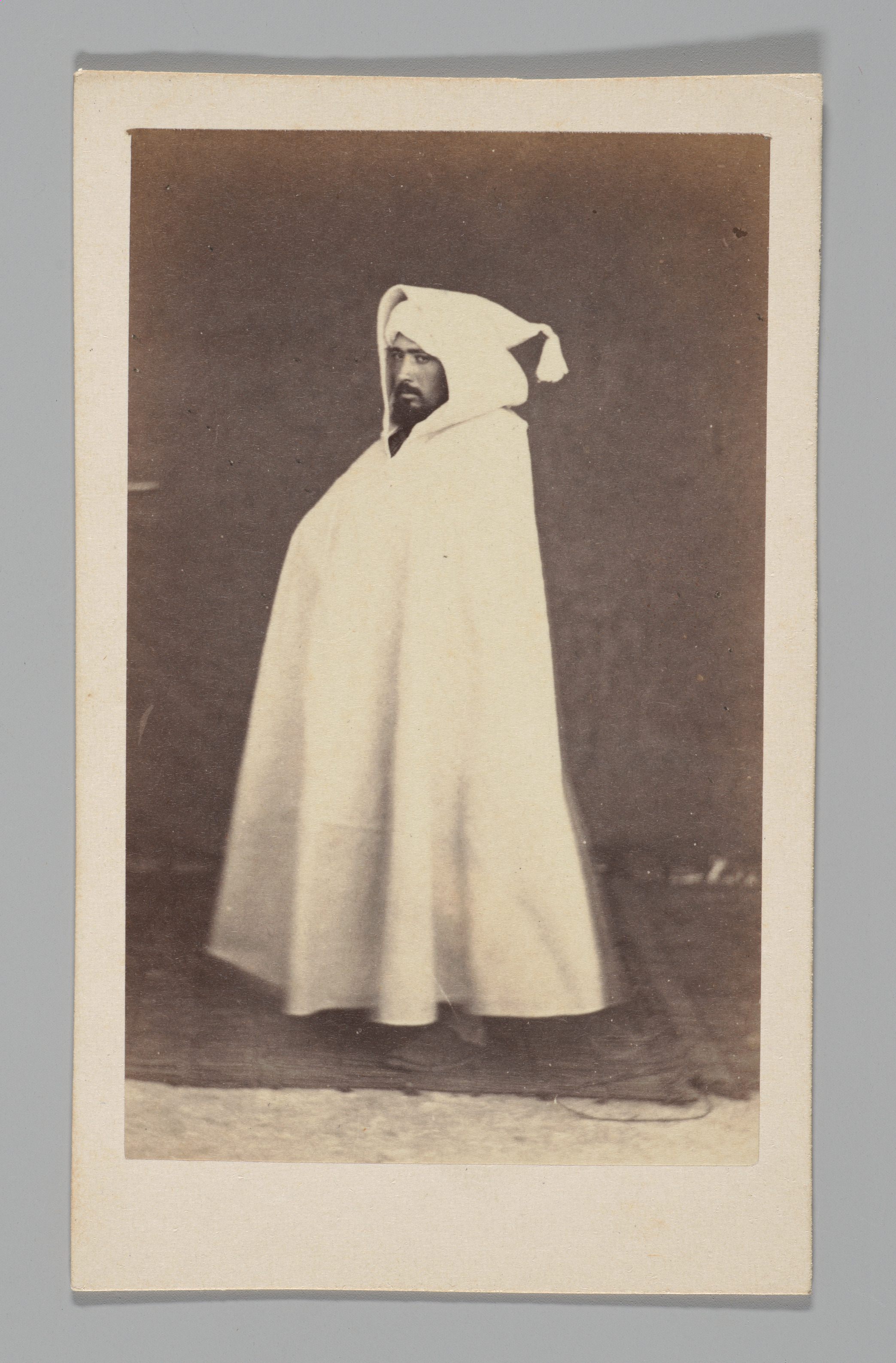
The Nomadic Cartography of Light: Deconstructing the Caïd Silhouette for SS26
The intersection of archival photographic processes and avant-garde garment construction presents a radical frontier for Spring/Summer 2026. At Zoey Fashion Laboratory, we have excavated the Caïd—a figure of authority and nomadic command from the Moroccan hinterlands—not as a historical costume, but as a diagram of power, movement, and temporal displacement. The chosen medium, the albumen silver print, is not merely a texture; it is a conceptual substrate. It encodes the very physics of light, shadow, and chemical decay into a textile language. This analysis dissects how the Caïd archetype, filtered through the lens of 19th-century photographic chemistry, yields a SS26 collection defined by structural innovation, deconstructive layering, and a futuristic silhouette that defies gravitational and historical gravity.
I. The Albumen Silver Print as a Textural Blueprint
The albumen silver print, with its characteristic sepia-toned highlights and deep, velvety blacks, is not a literal print on fabric. Instead, it serves as a generative algorithm for surface manipulation. The materiality of this process—the egg-white binder, the silver nitrate sensitivity, the fading over time—informs a new category of photographic textiles. For SS26, we propose a double-layered organza treated with a micro-encapsulated silver-based finish. When exposed to ambient UV light, the fabric undergoes a subtle chromatic shift, mimicking the print’s tonal gradation from highlight to shadow. This is not about representation; it is about indexicality. The garment becomes a living document, a light-sensitive membrane that records the wearer’s journey through space and time.
Structurally, the albumen print’s inherent fragility—its tendency to crack and craquelure—is translated into a deliberate deconstructive seam strategy. Seams are not hidden but exposed, their edges raw and unbound, mimicking the print’s physical deterioration. These fractured seams create a visual rhythm of interruption and repair, a commentary on the transience of both photographic memory and textile integrity. The result is a surface that is simultaneously archival and ephemeral, a paradox central to the avant-garde ethos.
II. The Caïd Silhouette: From Authority to Aerodynamics
The traditional Caïd silhouette—a long, flowing djellaba, often with a hood (qob), layered over a tunic—is not replicated but re-engineered for kinetic futurism. The key innovation lies in the negative space between the garment and the body. The djellaba’s volume is reimagined as a modular airfoil. Using a carbon-fiber-infused silk that maintains tensile strength while remaining fluid, we create a silhouette that is both rigid and billowing. The hood, traditionally a symbol of status and protection, is transformed into a detachable, sculptural collar that extends outward like a parabolic reflector. This piece, laser-cut from a single sheet of albumen-treated mylar, acts as a light-capture device, redirecting ambient illumination onto the wearer’s face and upper torso. It is a functional, futuristic nod to the Caïd’s role as a beacon of authority.
The underlying tunic is replaced by a second-skin base layer composed of a bioceramic-infused jersey. This material, which absorbs and re-emits body heat as far-infrared radiation, is printed with a photogram-negative pattern—a direct impression of desert flora and mineral formations, developed using a silver-nitrate solution. The pattern is not printed; it is chemically grown onto the fabric, creating a texture that is both organic and industrial. This base layer acts as a thermal and visual anchor, while the outer airfoil layers create a dynamic, ever-shifting silhouette. The interplay between the static, heat-active base and the mobile, light-reactive shell defines the collection’s structural logic.
III. Structural Innovation: The Architecture of Decay and Renewal
The albumen print’s propensity for fading and discoloration is harnessed as a design principle for modularity. Garments are constructed with interchangeable panels that can be swapped or removed to alter the silhouette’s volume and color profile. These panels, made from the same UV-sensitive organza, are treated with different concentrations of silver nitrate, resulting in a gradated fading scale. Over the course of a day or a season, the panels will slowly shift from a deep sepia to a pale, almost transparent tone. This self-obsoleting aesthetic encourages a new relationship between garment and wearer: one of active curation and temporal engagement. The wearer is not a passive consumer but a co-author of the garment’s decay.
Supporting this modularity is a hidden exoskeletal framework of 3D-printed, recycled polyamide joints. These joints, designed to mimic the articulation of a human skeleton, allow the airfoil layers to pivot, fold, and extend. They are not visible from the exterior but are felt as a subcutaneous structure, a kind of second skeleton that guides the garment’s movement. This framework is inspired by the Caïd’s traditional weaponry—the curved dagger (koummia) and the long rifle—but abstracted into pure, load-bearing geometry. The result is a silhouette that is simultaneously protective and aerodynamic, a living armor for the digital age.
IV. Futuristic Silhouettes: The Nomad in the City of Light
The final silhouette for SS26 is a layered, asymmetrical architecture that moves with the wearer like a shifting dune. The primary silhouette is a high-waisted, A-line skirt constructed from seven overlapping panels of the UV-sensitive organza. Each panel is cut at a different angle, creating a cascading, wave-like effect that references the albumen print’s tonal gradients. The skirt is supported by the hidden exoskeleton, which allows the panels to flare outward dramatically during movement, then collapse back into a sleek, aerodynamic form when static. This is a living silhouette, one that breathes and adapts.
For the upper body, the hood-collar is paired with a deconstructed bolero jacket that has no sleeves, only a single, sweeping lapel that wraps around the torso and extends into a long, trailing tail. This tail is made from the same bioceramic jersey as the base layer, but printed with a photogram of a desert night sky—a direct exposure of starlight onto the fabric. The tail is weighted with tiny, polished brass beads that mimic the albumen print’s metallic sheen, creating a sonic and visual counterpoint to the silent, light-sensitive panels. The wearer becomes a mobile celestial map, a nomad navigating the urban landscape by the light of a hundred tiny, captured stars.
V. Conclusion: The Archive of the Future
The Caïd, as reimagined through the albumen silver print, is not a nostalgic figure. He is a harbinger of a new material logic. The SS26 collection at Zoey Fashion Laboratory proposes a future where garments are active archives, recording light, heat, and movement. The silhouette is not a static shape but a dynamic system of forces—gravity, light, wear—that are visible, tactile, and ever-changing. This is structural innovation at its most radical: the garment as a time-based medium, a photograph that lives on the body. The nomad’s authority is no longer over territory, but over temporal and material perception. The future of couture is not in preservation, but in the beautiful, controlled decay of the new.