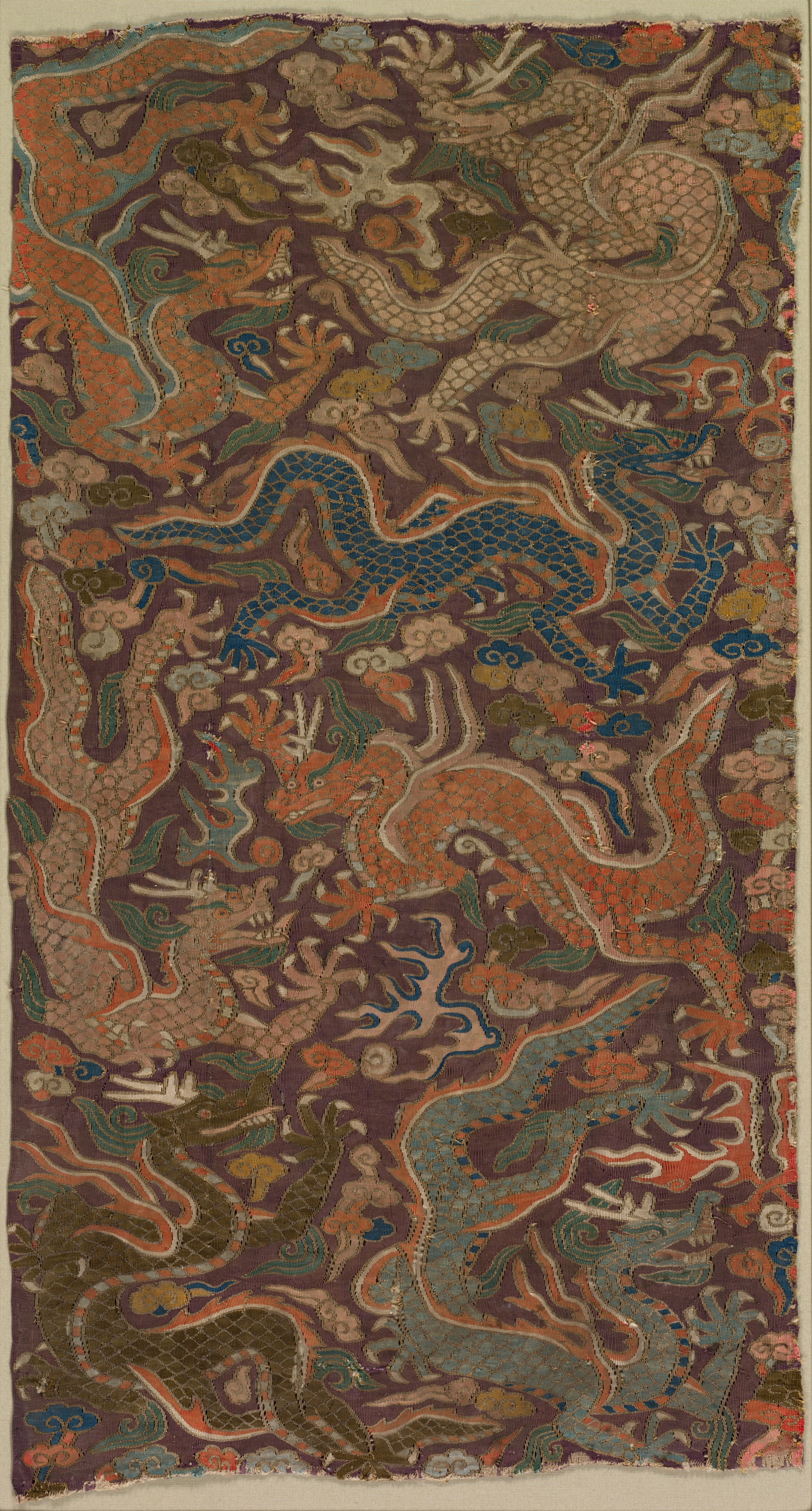
Deconstructing the Myth: An Avant-Garde Analysis of "Dragons Chasing Flaming Pearls"
At Zoey Fashion Lab, our mission is to sever the threads of convention and re-weave them into statements of radical modernity. The artifact before us—a Central Chinese tapestry in silk and gold thread, depicting the classic motif of "Dragons Chasing Flaming Pearls"—is not merely a relic. It is a reservoir of kinetic energy, a coded narrative of power and transcendence. As Chief Fabric Deconstructionist, I will dissect this piece not as a historical document, but as a proto-avant-garde text, a blueprint for subversive design that challenges the very fabric of perception.
Technical Dissection: The Alchemy of Silk and Gold
The tapestry’s technical foundation—silk and gold thread woven into a dense, warp-faced structure—is the first site of deconstruction. Silk, a protein fiber of unparalleled luster and drape, is inherently fluid, almost liquid in its response to light. Gold thread, on the other hand, is rigid, metallic, and declarative. The tension between these two materials is not a harmonious marriage; it is a dialectical struggle. The silk yields, the gold commands. In the tapestry, this creates a surface that is both supple and armored, a paradox that the avant-garde designer must exploit.
Consider the weave itself. Tapestry is a weft-faced technique, meaning the colored weft threads completely cover the warp. This creates a double-sided image, a simultaneous front and back. For our deconstruction, this duality is critical. The "front" is the narrative—the dragons, the pearls, the flames. The "back" is the structure—the knots, the loose ends, the raw tension. In an avant-garde garment, we would invert this hierarchy. Imagine a coat where the exterior is the chaotic, exposed reverse of the tapestry—threads dangling, colors bleeding—while the interior is the pristine, ordered myth. The wearer becomes a walking archive, revealing the labor of creation while concealing the finished narrative.
Furthermore, the use of gold thread is not decorative; it is a technological and symbolic intervention. Gold does not dye; it reflects. It creates a flickering, non-static surface that changes with the viewer’s angle. This is a proto-kinetic element, a precursor to the moving image. In a contemporary context, we could replace gold with conductive threads, embedding micro-LEDs that pulse in response to the wearer’s heartbeat. The "flaming pearl" becomes a literal, dynamic light source, transforming the garment from a static object into a living, responsive organism.
Iconography as Code: The Dragons and the Pearl
The motif of dragons chasing a flaming pearl is often interpreted as a symbol of wisdom, power, and the pursuit of enlightenment. But let us strip away this spiritual gloss. The dragon is a force of nature—untamed, serpentine, and voracious. The pearl is a luminous object of desire. The chase is an endless, cyclical propulsion. This is not a serene meditation; it is a relentless, almost violent pursuit. The avant-garde lens sees this as a metaphor for the fashion industry itself: the endless chase for the next trend, the next "pearl" of novelty, the next moment of viral attention.
Deconstructing the dragon’s form reveals a series of repetitive, sinuous curves. These are not organic; they are algorithmic. The dragon’s body is a continuous line that loops and twists, creating negative spaces that are as important as the positive form. In a garment, this translates to cut-outs, asymmetrical draping, and engineered seams that mimic the dragon’s trajectory. Imagine a dress where the fabric is cut in a single, continuous spiral from shoulder to hem, leaving gaps that reveal the skin beneath. The "chase" becomes a literal path around the body, with the "pearl" positioned at the heart or the throat—a focal point that draws the eye.
The pearl itself is a sphere, a perfect, self-contained form. In the tapestry, it is often surrounded by flames, which are jagged, irregular, and destructive. This is the collision of the ideal and the chaotic. For our deconstruction, the pearl can be rendered as a rigid, sculptural element—a transparent resin orb or a polished metal globe—while the flames become frayed, laser-cut edges that simulate burning. The garment becomes a site of controlled destruction, where the "pearl" is preserved but the "flames" are allowed to disintegrate.
Archive Resonance: The 16th–17th Century as a Liminal Space
The archive note references the 16th to 17th centuries, a period of intense cultural collision in China. This was the late Ming and early Qing dynasties, a time of trade, Jesuit missions, and the influx of European aesthetics. The tapestry, while "Central Chinese," likely absorbed influences from Persian silks, Tibetan thangkas, and even European heraldic motifs. This is not a pure, isolated artifact; it is a hybrid, a product of global exchange. The avant-garde designer must embrace this impurity.
This period also saw the rise of literati painting, where artists like Dong Qichang advocated for a return to "ancient" styles while simultaneously innovating. The tapestry, therefore, is caught between tradition and innovation. Its "resonance" is not a single note but a chord of conflicting frequencies. For our deconstruction, we can amplify this dissonance. Imagine a garment that combines the tapestry’s dense, pictorial surface with transparent, machine-knitted sections that reveal the wearer’s silhouette. The "archive" is not preserved; it is layered, disrupted, and re-contextualized.
From Textile to Text: An Avant-Garde Manifesto
To translate this analysis into a tangible design, Zoey Fashion Lab proposes a deconstructed tapestry coat. The primary fabric is a double-faced silk, with the front printed with a high-resolution scan of the dragon-and-pearl motif. The back is left raw, with the digital print intentionally pixelated and glitched, mimicking the decay of digital archives. Gold thread is replaced with gold-lamé piping that is deliberately frayed and unhemmed, creating a fringe that moves with the body.
The coat’s silhouette is asymmetrical: one shoulder is padded and structured like a dragon’s scale, while the other is draped and fluid, like the pearl’s trailing flame. The "pearl" is a three-dimensional resin orb attached at the left hip, connected to a network of conductive threads that power small LED lights along the coat’s hem. The "chase" is literalized through a series of laser-cut slits that spiral from the collar to the hem, allowing the inner lining—a chaotic, hand-painted pattern of flames—to peek through.
This garment is not wearable in the traditional sense. It is a performance piece, a critique, and a celebration. It asks the wearer to embody the tension between silk and gold, between tradition and disruption, between the archive and the future. The dragons chase the pearls, but the pearls are never caught. The chase is the point. In the same way, fashion must never settle. It must always pursue, deconstruct, and re-imagine.
At Zoey Fashion Lab, we do not preserve history. We explode it, re-weave its fragments, and present them as new constellations. The "Dragons Chasing Flaming Pearls" tapestry is not an artifact to be admired from a distance. It is a blueprint for a garment that burns with its own light.