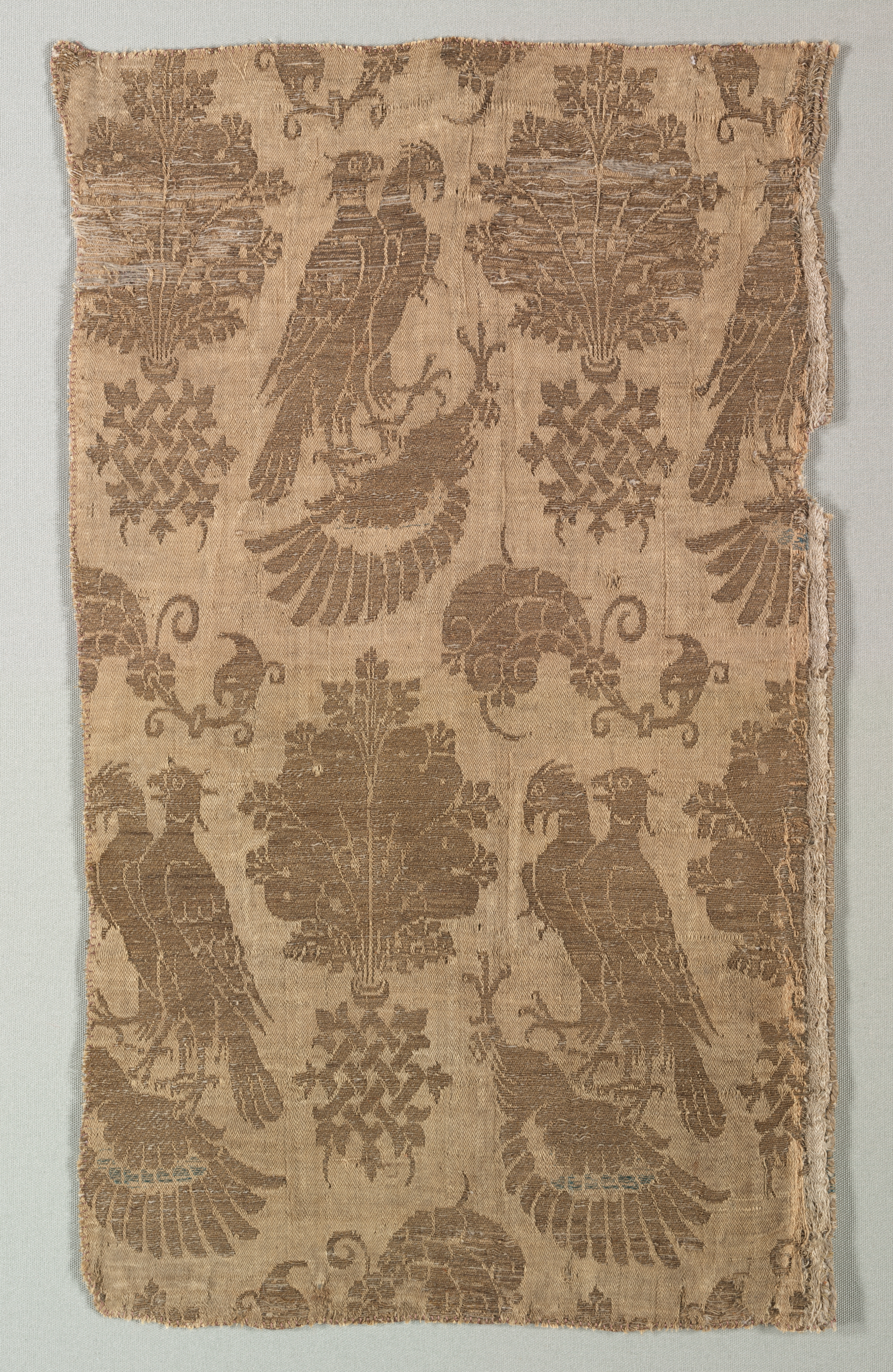
Deconstructing the Archive: A Zoey Fashion Lab Analysis of 14th-Century Italian Gold-Patterned Silk
At Zoey Fashion Lab, we do not merely preserve historical textiles; we vivisect them. We extract their structural DNA, their political whispers, and their sensory provocations to fuel a new, avant-garde vernacular. The subject of this analysis—a fragment of gold-patterned silk woven in Italy during the last third of the 14th century—is a prime candidate for such radical deconstruction. This is not a relic to be revered behind glass. It is a manifesto woven in silk and gold, a conversation between feudal power and the artisan’s hand, and a blueprint for a collection that defies time.
The technical specifications are deceptively simple: silk, gold thread, and a combination of two weaves known as lampas. This is the first point of entry for our deconstruction. Lampas is not a single weave but a compound structure, a marriage of a ground weave (often a plain weave or twill) and a pattern weave (typically a twill or satin) that floats on the surface to create the motif. This dualistic construction is the textile’s core metaphor. It is a fabric of two faces: one functional, one aspirational. The ground weave provides stability, the structural integrity necessary for a garment that must endure ceremony and movement. The pattern weave, executed in lustrous gold thread, is pure spectacle. It is the voice of the patron, the heraldry of power, the narrative of falcon and leaf.
Motif as Narrative: The Falcon and the Heraldic Code
The motifs—falcons and heraldic devices—are not decorative. They are a language. In the 14th century, silk was a global commodity, a symbol of status that transcended borders. The Italian city-states, particularly Lucca, Venice, and Florence, were masters of this trade, weaving for courts across Europe. A falcon, often depicted with a hood or in mid-strike, was a symbol of nobility, of the hunt, of the lord’s dominion over nature. Heraldry, with its geometric shapes, lions, and eagles, was a visual claim to lineage and territory. To wear this silk was to wear a coat of arms, to broadcast one’s place in a rigid hierarchy.
For Zoey Fashion Lab, we interpret this as a system of coded authority. The falcon is not just a bird; it is a silhouette of power. Its sharp beak, its folded wings, its predatory stillness—these are forms we can abstract into garment architecture. Imagine a shoulder line that mimics the falcon’s wing in a state of arrest, a sharp, angular cut that suggests both readiness and menace. The heraldic devices—the paly, fess, or bend—are not flat symbols. They are structural seams, cut lines that bisect the body, creating a visual armor. We are not replicating a medieval tunic; we are translating its logic of power into a modern, deconstructed silhouette. The gold thread becomes a line of force, a laser-like incision that traces the body’s topography.
Technical Alchemy: The Lampas as a Digital/Analogue Hybrid
The lampas weave is our technical muse. In the 14th century, it was a feat of engineering, requiring a drawloom and a second warp or weft to create the pattern. This is a proto-digital system. The pattern is a set of instructions, a binary code of thread raised or lowered. The gold thread—often a gilded membrane wrapped around a silk core—is the materialization of value. It is not merely shiny; it is a statement of economic and technological prowess.
Our avant-garde interpretation begins with a deconstruction of this binary. We will not weave a lampas; we will de-weave it. We will take the structural logic of the two weaves and explode it. Imagine a garment where the ground weave is a sheer, matte silk—a ghost of the original—while the pattern weave is rendered in a laser-cut metallic film, applied as a floating appliqué. The falcon’s wing is no longer woven; it is a cut-out, a negative space that reveals the skin beneath. The heraldic device becomes a chainmail-like grid, a 3D-printed lattice that is both rigid and fluid. The gold thread is no longer a line; it is a surface treatment, a gilded spray that catches light only at specific angles, a secret language for the wearer.
Archive Resonance: The Mirror and the Stone Coffin
The reference provided—“一面是光洁银镜上以黄金镶嵌的纷繁棕叶纹,另一面是冰冷石棺板上以浮雕诉说的生命叙事”—is our conceptual anchor. This is the dialectic of the archive. The silver mirror with its gold-inlaid palm leaves represents the surface, the allure, the immediate visual pleasure. It is the façade of wealth. The cold stone coffin with its relief-carved life narrative represents the depth, the history, the mortality that underpins all luxury. This silk fabric is both. The gold pattern is the mirror; the silk ground is the stone.
Our collection will be a dialogue between these two states. One side of a garment will be a highly polished, reflective surface—a liquid metal finish that recalls the mirror. The other side will be a textured, matte, almost abrasive surface—a felted wool or a raw silk that echoes the stone. The falcon motif will appear on the mirror side as a sharp, crisp, digital print; on the stone side, it will be embroidered in a heavy, knotted thread, a relief that begs to be touched. The garment itself will be reversible, a literal embodiment of this dual nature. The wearer chooses which narrative to present: the glittering surface of power, or the weighty, textured story of its origin.
Avant-Garde Silhouettes: From Heraldry to Haute Couture
The 14th-century silhouette was voluminous, structured by the houppelande and the cotehardie. Our avant-garde interpretation will distort these archetypes. The houppelande’s grand sleeves become detachable, sculptural wings, each one a single, massive falcon feather constructed from a carbon-fiber frame and gold-threaded silk. The cotehardie’s fitted bodice becomes a corset of heraldic panels, each panel a different weave density, creating a gradient of opacity from sheer to opaque. The gold thread is not just decorative; it is functional wiring, embedded with micro-LEDs that pulse with a slow, heartbeat-like rhythm. This is not costume; it is wearable architecture that references the past while existing in the future.
Conclusion: The Fabric as a Living Document
This 14th-century Italian silk is not a dead object. It is a living document of power, technology, and artistry. At Zoey Fashion Lab, our deconstruction is an act of re-animation. We strip away its historical context to reveal its core principles: the binary logic of the lampas, the coded language of the motif, the material dialectic of mirror and stone. We then rebuild these principles using the tools of our time—laser cutting, 3D printing, digital fabrication, and smart textiles. The result is a collection that does not imitate the past but resonates with its frequencies. It is a garment that speaks of falcons and heraldry, of gold and silk, but in a language that is entirely new. This is the work of the Chief Fabric Deconstructionist: to listen to the archive, and then to make it scream.