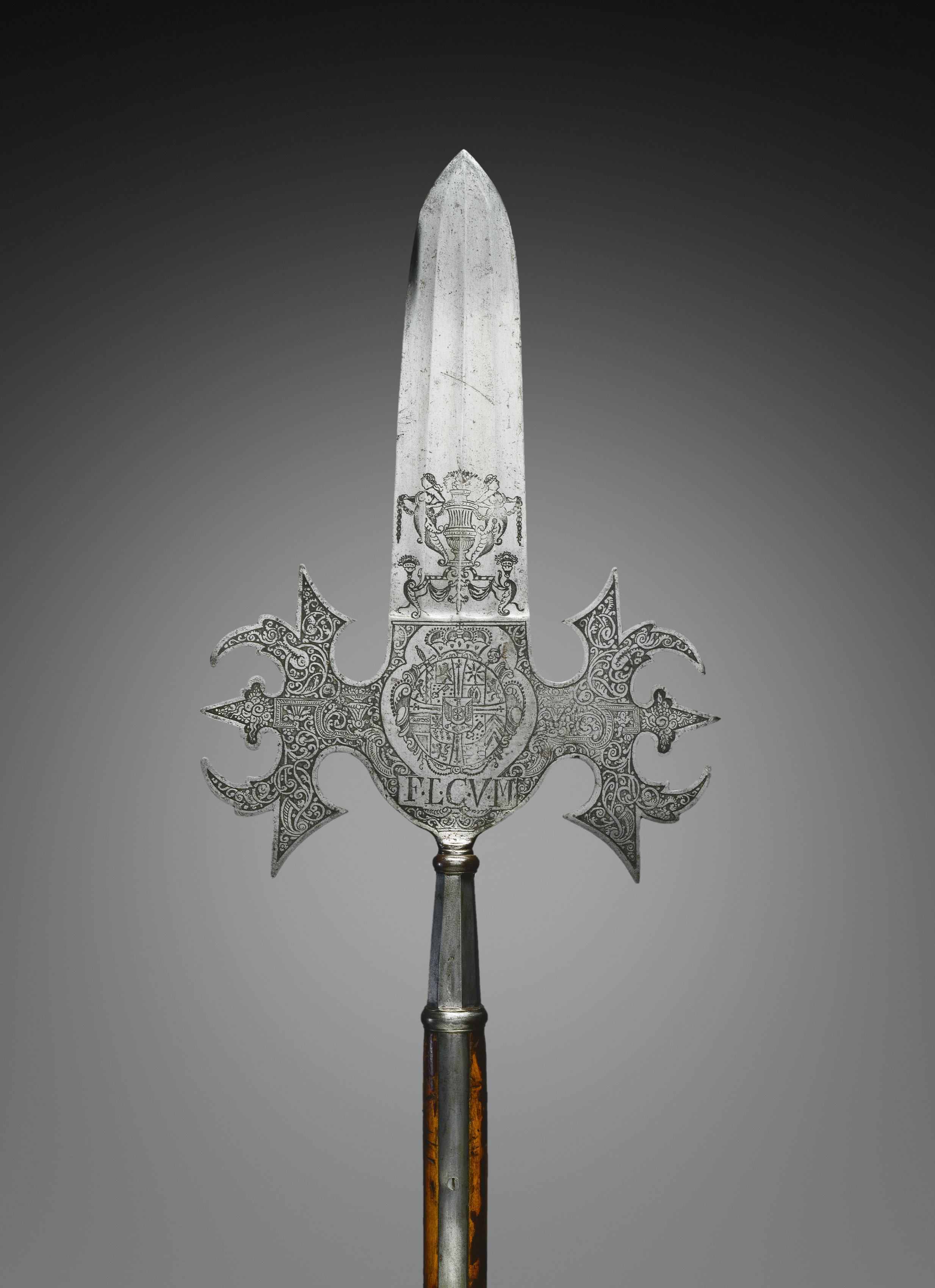
Deconstructing the Partisan: A Technical and Conceptual Analysis for Zoey Fashion Lab
Zoey Fashion Lab’s commitment to avant-garde deconstruction finds a powerful new artifact in the Partisan, a German polearm from the 18th century. This weapon, a hybrid of spear and halberd, is not merely a historical relic but a fabric of tension—between utility and ornament, violence and craft, linear history and fragmented future. Our analysis focuses on its material, structural, and symbolic DNA, specifically through the lens of its etched steel blade and broken haft, to propose how this object can be recontextualized into a new garment or accessory narrative for the lab’s next collection.
1. Technical Deconstruction: The Steel and the Break
The partisan’s defining feature is its etched steel blade. In the 18th century, such etching was not merely decorative; it was a language of status and lineage, often depicting hunting scenes, floral motifs, or heraldic symbols. For Zoey Fashion Lab, this etching represents layered surface tension—a dialogue between the hard, reflective steel and the deliberate, almost textile-like pattern carved into it. The blade’s geometry—long, tapering, with a central ridge for rigidity—mirrors the silhouette of a tailored jacket lapel or a sharply cut skirt panel. The etching, when viewed as a textile pattern, suggests a woven or embroidered surface that is paradoxically cold and unyielding.
The broken haft is the most critical technical element. The haft, originally of wood (likely ash or oak), is now fractured, leaving a jagged, splintered terminus. This break is not a flaw but a decisive cut—a moment of violent transformation. In fashion terms, this corresponds to an asymmetrical hem, a torn seam, or a deliberately unfinished edge. The haft’s fracture line creates a new silhouette: the weapon is no longer a complete, functional tool but a fragment, a deconstructed prototype. This break introduces a dynamic of potential energy—the weapon is frozen mid-act, its purpose interrupted. For Zoey Fashion Lab, this translates into garments that appear to be in a state of becoming or undoing: a sleeve that splits into ribbons, a collar that is partially detached, or a fabric that is burned or cut at the edges.
2. The New DNA Strand: Partisan as Genetic Code
Our reference to a New DNA Strand is not metaphorical but technical. The partisan’s form—a long, linear shaft with a bifurcated head—mimics the double helix structure of DNA when viewed in two dimensions. The blade’s central ridge acts as the backbone, while the etched patterns on either side represent the base pairs—A, T, C, G—encoded in steel. The broken haft introduces a mutation in this genetic sequence, a break in the continuous helix that suggests a new evolutionary path.
In fashion terms, this DNA strand becomes a structural pattern for a garment. Imagine a dress where the bodice is constructed from interlocking steel-like panels, each etched with a unique pattern that corresponds to a specific “base pair.” The skirt, instead of flowing, is composed of rigid, segmented panels that hinge at the waist, mimicking the haft’s break. The asymmetry of the broken haft is translated into a one-shoulder silhouette or a hem that rises sharply on one side. The “mutation” is expressed through deconstructed seams—threads left exposed, zippers that are partially undone, or fabric that is intentionally frayed. This garment is not a dress but a living code, a wearable artifact of a fragmented history.
3. Avant-Garde Style: The Partisan as Fashion Object
The avant-garde style demands that we reject the partisan’s original function—warfare—and instead embrace its symbolic and formal possibilities. The weapon becomes a wearable sculpture, a piece that challenges the body’s relationship to power, protection, and vulnerability. The etched blade, when translated into a garment, becomes a hard, protective shell—a corset made of metalized leather or a jacket with steel-like shoulder pads. The broken haft, however, introduces fragility—the garment is not invincible; it is marked by damage, by history.
Consider a coat that is half-tailored, half-ruined. One sleeve is intact, with etched patterns resembling the blade’s motifs; the other sleeve is torn away, leaving a ragged edge that echoes the haft’s break. The collar is asymmetrical, one side sharp and structured, the other soft and falling. The fabric itself is a hybrid: wool bonded with metallic thread, creating a surface that is both warm and cold, soft and hard. The etching is not printed but embossed or burned into the material, giving it a three-dimensional, tactile quality. The garment’s silhouette is elongated and angular, referencing the partisan’s linear form, but disrupted by the break—a sudden diagonal cut across the torso.
Accessories further this narrative. A belt is made from a series of interlocking steel rings, each etched with a fragment of a pattern, mimicking the blade’s surface. A necklace is a single, long chain that ends in a jagged, broken pendant—a miniature version of the haft. The shoes have heels that are asymmetrical, one high and sharp, the other low and splintered, forcing the wearer into a posture of imbalance, of perpetual motion.
4. The Partisan in the Collection: A Case Study
For Zoey Fashion Lab’s upcoming avant-garde collection, the partisan serves as a master motif. Each garment or accessory can be interpreted as a fragment of the original weapon, deconstructed and reassembled into a new form. The collection’s title, “Fractured Helix,” captures this duality: the DNA-like structure of the partisan, broken and recombined. The color palette is monochromatic with metallic accents: gunmetal gray, oxidized silver, and matte black, punctuated by flashes of rust or verdigris to suggest age and decay.
The key piece is a gown that is half-armor, half-drape. The bodice is a rigid, etched steel corset, with the pattern referencing the partisan’s hunting scenes—but abstracted into geometric shapes. The skirt is a cascade of silk organza, cut into long, jagged panels that mimic the haft’s splintered wood. The dress is unfinished at the hem, with raw edges and loose threads, suggesting that it is still in the process of being deconstructed. The wearer becomes a living artifact, a museum piece that is also a weapon, a code, a fragment.
Conclusion: The Partisan as a New Fashion Language
The German partisan, with its etched steel and broken haft, offers Zoey Fashion Lab a rich vocabulary for avant-garde design. It is not a weapon but a textile of history, a surface of encoded meaning, and a structure of tension. By deconstructing it into its technical, material, and symbolic components, we can create garments that are neither fully functional nor purely decorative—they are in-between states, fragments of a larger narrative. The New DNA Strand is not a literal biology but a fashion genetics, where the partisan’s form is the code, the break is the mutation, and the garment is the new organism. This analysis provides the foundation for a collection that is rigorous, provocative, and deeply material—a true reflection of Zoey Fashion Lab’s deconstructive ethos.