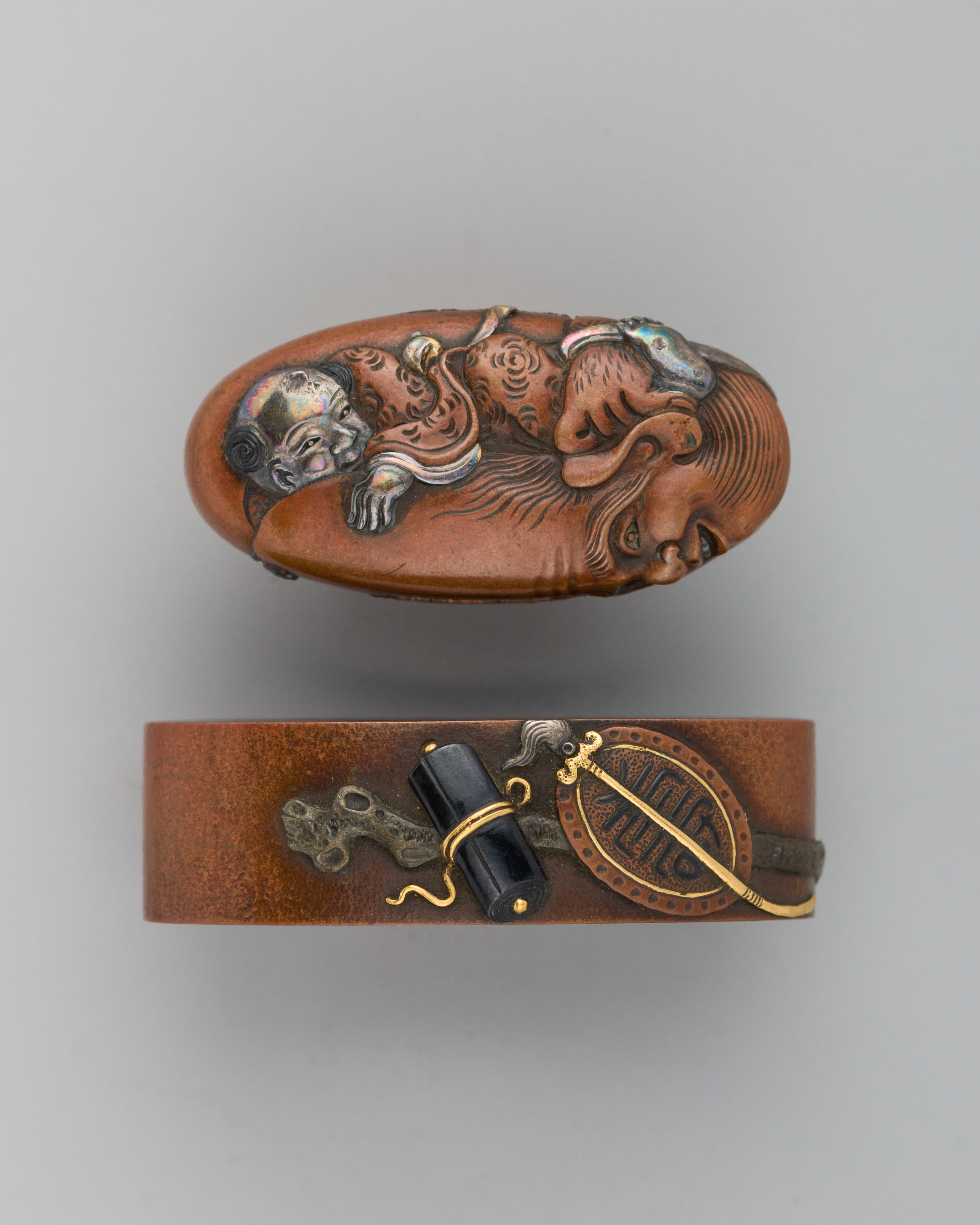
Deconstructing the Blade: The Fuchigashira as a Structural Paradigm for SS26
In the relentless pursuit of architectural transcendence within the garment, the avant-garde designer must look beyond the textile and into the armature of the object itself. For the SS26 season, Zoey Fashion Laboratory proposes a radical departure from conventional ornamentation, drawing inspiration from the Japanese sword-hilt collar and pommel, the fuchigashira. This small, yet profoundly significant, assembly—crafted from copper, gold, and the revered copper-gold alloy shakudō—offers a blueprint for a new vocabulary of structural innovation. It is not a decorative motif; it is a load-bearing, kinetic, and symbolic system that reimagines the silhouette as a protective, futuristic exoskeleton.
The Metallurgy of Memory: Shakudō as a Temporal Surface
The materiality of the fuchigashira is the first critical node of analysis. Shakudō, a patinated alloy of copper and gold, yields a deep, almost black-blue luster that is not static but responsive. This is not a cold, industrial finish; it is a living surface that shifts under varying light, revealing the latent gold within the copper matrix. For SS26, this translates into a textile and surface treatment strategy that rejects flatness. We propose a series of woven metallic filaments and laser-sintered polymer composites that mimic the shakudō’s chromatic depth. The garment’s surface becomes a temporal canvas, where the interplay of oxidation and reflection creates a narrative of age, wear, and transformation. This is not a nostalgic nod to tradition; it is a futuristic patina—a deliberate, engineered aging process that imbues the garment with a sense of historical weight while remaining undeniably contemporary. The copper base, when combined with gold accents, introduces a thermochromic potential: the collar could subtly shift in hue with the wearer’s body heat, a silent, organic communication between the individual and their armor.
Architectural Collars: From Ornament to Load-Bearing Structure
The fuchigashira’s primary function—to secure the sword’s hilt and provide a counterweight—is its most potent design lesson. In traditional Japanese swordsmithing, the kashira (pommel) and fuchi (collar) are not mere decorative caps; they are compression and tension elements that maintain the structural integrity of the entire handle. For the avant-garde silhouette, this translates into a collar that is not a trim but a frame. We envision a series of modular, articulated collar pieces fabricated from carbon fiber-reinforced shakudō composites. These collars would extend upward and outward, forming a cranial exoskeleton that shields the neck and shoulders. The fuchi component becomes a circular yoke, a rigid ring that sits at the base of the throat, from which the rest of the garment’s structure is suspended. The kashira is reinterpreted as a counterweighted shoulder plate, balancing the forward projection of the collar and creating a dynamic, asymmetrical silhouette. This is structural couture where every piece is a load-bearing member, eliminating the need for traditional seams and darts. The garment becomes a wearable truss system, with the collar acting as the primary node of force distribution.
Kinetic Silhouettes: The Pommel as a Pivot Point
The pommel’s role as a counterweight is not static; it is a point of kinetic balance. In the hands of a swordsman, the kashira allows for rapid, controlled rotation and leverage. We translate this into a kinetic silhouette for SS26. The collar and shoulder assembly are designed with articulated joints—small, hidden pivot points inspired by the menuki (handle ornaments) and the tsuka-ito (handle wrap). These joints allow the collar to tilt, rotate, and shift in response to the wearer’s movement. The result is a silhouette that is constantly in flux, never identical from one moment to the next. The garment does not just clothe the body; it dances with it, creating a visual language of power and precision. The asymmetrical projection of the collar, weighted by the pommel, forces the wearer into a new posture—a regal, grounded stance that echoes the swordsman’s readiness. This is not a costume; it is a postural prosthesis that redefines the human form as a weapon of aesthetic and structural intent.
Futuristic Silhouettes: The Exoskeleton as a Second Skin
The ultimate innovation for SS26 is the total exoskeleton derived from the fuchigashira’s logic. We propose a layered system: an inner, flexible layer of smart textiles that monitor biometrics (heart rate, temperature), and an outer, rigid layer of shakudō-inspired panels. The collar and pommel are the control nodes of this exoskeleton. The fuchi collar houses micro-sensors and haptic feedback units, while the kashira pommel contains a power source and micro-actuators. This allows the garment to self-adjust its rigidity and shape in real-time. In a low-energy state, the collar rests softly on the shoulders; in a state of heightened awareness, it locks into a rigid, protective carapace, mirroring the swordsman’s readiness. The silhouette becomes a responsive architecture, a living armor that blurs the line between fashion, technology, and sculpture. The copper-gold alloy is not just a material; it is a conductive circuit, allowing for seamless integration of lighting, sound, and data. The wearer becomes a cybernetic warrior, a walking artifact of a future where tradition is not discarded but reforged into a new, more formidable form.
Conclusion: The Fuchigashira as a Blueprint for Tomorrow
The fuchigashira is a masterclass in economy of means and multiplicity of function. For Zoey Fashion Laboratory’s SS26, it provides a definitive template for structural innovation. By reimagining the collar and pommel as load-bearing, kinetic, and responsive elements, we transcend the limitations of traditional garment construction. The result is a collection that is not merely clothing but wearable architecture—a futuristic silhouette that honors the precision and power of its Japanese origin while forging an entirely new path. The blade is drawn; the collar is set. The future of couture is forged in the crucible of the past.