Forensic Aesthetic Analysis: Textile Fragment 94-X
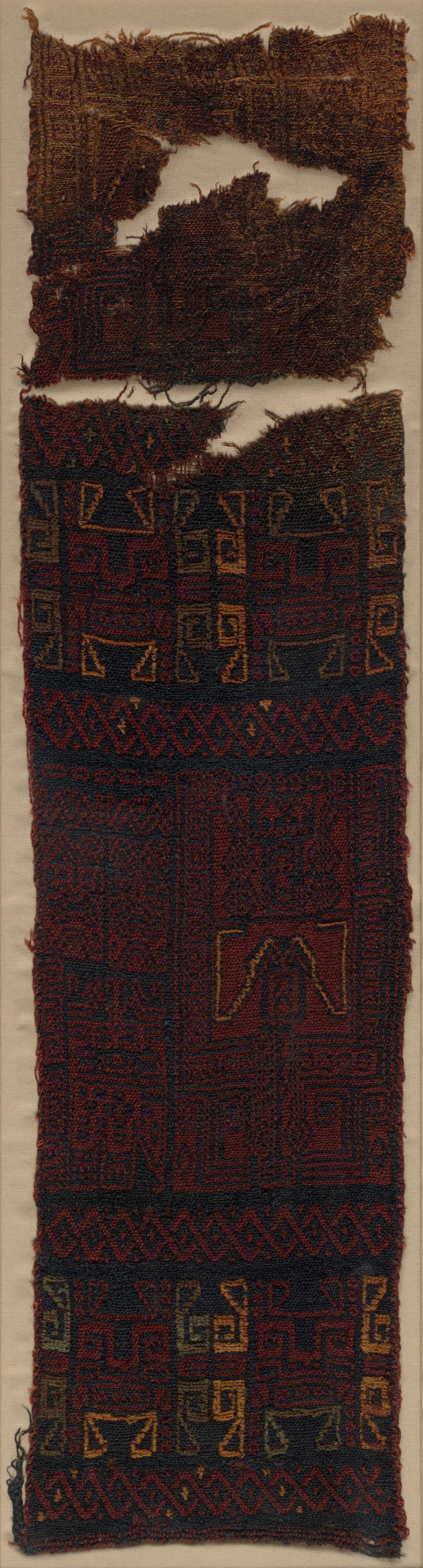
Subject Designation: Textile Fragment 94-X. Provisional Attribution: Paracas, Yauca Valley, South Coast Peru. Epoch: Approximately 500-200 BCE.
Technical Specification: Camelid fiber (presumed alpaca/vicuña). Construction: Double-cloth foundation with superimposed structural embroidery.
Analyst: Chief Fabric Deconstructionist, Zoey Fashion Lab.
Directive: Deconstruct narrative, technique, and spectral resonance for contemporary avant-garde application.
I. Structural Deconstruction: The Architecture of Dualism
The foundational double-cloth technique is not merely a method; it is a philosophical statement in thread. Two complete textile layers are woven simultaneously, interchanging at points to create the pattern. This generates a fabric that is inherently reversible, a perfect duality—two faces, one entity. The chosen structure suggests a Paracas worldview where the seen and unseen, the mortal and the supernatural, exist as inseparable counterparts. For the avant-garde, this is not historical craft but a prototype for modular fashion. Imagine garments that are functionally reversible yet narratively dichotomous: a structured blazer exterior that, when turned inside-out, reveals an embroidered, chaotic interior landscape—a dialogue between public persona and private psyche, rendered in a single, intelligent construction.
II. Iconographic Dissection: The Gaze of the Composite Being
The depicted frontal deity heads are not portraits; they are schematic power symbols. Their symmetrical, staring visages, often with streaming tear or moisture motifs, command the pictorial field. They are flanked and intertwined with stylized felines, likely representing the perilous power of the Andean mountain cat or pampas cat. This is not a decorative scene but a diagram of cosmic hierarchy and shamanic transformation.
For Zoey Lab’s avant-garde lexicon, this iconography is a masterclass in graphic intimidation and symbolic compression. The frontal gaze challenges the viewer, rejecting passive observation. This translates to garments that employ severe, symmetrical appliqués or laser-cut patterns across the chest or back, creating an unblinking “face” that engages the space around the wearer. The feline interlace is pure motion captured in static form—a blueprint for jacquard weaves or heat-transfer prints that suggest fluid, predatory movement across the garment’s architecture, perhaps distorting at the seams to imply transformation.
III. The Embroidery as Topography: Structural Haute Couture
Here lies the fragment’s most radical innovation: the embroidery is not surface decoration but structural embroidery. The colored threads, likely vibrant reds, greens, and yellows in their original state, are woven through both layers of the double-cloth, simultaneously embellishing and mechanically binding the strata. This creates a raised, textured topography where the iconography is both seen and felt—a tactile map of belief.
This technique is a direct precursor to the most radical principles of architectural haute couture. We can reconceive it as subcutaneous structuring. Instead of hidden boning, imagine functional embroidery using tensile, high-tech threads—Kevlar-infused or photochromic yarns—that provide sculptural support, shape the silhouette, and react to environmental stimuli. Seams become irrelevant; the “embroidery” lines themselves become the garment’s exoskeleton, tracing biomechanical pathways across the body, fusing decoration and load-bearing function into one.
IV. Archive Resonance & Avant-Garde Transmutation
The archival note references a later period of "cultural collision and aesthetic fusion" (16th-17th century). While chronologically distant from the Paracas fragment, this concept is the key to its modern relevance. This textile is itself an artifact of a collision—between the geometric and the organic, the human and the animal, the technical and the spiritual.
Our avant-garde interpretation must embrace a controlled collision. Imagine the solemn, ritualistic symmetry of the deity head shattered and re-composed using algorithms derived from glitch art. Envision the interlace pattern, once a sacred border, escaping its frame and cascading across garments in a disrupted, digital print, colliding with the severe lines of a tailored coat. The palette—once earth and mineral dyes—can be transmuted into hyper-saturated neons or desaturated, concrete grays, creating a jarring yet deliberate dialogue between ancient sacredness and postmodern syntheticism.
V. The Zoey Lab Prototype: "Dual Aspect No. 1"
From this analysis, a prototype manifesto emerges:
Garment: A long-line vestment, potentially a coat or dress.
Construction: Double-cloth system with a tech-wool exterior and a fluid silk-metal interior. The two layers are joined not by traditional seams but by lines of structural embroidery executed with shape-memory alloy wire.
Iconography: A stark, frontal graphic, inspired by the deity head, is rendered in a bonded, raised material on the back. From this graphic, a distorted, pixelated feline pattern—suggesting the interlace—flows over the shoulders and down the sleeves, dissolving at the cuffs.
Duality: The garment is fully reversible. The exterior presents a graphic, armored severity. The interior reveals the full, chaotic complexity of the embroidered topographic map, now in contrasting colors, touching the skin directly.
Narrative: It is a wearable thesis on protection and vulnerability, on the curated self versus the complex inner world, built upon the oldest principles of Andean textile wisdom.
This Paracas fragment is not a relic. It is a blueprint for intelligent fashion. It teaches us that structure is narrative, that embellishment can be foundational, and that true power lies in holding dualities in perfect, tensioned balance. Our task is not to replicate, but to resonate—to let the spectral frequencies of this ancient technology disrupt and redefine the contours of the contemporary body.