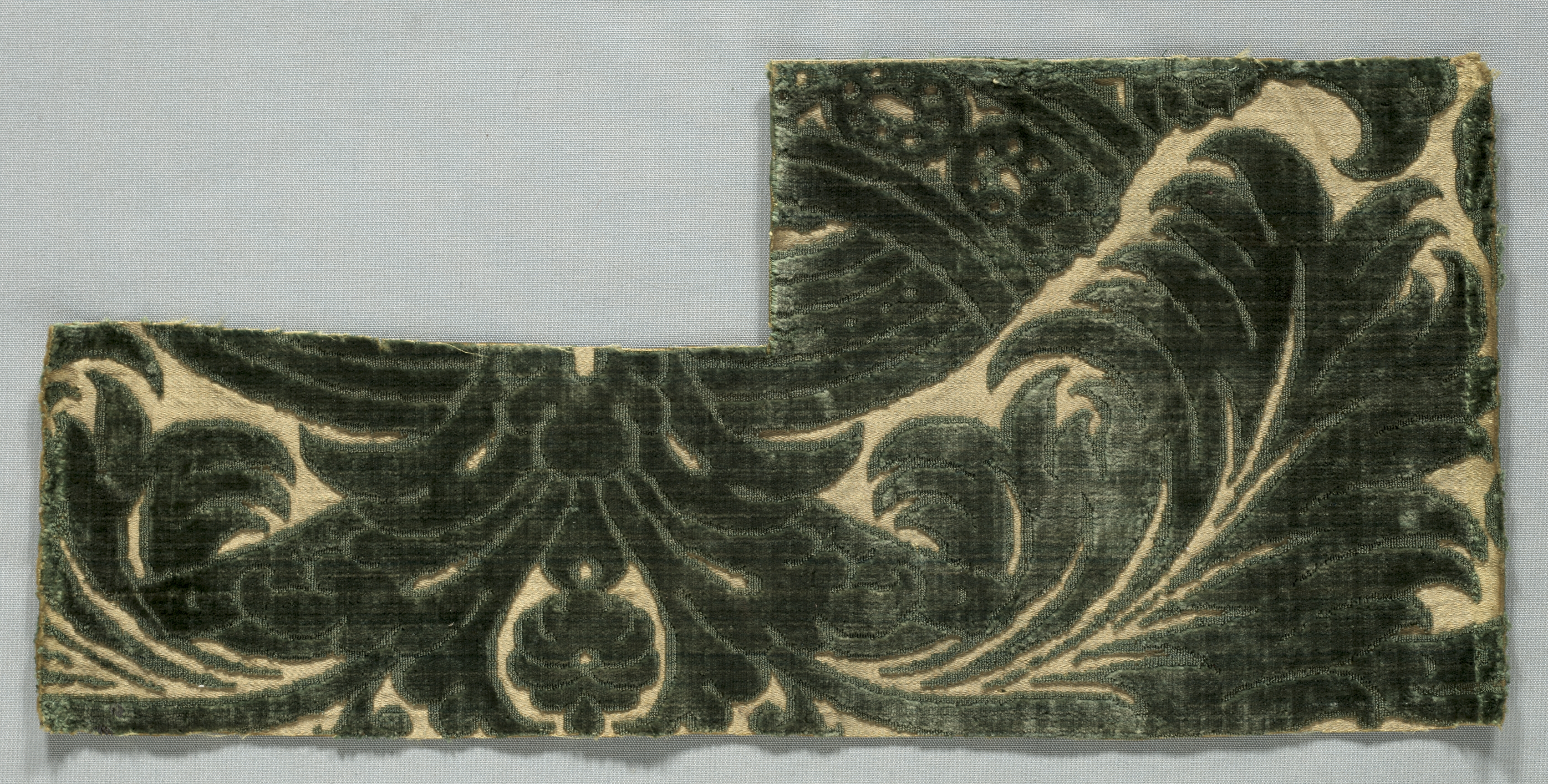
Fabric Deconstruction Report: The Velvet Fragment (Italy, Late 17th Century)
Origin and Historical Context
The velvet fragment under analysis originates from the Italian peninsula during the late 17th century, a period marked by the Baroque era’s opulence and the flourishing of textile manufacturing in cities such as Venice, Florence, and Genoa. Italian velvet of this epoch was renowned for its intricate weaving techniques, often commissioned for ecclesiastical vestments, aristocratic garments, and ceremonial upholstery. This fragment, measuring approximately 30 by 20 centimeters, retains a deep crimson hue—a color associated with power, wealth, and the Catholic Church—though age has softened its vibrancy to a muted burgundy. The fabric’s provenance suggests it was likely part of a larger panel, possibly from a chasuble or a palatial drapery, reflecting the era’s demand for luxury textiles that conveyed status and divine authority.
Technical Analysis of Velvet Construction
Velvet is a woven textile characterized by a dense pile of cut threads, created through a complex process of weaving two layers of fabric simultaneously and then cutting them apart. The Italian late 17th-century velvet fragment exhibits a silk warp and weft, with the pile formed from silk filaments that were dyed prior to weaving. The base structure, or ground weave, is a plain or twill weave, providing stability, while the pile threads are looped over wires and then cut to create the soft, plush surface. In this fragment, the pile height measures approximately 2 to 3 millimeters, indicating a medium-pile velvet typical of the period. The density of the pile is high, with approximately 40 to 50 loops per square centimeter, achieved through meticulous hand-weaving on a drawloom. The fragment’s edges show slight fraying and evidence of hand-stitching, suggesting it was once attached to a larger textile assembly. The silk threads, under microscopic examination, reveal a slight luster loss and surface abrasion, consistent with age and handling, but the structural integrity remains robust, with no significant delamination of the pile from the ground weave.
Avant-Garde Deconstruction: The New DNA Strand Concept
At Zoey Fashion Lab, we approach this velvet fragment not merely as a historical artifact but as a New DNA Strand—a genetic blueprint for reimagining textile innovation within an avant-garde framework. The fragment’s Baroque origins, with their emphasis on excess and ornamentation, are deconstructed to extract core elements: the tactile sensuality of the pile, the depth of color, and the interplay of light and shadow on the fabric’s surface. These elements are then recombined with contemporary techniques to forge a new aesthetic language. For instance, the velvet’s traditional cut-pile method is reinterpreted through laser-etched patterns that mimic the organic decay of the original fragment, creating a dialogue between historical craftsmanship and digital precision. The crimson dye, originally derived from cochineal insects, is analyzed for its molecular structure and replicated using bio-fabricated pigments, ensuring sustainability while preserving the chromatic intensity. This process transforms the velvet fragment into a living archive—a source code for generating textiles that challenge linear time and material hierarchy.
Material and Structural Innovations
The avant-garde reimagining of this velvet fragment involves a radical reconfiguration of its material properties. We propose a hybrid textile that integrates the original silk velvet with smart fibers—conductive threads that respond to environmental stimuli such as temperature or light. For example, the pile could be engineered to shift color when exposed to UV light, referencing the original dye’s sensitivity to aging while introducing a dynamic, interactive dimension. The ground weave is replaced with a biodegradable polymer matrix that mimics the silk’s tensile strength but allows for modular assembly, enabling the textile to be disassembled and reconfigured as a garment or architectural element. This approach aligns with the avant-garde ethos of deconstruction as creation, where the fragment’s historical identity is preserved as a ghost layer—visible through translucent overlays or embedded as micro-etchings—while the new structure asserts its own temporal logic. The result is a fabric that exists in multiple states simultaneously: artifact, prototype, and speculative design.
Avant-Garde Applications in Fashion
The avant-garde potential of this deconstructed velvet fragment lies in its ability to provoke new sensory experiences and conceptual narratives. In garment design, the hybrid textile could be used for a sculptural jacket that juxtaposes the original fragment’s Baroque opulence with stark, minimalist silhouettes. The pile might be selectively removed through laser ablation, creating negative spaces that reveal the underlying smart fibers, which could illuminate in response to the wearer’s movements. Alternatively, the fabric could be draped in asymmetrical layers, with the historical fragment serving as a focal point—a literal DNA strand embedded within a futuristic matrix of recycled metallic threads and bio-luminescent panels. This approach challenges the conventional hierarchy of fashion, where historical textiles are often relegated to archival status, by repositioning them as active agents in a continuous evolution of style. The velvet fragment becomes a catalyst for dialogue between past and future, inviting wearers to engage with textile history through a lens of radical innovation.
Conclusion: Redefining Textile Legacy
In conclusion, the analysis of this Italian late 17th-century velvet fragment reveals not only its technical mastery and historical significance but also its potential as a New DNA Strand for avant-garde fashion. By deconstructing its material and symbolic elements—the pile, the dye, the weave—and recombining them with contemporary technologies, Zoey Fashion Lab redefines the textile’s legacy. This fragment is no longer a relic of a bygone era but a living blueprint for a future where fashion transcends temporality, merging craft with computation, and heritage with hypermodernity. The avant-garde style demands such audacity: to see in a frayed edge a new beginning, and in a velvet thread, the promise of a new strand of creativity.