Technical Deconstruction: The Alsatian Loom and its Structural Legacy
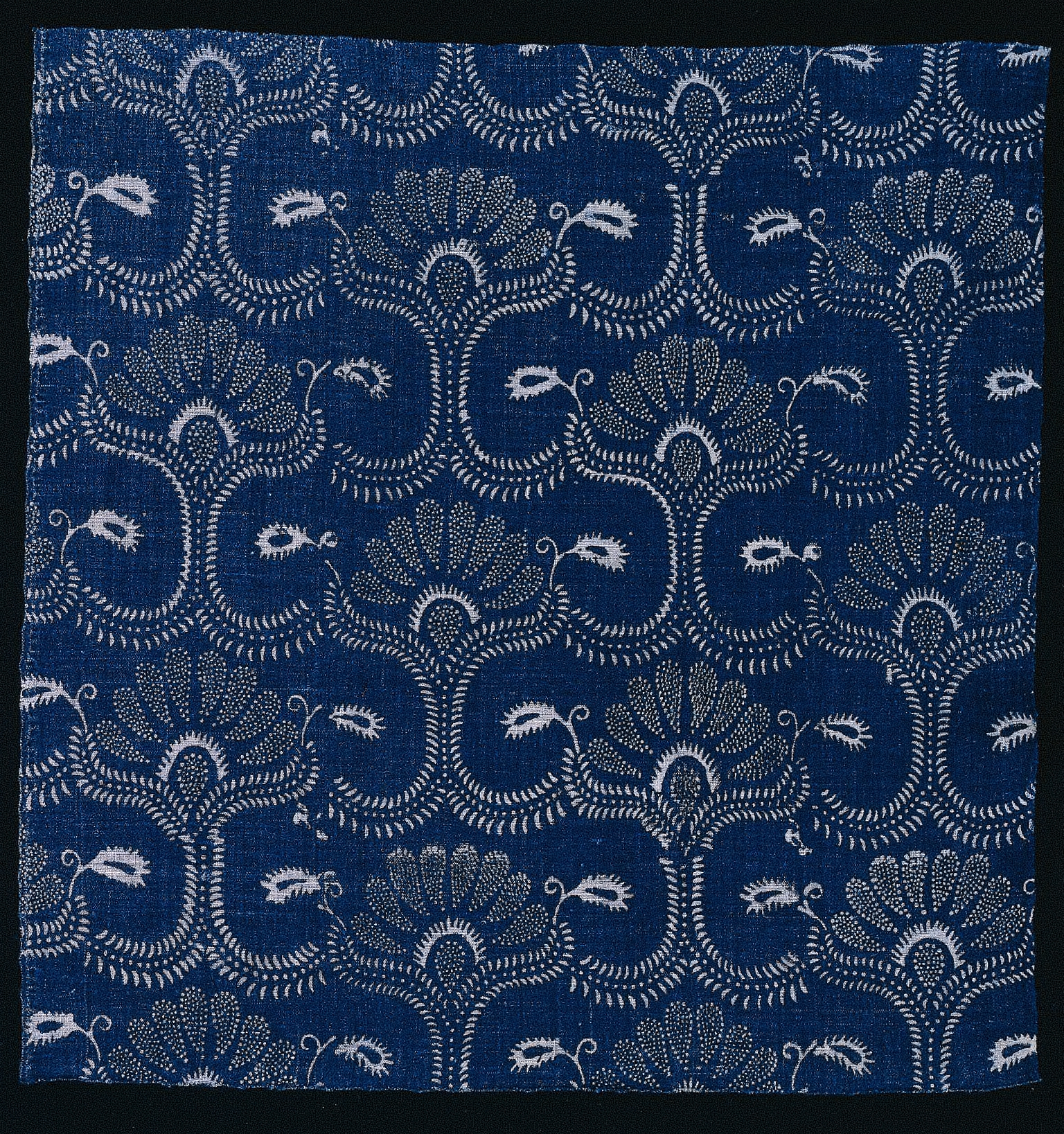
The artifact under scrutiny—a wax-resist, indigo-dyed textile from Sain-Bel, Alsace, circa 1780s—presents a paradox that defines the Zoey Fashion Lab methodology. Its loom width, a modest 52 centimeters, is not a limitation but a radical constraint that shaped the visual grammar of the stylized leaf design. In late 18th-century France, this width was standard for narrow handlooms used in domestic or small atelier production, yet within the context of avant-garde fashion deconstruction, it becomes a generative boundary. The repeat pattern of the leaf motif, printed via woodblock, aligns precisely with this width, creating a rhythmic verticality that anticipates modernist grid systems. The wax-resist technique, where molten wax is applied to resist indigo dye, produces a crackled, unpredictable line—a deliberate imperfection that challenges the industrial ideal of seamless repetition. For Zoey Fashion Lab, this width dictates pattern cutting: a garment constructed from such cloth must honor the seam, not hide it. The leaf design, rendered in a stylized, almost geometric silhouette, suggests a hybridization of botanical observation with the abstracting impulse of the woodblock carver. The indigo, sourced from woad or imported indigofera, yields a deep, almost black-blue that absorbs light, creating a velvety depth against which the white wax-resist lines vibrate. This is not mere decoration; it is a structural dialogue between the loom’s physical limits and the designer’s hand.
Cultural Resonance: The Archive as Avant-Garde Catalyst
The Archive Resonance statement—"器物与绘画不仅是时代技艺的结晶,更是文化碰撞与美学交融的无声见证"—finds its material echo in this textile. The stylized leaf is not a naturalistic rendering but a transcultural symbol. In late 18th-century Alsace, a region caught between French and German influences, the leaf motif could reference both the Blumenmalerei of German folk art and the chinoiserie that swept French courts after trade with East Asia expanded. The woodblock itself is a technology of repetition, a proto-industrial tool that democratized design by allowing multiple impressions. Yet the wax-resist step introduces an element of chance: each block strike leaves a unique residue, and the indigo bath’s temperature and pH alter the final hue. This interplay between control and chaos is the essence of avant-garde practice. Zoey Fashion Lab recontextualizes this as a design philosophy: the archive is not a mausoleum but a laboratory. The leaf, stripped of its botanical specificity, becomes a cipher for organic growth within rigid systems. The width of the loom—narrow enough to require piecing for a full garment—forces the designer to confront the cloth’s history. Every seam becomes a line of tension, a visual record of the weaver’s reach. In an era of digital printing and endless width, this constraint is a radical act of material honesty. The indigo’s fugitive nature—its tendency to fade and shift with light and washing—adds a temporal dimension: the garment will age, and its design will evolve. This is fashion as process, not product.
Avant-Garde Application: Deconstructing the Leaf, Reconstructing the Silhouette
For Zoey Fashion Lab, the stylized leaf design is not a motif to be reproduced but a generative algorithm. The woodblock’s repeat, at a 52-centimeter width, creates a modular unit that can be rotated, mirrored, or fragmented. An avant-garde collection might begin by isolating a single leaf, enlarging it via digital scanning, and translating its contour into a garment’s silhouette. The wax-resist crackle becomes a textural map for laser-cut perforations or hand-stitched embroidery. The indigo’s depth suggests layering: a sheer organza printed with a ghost of the leaf over a dense denim base. The loom width itself inspires a new pattern-cutting strategy: narrow panels sewn together with exposed seams, referencing the original cloth’s construction. The asymmetry of the woodblock impression—where the left edge might align perfectly but the right edge shows a slight offset—is celebrated as a design feature. Garments are cut on the bias to distort the leaf pattern, creating moiré effects that echo the crackle. The historical context of Alsace, a borderland, informs a narrative of hybridity: the collection might blend French tailoring with German folk embroidery techniques, using the leaf as a unifying symbol. The wax-resist process is revived in a contemporary form: instead of wax, a biodegradable polymer is applied to resist natural dyes derived from woad and indigo, honoring the original while pushing toward sustainability. The result is a deconstructed uniform—a coat whose panels are deliberately mismatched in pattern alignment, a dress whose hem reveals the selvedge of the original loom width. This is not nostalgia; it is an archaeology of the future.
Material Poetics: Indigo, Wax, and the Politics of Blue
The choice of indigo is laden with historical weight. In the late 18th century, indigo was a colonial commodity, its production tied to plantations in the Americas and India. Yet in Alsace, woad—a local plant—had been used for centuries before indigo’s importation. The textile thus embodies a tension between local and global. The wax-resist technique, known as batik in Southeast Asia, traveled to Europe via trade routes, adapting to local materials. Zoey Fashion Lab deconstructs this politics by using the blue as a neutral ground—a color that absorbs all others, symbolizing both depth and erasure. The stylized leaf, repeated across the width, becomes a pattern of repetition with difference, a concept borrowed from Jacques Derrida. Each block impression is slightly varied due to hand pressure, wax temperature, and dye absorption. This micro-variation is amplified in the avant-garde garment: a single leaf is isolated and embroidered in white thread, while another is bleached out, leaving a ghostly negative. The loom width’s constraint is transformed into a design principle: all garment pieces are derived from modules of 52 centimeters, forcing a modular construction that references both the original cloth and contemporary modular fashion systems. The indigo’s scent—earthy, slightly metallic—is preserved through natural mordants, making the garment an olfactory as well as visual experience. This is fashion as archival performance, where the wearer becomes a custodian of a material memory that spans centuries and continents.
Conclusion: The Loom as a Lens
The 52-centimeter loom width of this late 18th-century Alsatian textile is not a historical footnote but a critical tool for Zoey Fashion Lab’s avant-garde practice. It forces a reexamination of scale, repetition, and material agency. The stylized leaf, born from the intersection of woodblock precision and wax-resist chaos, becomes a metaphor for design itself: a negotiation between intention and accident. By deconstructing this artifact—its technical constraints, its cultural hybridity, its material poetics—we uncover a blueprint for fashion that resists the homogenizing forces of mass production. The garment is no longer a canvas for pattern but a structural argument, where every seam, every repeat, every fade tells a story. In the hands of Zoey Fashion Lab, the archive is not a relic but a resonance, a frequency that vibrates through time to inform a future of radical materiality. The leaf, once rooted in Alsatian soil, now grows into a global, avant-garde canopy.