Fabric Deconstructionist Analysis: The Halberd as Avant-Garde DNA
As the Chief Fabric Deconstructionist for Zoey Fashion Lab, I am tasked with dissecting not merely garments, but the very structural DNA of form, function, and materiality. Our latest subject—the German halberd—presents a profound challenge and an exhilarating opportunity. This weapon, historically a tool of war, is being re-imagined through the lens of our New DNA Strand concept, which seeks to weave the axial, the structural, and the biological into a single, cohesive avant-garde expression. The halberd is not a fabric; it is a skeletal blueprint for a new kind of wearable architecture.
Material Deconstruction: Steel and Wood as Textile Analogues
The Steel Blade: A Study in Perforated Rigidity
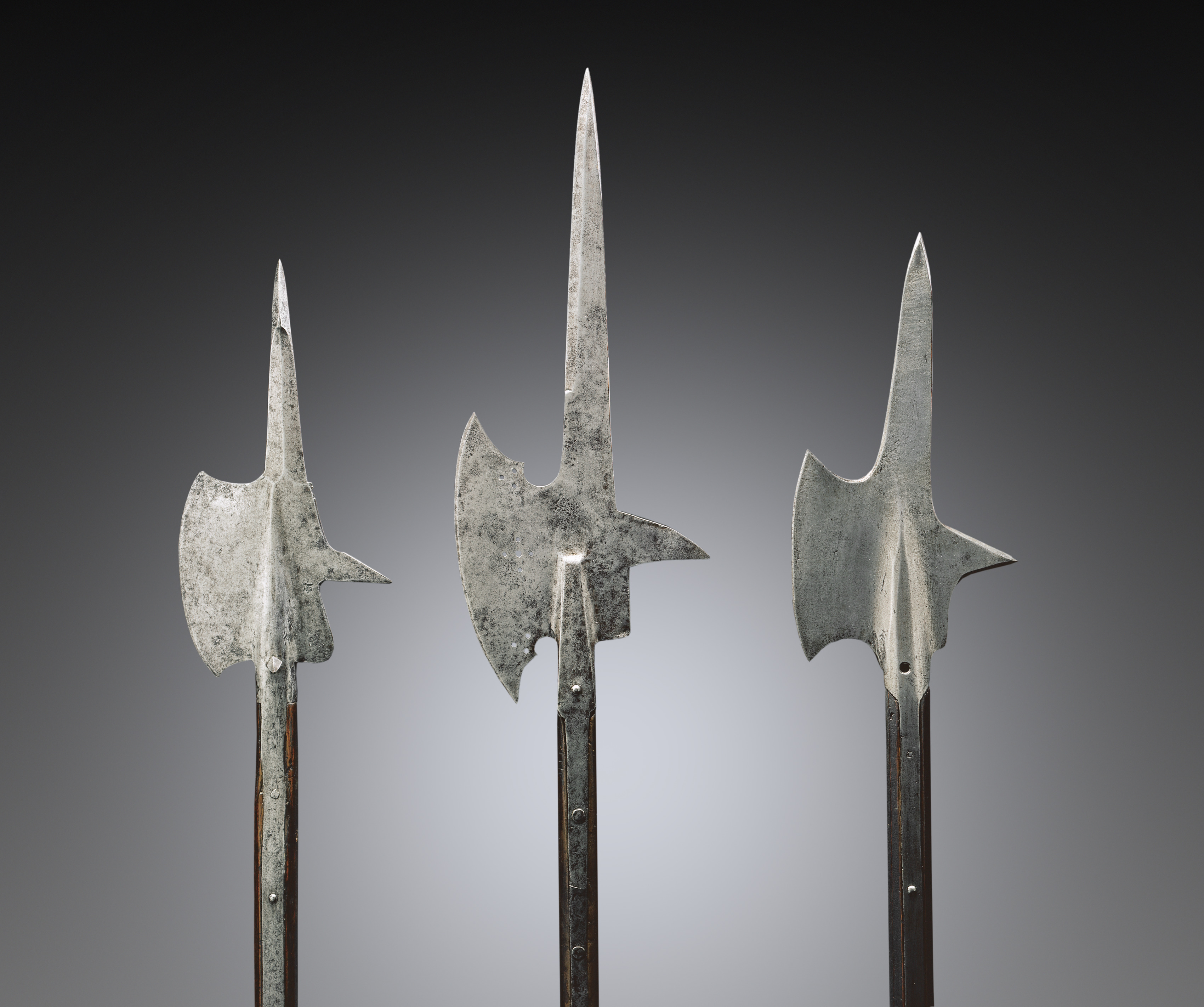
The steel component of the halberd, with its characteristic pierced circular holes, is the most direct challenge to traditional textile thinking. In our lab, we do not see a weapon; we see a rigid, perforated membrane. The circular holes are not merely decorative; they are structural apertures that speak to a deeper architectural logic. In the context of the New DNA Strand, these holes represent cellular nodes—points of connection, light, and breath within an otherwise impenetrable surface. The avant-garde application demands that we treat this steel as a metallic skin. The holes can be reinterpreted as negative-space embroidery, where the absence of material creates a pattern as potent as any thread. We can envision this as a laser-cut steel corset or a shoulder pauldron that mimics the halberd’s blade, but rendered in a flexible, perforated metal mesh. The circular apertures become the basis for a modular attachment system, allowing for the insertion of translucent polymers, organic fibers, or even illuminated elements. This transforms the halberd from a tool of violence into a wearable exoskeleton that breathes and adapts.
The Wooden Haft: The Organic Spine
The wood haft is the anatomical core of the halberd. In our deconstruction, it is not a handle but a vertebral column—a long, linear, organic structure that provides both support and movement. The natural grain of the wood, with its irregularities and growth rings, is a living texture that our New DNA Strand seeks to amplify. In an avant-garde context, the haft becomes a structural spine for a garment. We can imagine it as a back-brace or a central seam that runs the length of a coat, made from laminated, flexible wood veneers. The wood’s tactile warmth and organic irregularity contrast sharply with the cold, precise geometry of the steel. This dichotomy is the essence of the New DNA Strand: the fusion of the biological and the industrial. The haft’s length can be deconstructed into segmented, articulated panels that allow for movement, much like the vertebrae of a spine. These panels can be interwoven with fabric, creating a hybrid material that is both rigid and pliable. The wood’s natural color and grain become a chromatic base for the entire piece, grounding the metallic accents in a sense of earth and origin.
Avant-Garde Application: The New DNA Strand
From Weapon to Wearable Architecture
The New DNA Strand concept is about re-coding existing forms. The halberd, with its dual-material construction, is a perfect candidate for this re-coding. We are not interested in creating a costume that mimics a medieval weapon. Instead, we are extracting its core principles: the axial alignment of the haft and blade, the perforated structure of the steel, and the tension between organic and inorganic. The avant-garde garment we envision is a skeletal dress or a structural jumpsuit that uses the halberd’s geometry as its primary scaffolding. The wood haft becomes the central spine of the garment, running from the nape of the neck to the base of the spine. From this spine, steel-inspired panels extend outward, forming the shoulders, hips, and limbs. These panels are not solid; they are perforated with circular apertures that echo the halberd’s holes. These apertures serve multiple functions: they reduce weight, allow for ventilation, and create a visual rhythm that mimics the repetitive patterns of DNA base pairs. The garment becomes a living structure, where the holes are the nucleotides of a new fashion genome.
Texture and Contrast: The Avant-Garde Palette
The avant-garde aesthetic demands extreme contrast. The smooth, cold steel must be juxtaposed with the warm, textured wood. In our deconstruction, we propose a layered approach. The primary layer is a highly polished, perforated metal mesh that mimics the halberd’s blade. Over this, we place segments of treated wood veneer that are laser-cut into organic, flowing shapes. The wood is not left raw; it is carbonized or stained to achieve a deep, almost black finish, creating a monochromatic palette that emphasizes form over color. The circular holes in the steel are backed with translucent, resin-like material that can be illuminated from within, suggesting a bioluminescent quality. This aligns with the New DNA Strand’s focus on life and growth. The garment is not static; it glows, breathes, and moves with the wearer. The wood haft’s grain is accentuated through a high-gloss lacquer, making it appear almost liquid. The overall effect is one of controlled chaos—a harmonious discord between the rigid and the organic, the ancient and the futuristic.
Conclusion: The Halberd as a Genetic Marker
In conclusion, the German halberd, when deconstructed through the lens of Zoey Fashion Lab’s New DNA Strand, is not a historical artifact but a genetic marker for a new species of fashion. Its steel blade, with its pierced circular holes, becomes a perforated exoskeleton that is both protective and expressive. Its wood haft becomes an organic spine that grounds the design in natural form. The avant-garde application is not about replication but transformation. We are taking the halberd’s structural DNA and splicing it with contemporary materials and technologies to create a garment that is both a tribute to history and a leap into the future. This is the essence of our work at Zoey Fashion Lab: to deconstruct the past to construct the future, one fiber, one hole, one spine at a time.