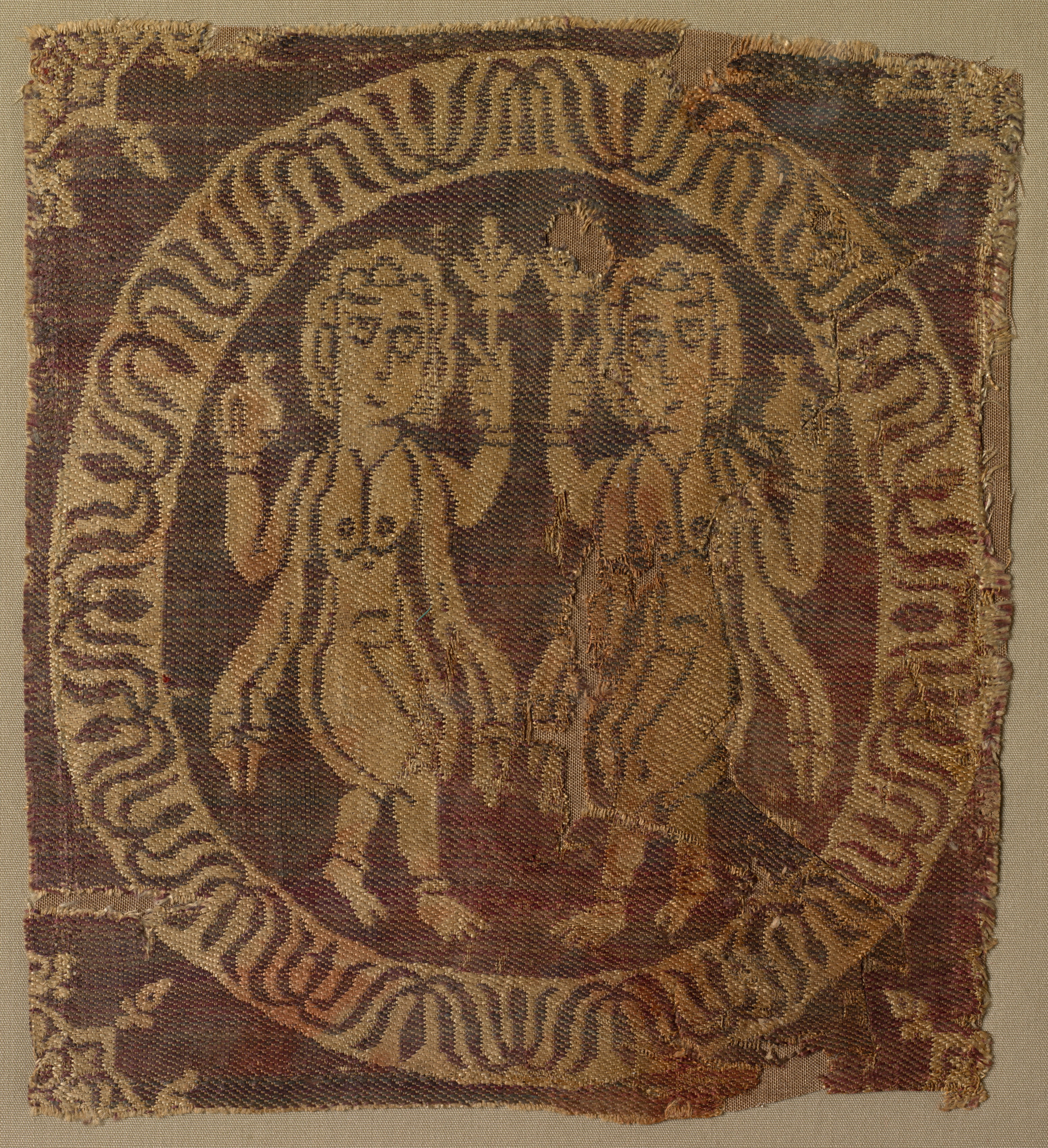
Deconstructing the Samite: An Avant-Garde Analysis of the Nude Female Dancers Tunic
At Zoey Fashion Lab, our mission is to unravel the fabric of history, extracting its hidden narratives and re-weaving them into the avant-garde. The subject of this analysis—a fragment of silk from the Umayyad or Abbasid period, depicting nude female dancers from a tunic—presents a profound challenge and an extraordinary opportunity. This is not merely an artifact; it is a textile DNA strand, a coded message from a sophisticated, cosmopolitan world. Our deconstruction will focus on three key areas: the technical mastery of the samite weave, the iconographic subversion of the female form, and the translation of this ancient code into a contemporary, avant-garde fashion statement.
Technical Mastery: The Samite Weave as a Structural Codex
The tunic fragment is executed in complementary weft-faced twill weave with inner warps, a technique known historically as samite. This is not a simple cloth; it is a complex, multi-layered system. The inner warps, often of a coarser material, act as a structural core, providing stability and weight. The outer, supplementary wefts—here, lustrous silk—create the patterned surface. This is a two-faced fabric, where the design on the front is mirrored, often in reverse colors, on the back. For the avant-garde designer, this duality is a goldmine. It speaks to the concept of the palimpsest, where multiple layers of meaning and material coexist.
The weft-faced nature of the weave means the weft threads completely cover the warp threads, creating a dense, almost painterly surface. The twill structure, with its diagonal ribs, adds a subtle, directional texture that catches light. The use of silk, a material of immense value and trade, places this garment within the context of the Silk Road, a network of cultural and commercial exchange. This is not a local craft; it is a globalized luxury good from the 8th or 9th century. For Zoey Fashion Lab, we see this as a prototype for sustainable, high-impact textile design. The samite technique demands precision and patience, qualities we champion in our slow-fashion, artisanal approach. We can deconstruct this weave by isolating its components: the inner warp as a hidden skeleton, the weft as a surface narrative. An avant-garde garment might expose these layers, perhaps through cutouts that reveal the inner structure, or by using contrasting materials (e.g., a recycled polyester core with organic silk weft) to comment on historical luxury versus modern sustainability.
Iconographic Subversion: The Nude Female Dancers as Agents of Disruption
The imagery of nude female dancers is both provocative and instructive. Within the Umayyad and Abbasid courts, such depictions were common in secular art, adorning palaces, ceramics, and textiles. They are not merely decorative; they represent a performance of power, pleasure, and the exotic. The dancers, often depicted with flowing hair, jewelry, and transparent garments, embody a controlled sensuality. Their nudity is not raw but stylized, a part of a courtly aesthetic that celebrated the human form as a vessel for luxury and refinement. This is a far cry from the modern, often commodified, nude. Here, the female body is a site of agency and artistry, not passive objectification.
For the avant-garde, this iconography is a weapon. We can subvert the original context by decontextualizing and recontextualizing the dancers. Imagine a garment where the dancers are printed or woven onto sections of the fabric that are deliberately distorted—perhaps through pleating, shirring, or asymmetrical draping. This disrupts the viewer’s ability to consume the image easily. The dancer becomes a ghost in the machine of the garment, appearing and disappearing as the wearer moves. Alternatively, we can isolate a single dancer’s hand or foot, enlarging it to an abstract, almost architectural scale. This removes the erotic charge and transforms the body part into a structural element—a clasp, a strap, a pocket. The dancers can also be juxtaposed with contemporary symbols of female power: a dancer’s pose mirrored in a robotic arm, or her flowing hair becoming a cascade of metallic chains.
Translating the DNA Strand: An Avant-Garde Collection Concept
Drawing from this analysis, Zoey Fashion Lab proposes a collection titled "Samite Ghosts." The central concept is the incomplete archive. Just as this tunic fragment is a surviving piece of a larger whole, each garment in the collection will be deliberately fragmented, layered, and partially obscured. The key elements are as follows:
1. The Inner Warp as Exoskeleton: Garments will feature visible, structural “bones” made from a stiff, recycled material (e.g., 3D-printed bioplastic or reclaimed metal). These bones mimic the inner warps of the samite, supporting flowing panels of silk or silk-like materials. The dancer imagery will be printed or woven onto these panels, but only in sections, creating a sense of archaeological reveal. A dress might have a corset-like exoskeleton that holds a single, floating panel depicting a dancer’s torso, leaving the rest of the garment transparent or absent.
2. The Weft as a Narrative Surface: The dancer imagery will be treated as a surface code that can be manipulated. Using digital printing and laser-cutting, we will create patterns where the dancers appear to dissolve into the twill texture. Some garments will have the dancers printed in reverse on the inside, visible only through transparent mesh or cutouts. This plays with the samite’s two-faced nature and the idea of hidden histories. A coat might have a lining that reveals a full dancer tableau, visible only when the wearer opens the garment.
3. The Dance as Movement: The dancers’ poses are inherently dynamic. We will capture this through kinetic design elements. Garments will include articulated panels, weighted hems, and strategic slits that create movement. A skirt might have a series of overlapping, semicircular panels that, when the wearer walks, mimic the swirling motion of a dancer’s skirt. The dancers’ hands and feet will be used as graphic motifs for closures—a hand-shaped clasp, a foot-shaped zipper pull.
4. Material Dialogue: The original silk will be honored but challenged. We will pair high-lustre silk with matte, industrial materials like neoprene or felt. This creates a tension between the historical and the contemporary, the luxurious and the utilitarian. The color palette will be drawn from the fragment: deep indigo, faded gold, ochre, and bone white, but with unexpected accents of neon or reflective materials. This is not a costume; it is a critical commentary on the ways we dress our bodies with history.
Conclusion: The Garment as a Living Archive
The nude female dancers from a tunic are not a relic to be preserved under glass. They are a living DNA strand that can be spliced, edited, and re-expressed. By deconstructing the samite weave, we reveal the structural DNA of the garment. By subverting the iconography, we challenge the historical gaze. And by translating these elements into an avant-garde collection, we create a fashion that is not about the past, but about the future of memory. At Zoey Fashion Lab, we do not replicate history; we recode it. The result is a garment that is both a museum and a manifesto, a dance between the ancient and the radical.