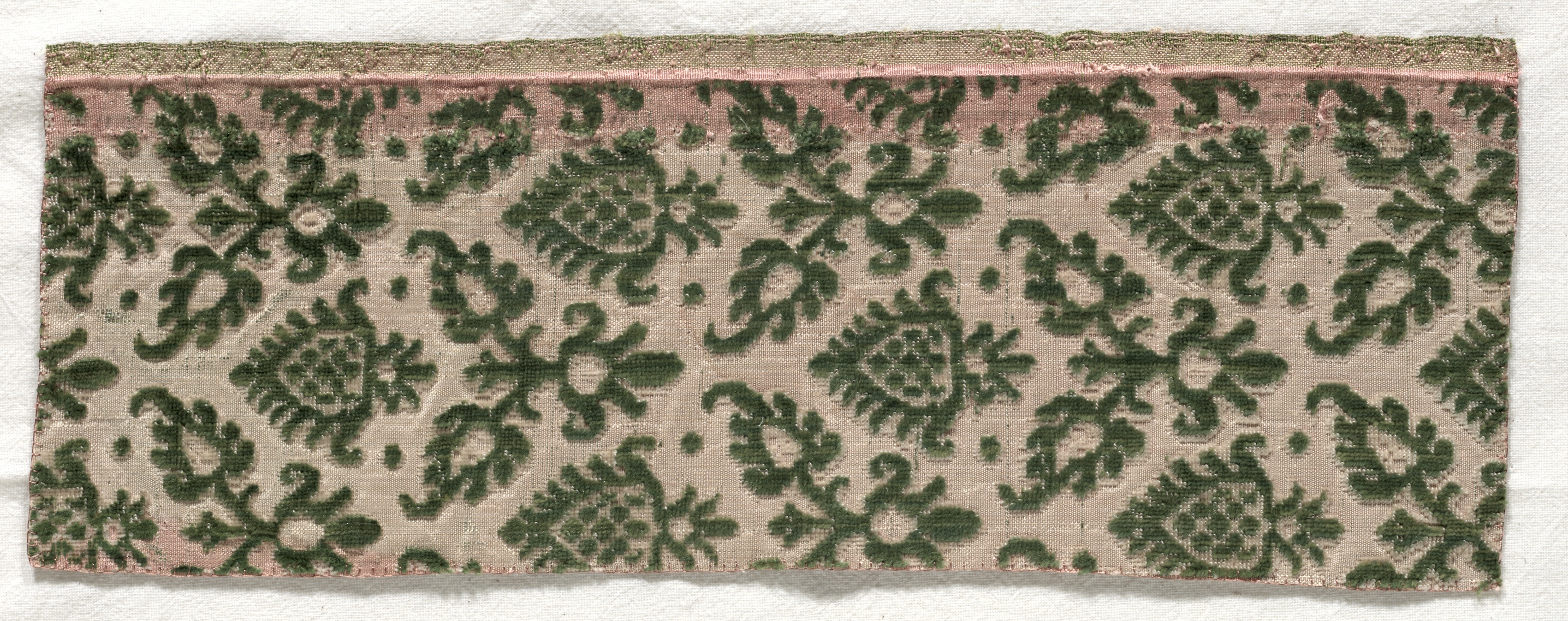
Analysis of a 16th-Century Italian Velvet Fragment: A New DNA Strand for Avant-Garde Design
As Chief Fabric Deconstructionist for Zoey Fashion Lab, I am tasked with interrogating historical textiles not as relics, but as living blueprints. The subject of this analysis—a fragment of Italian velvet from the 16th century—presents a profound opportunity. This is not merely a piece of fabric; it is a genetic code of opulence, craftsmanship, and tactile memory. Its technical composition, a masterful interplay of cut and uncut velvet on a silk ground, offers a complex syntax of light, shadow, and texture. For Zoey Fashion Lab, this fragment is not a historical curiosity but a New DNA Strand—a foundational sequence to be decoded, recombined, and expressed through the lens of avant-garde fashion.
Technical Deconstruction: The Cut and Uncut Velvet Paradox
The fragment’s core technical innovation lies in its dual-pile construction. Velvet, by definition, is a warp-pile weave where extra sets of warp yarns are looped over wires. In this 16th-century specimen, the artisan employed both cut velvet (where the loops are severed, creating a soft, dense, reflective pile) and uncut velvet (where loops remain intact, forming a matte, ribbed, and more durable surface). This juxtaposition is not decorative whimsy; it is a deliberate narrative device. The cut areas—likely forming floral motifs or arabesques—rise like islands of luxurious depth, while the uncut ground provides a quiet, textured field. The contrast between the two creates a dynamic optical illusion: the cut pile catches light and appears to glow, while the uncut loops absorb it, producing a subtle chiaroscuro effect.
From a deconstructionist perspective, this technique is a binary system of touch and sight. The cut pile invites the hand to sink into its plushness; the uncut loops resist, offering a gritty, almost abrasive friction. This tactile duality is a precursor to the sensory dissonance that defines avant-garde fashion. For Zoey Fashion Lab, this fragment teaches us that texture is not a single note but a chord. We must replicate this interplay using modern materials—perhaps by combining micro-suede with laser-cut silicone or by embedding fiber-optic threads that simulate the cut pile’s light capture while leaving uncut, matte zones of conductive fabric.
Historical Context and Material Integrity
The fragment originates from 16th-century Italy, a period when velvet was the currency of power. Florence, Venice, and Genoa were epicenters of velvet production, using silk imported from the East and dyes derived from cochineal, kermes, and woad. The silk ground of this fragment is a testament to the era’s obsession with material purity. Silk’s natural luster and strength allowed the velvet to drape with a liquid weight, while its protein-based fibers could absorb dyes to an extraordinary depth. The fragment’s survival—its colors perhaps faded yet still vibrant—speaks to the durability of this ancient biotechnology.
For Zoey Fashion Lab, this historical context is not about nostalgia but about material ethics. We must ask: How do we honor the labor and resource intensity of this silk without replicating its environmental cost? The answer lies in bio-fabrication. We can engineer a silk analogue from yeast-fermented proteins or lab-grown spider silk, maintaining the same tensile strength and dye affinity while eliminating the ecological toll of sericulture. The velvet pile can be recreated using recycled polyester microfibers or even mushroom mycelium, which can be grown in cut and uncut patterns. This fragment’s DNA becomes a template for sustainable luxury.
The Avant-Garde Translation: From Fragment to Fashion Statement
The avant-garde style demands that we rupture the original while preserving its essence. For Zoey Fashion Lab, this fragment will not be reproduced as a panel or a trim. Instead, we will treat its structural logic as a generative algorithm. The cut/uncut duality will be translated into a garment’s architecture: a coat where the body is cut velvet (dense, luminous, protective) and the sleeves are uncut (matte, flexible, breathable). The contrast becomes a metaphor for the human condition—vulnerability versus strength, exposure versus concealment.
We will also deconstruct the scale. The original fragment’s motifs are likely small and repetitive, designed for a full-length gown or altar cloth. In the avant-garde context, we will blow these patterns up to monumental proportions—a single cut-velvet rose the size of a torso, surrounded by an uncut velvet void. This scaling creates a visual shock that forces the viewer to reconsider the fragment’s intimacy. The silk ground, once a passive backdrop, will become an active participant through digital embroidery of historical text or binary code, embedding the fragment’s story into the garment’s very fibers.
Incorporating the New DNA Strand Concept
The fragment is not a finished garment but a genetic strand—a sequence of instructions for form, texture, and light. For Zoey Fashion Lab, this means we must clone, mutate, and hybridize. We will create a digital twin of the fragment using 3D scanning and photogrammetry, then algorithmically generate variations: one where the cut pile is replaced with thermochromic fibers that change color with body heat; another where the uncut loops are woven with shape-memory alloys that curl into petals when exposed to humidity. These are not copies but descendants of the original DNA.
Furthermore, the fragment’s structural integrity offers a lesson in deconstruction. The cut pile, by nature, is fragile—the loops are severed, leaving the pile vulnerable to crushing. In our avant-garde interpretation, we might exaggerate this fragility by leaving edges raw, allowing the pile to fray and shed. This impermanence becomes a statement on fashion’s temporality. Alternatively, we could reinforce the cut pile with a flexible polymer backing, transforming it into a sculptural armor that retains the velvet’s softness but gains structural rigidity—a paradox that defines the avant-garde.
Conclusion: A Living Archive
This 16th-century Italian velvet fragment is not a museum piece. It is a living archive of techniques, materials, and sensory experiences. For Zoey Fashion Lab, it represents a challenge: to honor its historical DNA while breaking its genetic code to create forms that have never existed. By deconstructing its cut and uncut velvet, its silk ground, and its tactile duality, we can engineer garments that are at once ancient and futuristic, luxurious and sustainable, intimate and monumental. The fragment whispers of Renaissance opulence; we will make it shout in the language of avant-garde design. This is the work of the Chief Fabric Deconstructionist—to see the past not as a tomb, but as a womb.