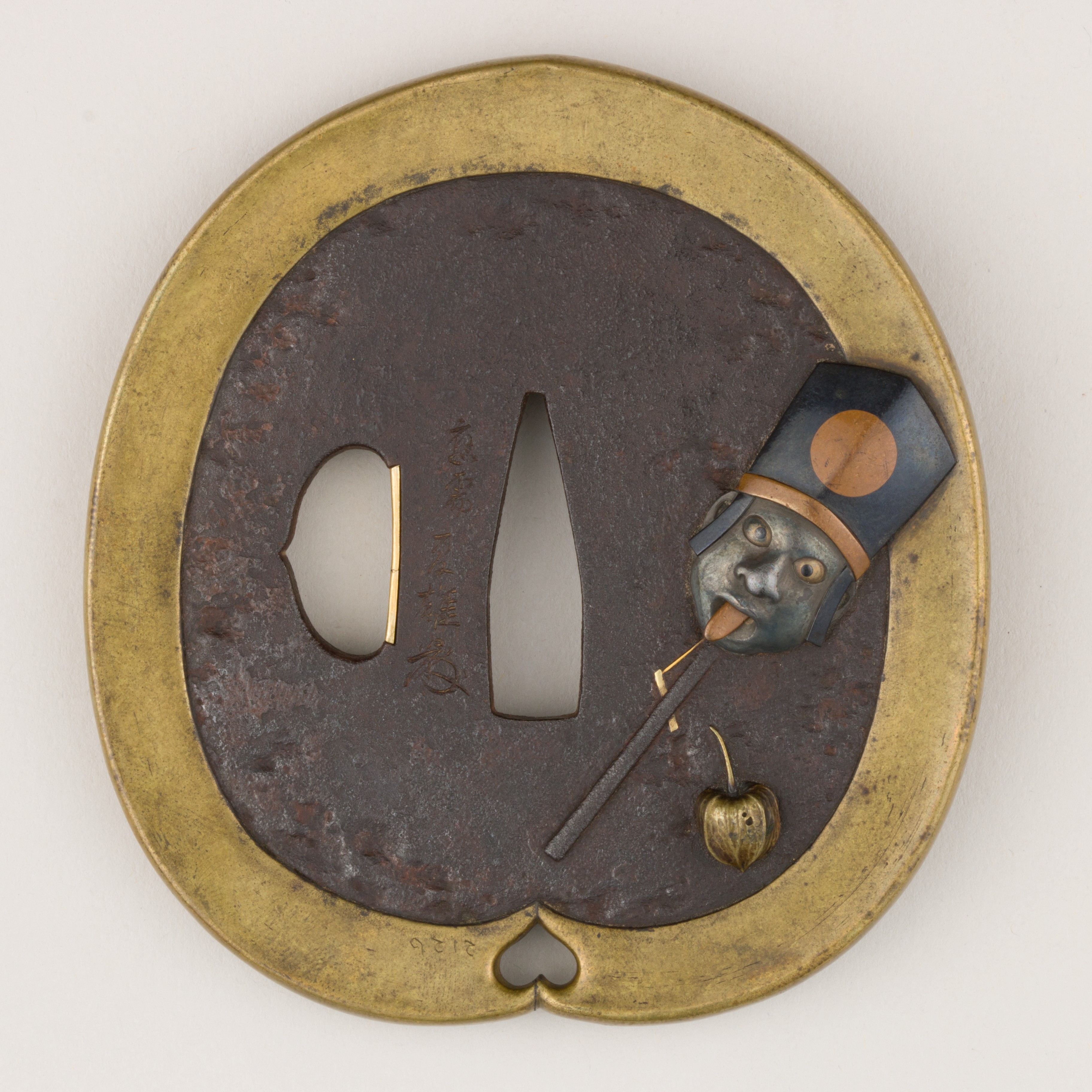
Deconstructing the Tsuba: An Avant-Garde Blueprint for SS26
The Japanese tsuba, a sword guard traditionally designed for function and symbolic potency, offers a radical departure point for the SS26 collection at Zoey Fashion Laboratory. Specifically, the Sword guard (Tsuba) Depicting Head on Stick Toy—crafted from iron, brass, gold, copper, and the revered copper-gold alloy shakudō—is not merely an artifact of Edo-period craftsmanship. It is a manifesto for deconstructive aesthetics, a blueprint for futuristic silhouettes, and a high-concept study in structural innovation. This analysis deconstructs the tsuba’s material language, visual narrative, and architectural logic, translating them into a definitive avant-garde couture framework for the coming season.
Material Alchemy: From Shakudō to Structural Skin
The Chromatic Dissonance of Patina and Precious Metal
The tsuba’s material palette is a masterclass in controlled dissonance. The shakudō—a dark, indigo-black alloy—provides a grounding, almost abyssal backdrop, while brass, gold, and copper erupt in stark contrast. For SS26, this translates into a layered, metallic textile system. Imagine a base of oxidized, matte-black technical jersey or bonded neoprene, representing the iron core. Overlaid are laser-cut, patinated brass scales that mimic the tsuba’s textured surface, but with a futuristic twist: these scales are not static; they are articulated, modular panels attached via magnetic or micro-hinge systems, allowing the garment to shift and reconfigure on the body. The gold and copper accents—applied as foil-stamped leather straps or hand-embroidered metallic threads—create a visual rhythm of disrupted symmetry, echoing the tsuba’s asymmetrical motifs. This is not decoration; it is functional armor for the post-human form.
Deconstructing the Alloy: A New Textile Lexicon
The alloyed nature of shakudō—a fusion of copper and gold—suggests a hybrid textile approach. We propose a biomimetic knit structure that interweaves copper-infused yarns with recycled gold-plated filaments. The result is a fabric that changes color under different light conditions, echoing the tsuba’s subtle luster. This material can be heat-bonded into sculptural pleats or laser-perforated to create a lattice that references the tsuba’s openwork designs. The garment becomes a living alloy, a second skin that reflects the wearer’s environment and movement.
Futuristic Silhouettes: The Head on a Stick Toy as Structural Provocation
Asymmetric Volumetrics and Suspended Geometry
The central motif—a head on a stick toy—is a jarring, almost surreal image. It demands a deconstructive approach to silhouette. For SS26, this translates into a series of asymmetric, cantilevered forms. Picture a jacket where one shoulder is exaggerated into a floating, spherical volume—a nod to the “head”—connected to the body by a single, rigid, gold-plated strut (the “stick”). The opposite side is stripped down to a bare, athletic cut, creating a dramatic tension between mass and void. The “toy” aspect suggests playfulness, but with a dark, avant-garde edge. This could be realized through inflatable, structural inserts within a sheer organza shell, allowing the silhouette to be manipulated by the wearer—a living sculpture that defies static form.
The Stick as Linear Architecture
The stick element is not merely a support; it is a linear architectural principle. We interpret this as a series of exoskeletal seams that run along the garment’s surface, constructed from rigid, polished brass or carbon fiber tubing. These lines do not follow the body’s natural curves; instead, they cut across and redirect the fabric, creating sharp, angular folds. A dress might feature a single, continuous brass rod that spirals from the waist, up the back, and over the shoulder, anchoring a cape-like panel that floats behind the wearer. This is structural innovation as narrative: the stick becomes a spine, a weapon, a line of flight.
Structural Innovation: Modularity and the Deconstructive Aesthetic
Modular Components and Reconfigurable Garments
The tsuba’s construction—a composite of separate metal pieces—lends itself directly to modular couture. For SS26, we propose garments composed of interchangeable, magnetic panels. A base bodysuit in matte black shakudō-inspired fabric serves as the canvas. Attachable components—a copper-plated shoulder guard, a brass “head” pendant that clips onto a gold chain, a series of iron-toned, articulated sleeves—can be swapped, layered, or removed. This deconstructs the idea of a fixed garment, allowing the wearer to assemble a look that reflects their identity or mood. The tsuba’s function as a protective guard is reimagined as psychological armor—a modular system for self-curation.
Negative Space and the Void in Couture
The tsuba’s openwork areas—the voids between metal elements—are as important as the solid forms. In couture, this translates to strategic cutouts, laser-etched lattices, and transparent mesh inserts. A gown might feature a full, iron-like skirt in heavy duchesse satin, but with a geometric void carved from the hip to the hem, revealing a sheer, gold-threaded underlayer. This negative space creates a dynamic interplay of presence and absence, echoing the tsuba’s visual tension. The void is not an absence; it is a space for movement, light, and the body’s own narrative.
Deconstructive Seaming and Exposed Construction
The tsuba’s raw, metallic edges are a testament to its handcrafted nature. For SS26, we celebrate exposed construction. Seams are not hidden; they are accentuated with brass rivets or gold thread topstitching. Hems are left unfinished, fraying into metallic fringes that mimic the tsuba’s textured surface. Linings are deliberately visible, perhaps in a contrasting copper silk, turned outward to form a deconstructive lapel. This approach honors the tsuba’s honest materiality while pushing the boundaries of traditional tailoring. The garment becomes a diagram of its own making, a study in structural logic.
Conclusion: The Tsuba as a Catalyst for Avant-Garde Evolution
The Sword guard (Tsuba) Depicting Head on Stick Toy is far more than a historical artifact. It is a provocative design thesis for Zoey Fashion Laboratory’s SS26 collection. By deconstructing its material alchemy—from shakudō’s dark patina to the defiant gold accents—we unlock a new textile lexicon. By reinterpreting its surreal motif, we forge futuristic silhouettes that balance asymmetry with architectural rigor. And by embracing its modular, deconstructive logic, we pioneer structural innovations that redefine the garment as a living, reconfigurable system. This is not fashion as ornament; it is couture as critical theory, a wearable meditation on protection, play, and the fragmented self in a post-industrial age. The tsuba’s head on a stick is no longer a toy; it is a compass pointing toward the avant-garde frontier.