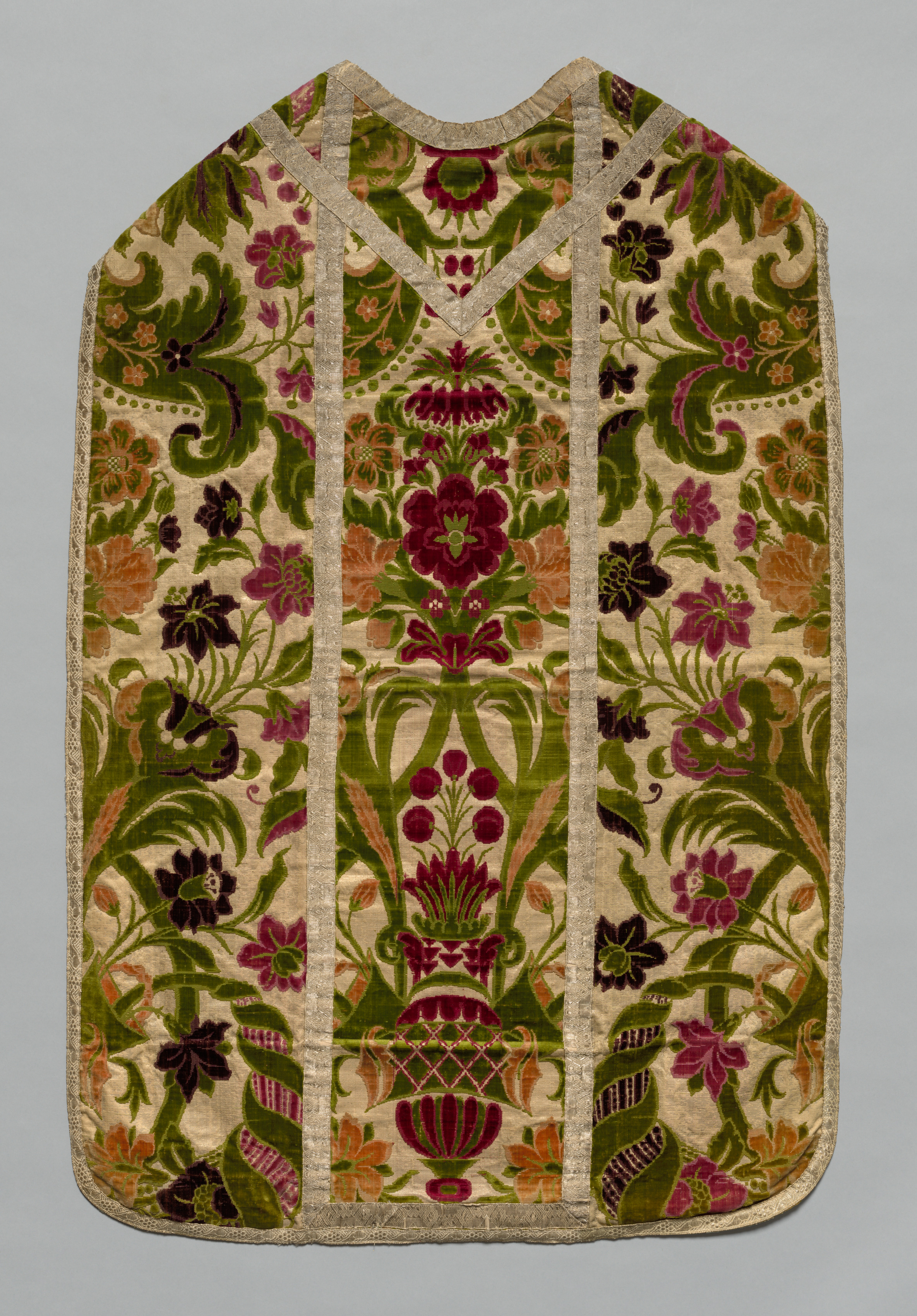
Deconstructing the Chasuble: An Avant-Garde Analysis of Genoese Silk and Gilt Metal Velvet
At Zoey Fashion Lab, our mission is to unravel the architectural and cultural DNA of historical textiles, repurposing them as blueprints for radical, future-facing design. The subject of this analysis—a chasuble from Genoa, Italy, woven from silk and gilt metal threads in a cut and uncut velvet technique—presents a uniquely potent case study. This garment, traditionally a liturgical vestment, is not merely an artifact of religious ceremony. It is a complex system of material, technique, and symbolism that, when deconstructed through an avant-garde lens, reveals a new "DNA strand" for contemporary fashion. We will examine its technical composition, its historical weight, and its potential to be re-engineered into a garment that challenges the very definition of wearable art.
Technical Analysis: The Woven Architecture of Opulence
The chasuble’s primary technical innovation lies in its dual-thread construction: silk and gilt metal. The silk provides a fluid, absorbent base, capable of holding complex dye structures and offering a soft, matte contrast to the metal. The gilt metal—typically a fine strip of silver or copper coated in gold and wound around a silk core—introduces a rigid, reflective element. This is not a simple mixture; it is a deliberate tension between softness and hardness, absorption and reflection.
The cut and uncut velvet technique further complicates this material dialogue. In velvet, the pile is created by weaving an extra warp thread over metal rods or wires. When the wires are removed, the loops can be left intact (uncut velvet, creating a dense, shimmering surface) or sliced open (cut velvet, producing a soft, plush texture with a deeper color saturation). In this chasuble, both techniques coexist. The uncut loops catch light in a uniform, almost pixelated manner, while the cut areas create deep, shadowy voids. This interplay generates a three-dimensional, topographical surface—a landscape of light and dark, smooth and rough. The gilt metal threads, woven into both the ground and the pile, ensure that even the cut sections retain a metallic glimmer, preventing total absorption of light.
From a structural standpoint, the chasuble’s shape is deceptively simple: a large, semicircular or bell-shaped garment with a central opening for the head. However, the weight of the metal threads and the density of the velvet create a specific drape. The garment does not flow freely; it hangs with a deliberate, almost sculptural stiffness. This is not a fabric that moves with the body; it is a fabric that the body moves within, a wearable architecture. The cut and uncut velvet acts as a kind of micro-architecture, with the pile heights creating a textured surface that can be read as a form of data—a tactile code of opulence and ritual.
Historical Context: Genoa as a Nexus of Luxury and Power
Genoa, during the Renaissance and Baroque periods, was a dominant force in the production of luxury velvets, particularly those incorporating metal threads. The city’s maritime trade networks brought raw silk from the East and gold from the Americas, while its skilled weavers developed techniques that were unmatched in Europe. The chasuble, as a liturgical garment, was a primary vehicle for this craftsmanship. It was not merely clothing; it was a statement of institutional wealth and divine authority. The use of gilt metal threads and complex velvet techniques transformed the priest into a living icon, a figure whose garment shimmered with the light of heaven and the gold of earthly power.
The symbolic weight of this chasuble is immense. The metal threads represent the immutable, the eternal, and the divine. The silk represents the human, the soft, and the perishable. The cut velvet, with its plush depth, can be read as a metaphor for the interior life, the soul, while the uncut velvet, with its uniform loops, suggests the outward, ordered presentation of faith. The garment’s shape—enveloping, concealing, and elevating the wearer—reinforces the idea of transformation. The priest is not an individual; he is a vessel for the sacred.
This historical context is crucial for the avant-garde designer. We are not simply borrowing a shape or a pattern; we are inheriting a system of meaning. The chasuble’s DNA is encoded with power, ritual, and material excess. To deconstruct it is to question these codes and reassemble them in a new, critical context.
Avant-Garde Re-Engineering: The New DNA Strand
For Zoey Fashion Lab, the chasuble is a starting point for a new design paradigm. We identify three key DNA strands to extract and mutate:
1. The Material Paradox: Rigidity vs. Fluidity. The original chasuble’s stiffness is a limitation in traditional fashion, but in avant-garde design, it is an opportunity. We can re-engineer the cut and uncut velvet structure to create garments that are both structural and responsive. Imagine a coat where the uncut velvet sections are programmed to expand and contract with body heat, creating a living, breathing surface. The gilt metal threads could be replaced with conductive fibers, turning the garment into a wearable interface that responds to touch or light. The paradox of soft silk and hard metal is translated into a dialogue between organic and synthetic, passive and active.
2. The Topographical Surface: Data as Texture. The cut and uncut velvet creates a surface that is not flat but dimensional. In an avant-garde context, this topography can be used to encode information. The pile heights could represent data points—heart rate, environmental pollution levels, social media activity—creating a garment that is a living data visualization. The gilt metal threads become the conductive pathways, while the silk base acts as the substrate. The chasuble’s traditional role as a symbol of divine order is subverted into a symbol of personal, digital identity.
3. The Ritual Silhouette: From Liturgical to Liminal. The chasuble’s enveloping shape, which obscures the body’s natural form, is a powerful tool for the avant-garde. It can be deconstructed into modular components: a detachable collar that functions as a sound amplifier, a cape that projects holographic imagery, or a train that records and replays footsteps. The garment no longer serves a single, fixed ritual; it becomes a platform for multiple, personal rituals—of protest, performance, or meditation. The central opening, originally for the head, can be reimagined as a portal for the voice, a speaker, or a camera lens.
Conclusion: The Chasuble as a Blueprint for the Future
The Genoese silk and gilt metal chasuble is far more than a historical curiosity. It is a sophisticated material system, a repository of cultural power, and a sculptural form. By deconstructing its technical and symbolic DNA, Zoey Fashion Lab can re-engineer it into an avant-garde garment that speaks to our contemporary moment—a moment defined by digital saturation, environmental anxiety, and a search for new rituals. The cut and uncut velvet becomes a metaphor for the layered, often contradictory nature of modern identity. The gilt metal threads, once symbols of divine wealth, become conduits for personal data. The chasuble’s rigid, enveloping shape becomes a platform for fluid, interactive expression.
In this analysis, we have not simply described a garment; we have decoded its potential. The new DNA strand is not a copy of the original but a mutation—a radical, critical, and beautiful reimagining of what a garment can be. For the avant-garde designer, the past is not a museum; it is a laboratory. And in this laboratory, the chasuble is our most promising specimen.