Deconstructing the Qing Dynasty Rank Badge: A Blueprint for Avant-Garde Fashion
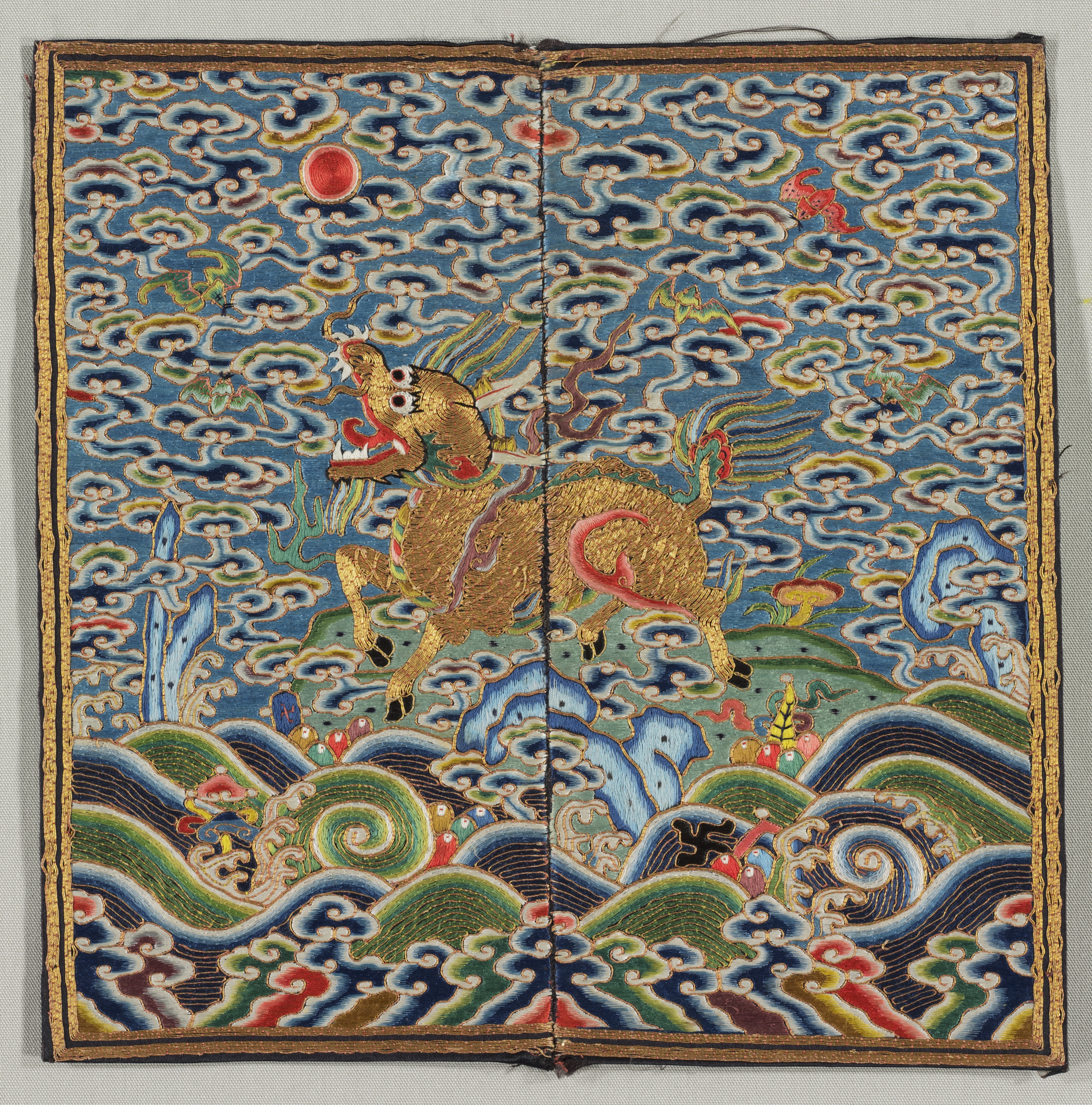
As the Chief Fabric Deconstructionist for Zoey Fashion Lab, my role is to dissect historical artifacts not merely as relics, but as living blueprints for radical, avant-garde design. The subject of this analysis—a Chinese Qing dynasty rank badge (buzi) from the Qianlong reign (1736–95)—presents a paradox. It is a symbol of rigid imperial hierarchy, yet its technical execution and symbolic language offer a fertile ground for subversion and reinterpretation. This object, crafted from silk satin weave and embroidered with silk and metal thread, is not a static artifact but a New DNA Strand—a genetic code for garments that challenge structure, authority, and materiality.
I. The Buzi as a System of Control and Ornament
The rank badge functioned as a precise, codified marker of status within the Qing bureaucracy. Worn on the surcoat of civil and military officials, its imagery—a bird for civil ranks, a mythical beast for military—was dictated by sumptuary laws. The Qianlong reign, a period of immense cultural and economic flourishing, saw these badges reach a peak of technical refinement. The satin weave base provides a lustrous, almost liquid ground, while the embroidery in silk and metal thread creates a dense, sculptural surface. This is not decoration; it is a visual language of power.
For an avant-garde approach, we must first deconstruct this system. The badge’s strict bilateral symmetry and its placement on the chest and back act as a kind of armor—a declaration of the wearer’s place in the cosmic and political order. The metal thread, often gold or silver, is not merely decorative; it is a material that catches light, signifying the wearer’s proximity to the imperial sun. This is a garment that commands attention, not through volume or silhouette, but through surface intensity and symbolic weight.
II. Technical Deconstruction: Satin, Silk, and Metal as Avant-Garde Materials
The satin weave of the base fabric is a study in controlled luxury. Its long floats of warp thread create a smooth, reflective surface that is paradoxically both fragile and resilient. In an avant-garde context, we can exploit this duality. Imagine a garment where the satin is deliberately deconstructed—pulled, frayed, or chemically distressed—to reveal the underlying weave structure. This act of controlled destruction would transform the badge from a symbol of static order into a record of process and entropy.
The silk and metal thread embroidery is where the most radical interventions can occur. Traditional couching techniques, where metal thread is laid on the surface and stitched down with silk, create a raised, linear pattern. For Zoey Fashion Lab, we would extract this thread and re-contextualize it. Consider a garment where the metal thread is not embroidered but suspended—woven into a mesh that floats away from the body, creating a second, spectral skin. The silk thread, traditionally used for subtle shading, could be unraveled and re-spun into a coarse, textured yarn, then applied in chaotic, gestural stitches that mimic the brushwork of a calligrapher but with the violence of a deconstructionist.
III. The New DNA Strand: Symbolic Re-coding
The rank badge’s imagery—the crane for civil officials, the qilin for military—is a New DNA Strand waiting to be mutated. These creatures are not just animals; they are archetypes of virtue, strength, and longevity. In an avant-garde design, we would slice these motifs, amplify their details, and recombine them with foreign elements. The crane’s wing, for example, could be magnified to an abstract, geometric pattern that covers the entire back of a coat, while the qilin’s scales could be rendered in laser-cut metal that clatters with movement.
The symbolic hierarchy of the badge—where the central creature is surrounded by clouds, waves, and the sun—can be flattened or inverted. The sun, traditionally at the top, could be repositioned at the hem, suggesting a world where authority is no longer celestial but grounded. The waves, which represent the sea and the cosmic order, could be abstracted into a series of jagged, asymmetrical lines that disrupt the garment’s silhouette. This is not a rejection of the original symbolism but a re-coding of it for a contemporary, questioning audience.
IV. Avant-Garde Applications: From Badge to Body
The rank badge is a two-dimensional object applied to a three-dimensional garment. For Zoey Fashion Lab, we would explode this relationship. Instead of a single, centralized badge, consider a garment covered in multiple, fragmented badges—each one a different scale, a different creature, a different level of completeness. This creates a visual cacophony that challenges the idea of a single, legible rank. The wearer becomes a walking archive of status, but one that is deliberately illegible and contradictory.
The metal thread can be used to create armature—a structural exoskeleton that extends beyond the fabric. Imagine a collar or cuffs made entirely of coiled metal thread, referencing the badge’s original function as a marker of authority but transforming it into a sculptural, almost aggressive form. The satin weave base could be cut away in strategic places, revealing a lining of raw silk or a contrasting color, creating a garment that is both luxurious and deliberately unfinished.
V. Conclusion: The Badge as a Living Code
The Qing dynasty rank badge is not an artifact to be preserved in a glass case. It is a New DNA Strand—a set of instructions for creating garments that are intellectually rigorous, technically innovative, and visually arresting. By deconstructing its materials—the satin weave, the silk and metal thread—and re-coding its symbols, Zoey Fashion Lab can produce work that honors the original’s craftsmanship while subverting its authoritarian logic. The result is an avant-garde fashion that is both a critique of power and a celebration of material intelligence. The badge is no longer a marker of rank; it is a manifesto for a new kind of dress, one that is layered, contradictory, and alive.