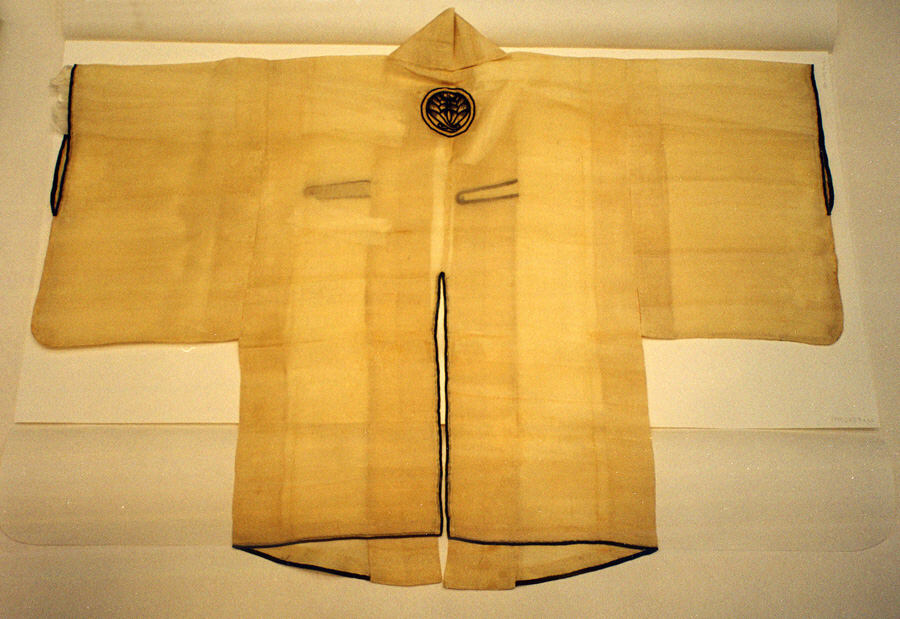
The Incendiary Silhouette: Deconstructing the Japanese Fireman's Jacket for SS26
In the relentless pursuit of garment architecture that transcends mere clothing, Zoey Fashion Laboratory turns its gaze to a paradoxical artifact of historical utility: the Japanese fireman's jacket, or hikeshi banten. Traditionally crafted from multiple layers of cotton, dyed with bold, protective motifs, and worn by Edo-period firefighters, this garment was a shield against flame. Yet for SS26, we strip it of its literal function, extracting its essence—its structural logic, its volumetric defiance, its coded symbolism—and reforge it into an avant-garde manifesto. The result is a futuristic silhouette that does not fight fire, but dances with it; a study in material tension, where silk and paper become the new armor of a post-industrial nomad.
Deconstructive Anatomy: The Jacket as Architectural Membrane
The primary subject—the fireman's jacket—is not reproduced but reconstructed. Its traditional boxy shape, designed to be quickly shed in emergencies, is exaggerated into a cocoon-like carapace. The shoulders are extended into sharp, angular points, evoking both the wings of a phoenix and the geometric precision of origami. The front closure, once a simple tie or frog button, is reimagined as a series of asymmetrical paper-and-silk folds that lock the garment in a state of perpetual motion—as if caught mid-ignition. This silhouette is not static; it breathes, it fractures, it resists gravity.
The material palette—silk and paper—is a deliberate provocation. Silk, with its fluid luminosity and historical association with luxury, is treated as a canvas for vulnerability. It is pleated, burned at the edges, and layered in translucent sheets that catch light like smoke. Paper, typically ephemeral, is reinforced with a resin binder to create a structural skin. This hybrid material is cut into jagged shards that form the plastron—a second skin over the torso that mimics the protective layering of the original jacket. The paper segments are not sewn but threaded through silk loops, allowing for modular reconfiguration. The wearer becomes architect and element, adjusting the garment’s drape and density in response to environment or mood.
The Plastron and Sash: Symbols of Controlled Chaos
Central to this composition is the plastron, a chest piece that divorces the jacket’s protective function from its back. In the original hikeshi banten, the back bore the fireman’s insignia—often a dragon or water motif. Here, the plastron is a floating shield, suspended by a network of silk cords that cross the torso like a harness. Its surface is a collage of hand-painted kanji for “fire,” “wind,” and “void,” executed in sumi ink on paper that has been scorched with a blowtorch, leaving charred edges that resemble lightning strikes. This is not decoration; it is narrative scarification.
The sash, or obi-inspired belt, is reengineered as a tensile structural element. Traditionally a wide band that cinches the waist, here it is a series of interlocking paper-and-silk loops that wrap around the lower ribcage and hips, creating a corset-like tension that pushes the jacket’s volume outward. The sash is not merely functional; it is a kinetic sculpture. Each loop is weighted with a small, polished brass bead—a nod to the fireman’s bells—that clinks with movement, producing a percussive rhythm that underscores the wearer’s gait. The sash can be detached and worn as a necklace or headpiece, furthering the modular ethos of the collection.
Futuristic Silhouettes: The Body as Flame
The SS26 silhouette is defined by exaggerated negative space. The jacket’s sleeves are cut away at the underarm, leaving only a paper-and-silk lattice that bridges the armhole to the wrist. This creates a visual paradox: the garment appears both voluminous and skeletal, protective and vulnerable. The hem is asymmetrical, dipping to the floor on one side while cropped at the hip on the other, suggesting the aftermath of a fire—a garment half-consumed by flame. The overall form is that of a human torch, but one that has been frozen mid-transformation, suspended between destruction and rebirth.
This is not a silhouette for the passive observer. It demands interaction, movement, and a deliberate negotiation of space. The wearer must adopt a new posture—shoulders back, torso elongated—to balance the shifting weight of the paper shards and silk pleats. The garment becomes a performance, a dialogue between human and material.
Structural Innovation: The Paper-Silk Composite
The technical breakthrough of this study lies in the paper-silk composite. Traditional Japanese washi paper is known for its tensile strength and ability to hold shape. By laminating it with a thin layer of silk habotai using a natural persimmon tannin (kakishibu), we create a material that is both rigid and flexible, breathable yet water-resistant. This composite is then laser-cut into interlocking geometric tiles, each one individually sewn to a silk base by hand. The result is a garment that can be folded flat for transport but springs into three-dimensional form when worn—a nod to the origami roots of Japanese design.
Additionally, the jacket incorporates thermochromic silk, a fabric treated with a heat-sensitive dye that shifts from black to deep crimson when exposed to body heat. This is not mere gimmickry; it is a functional metaphor. As the wearer’s temperature rises—from exertion, emotion, or environment—the garment “burns,” revealing hidden layers of pattern. The fireman’s jacket, once a symbol of protection, becomes a living record of the wearer’s internal state.
Conclusion: A New Lexicon of Avant-Garde Couture
This standalone study of the Japanese fireman’s jacket, plastron, and sash is not a historical homage but a reclamation of archetype. By stripping the garment of its context and rebuilding it with silk and paper, we have created a silhouette that speaks to the anxieties and aspirations of SS26: a world where protection is fluid, identity is modular, and the body is both the canvas and the flame. For Zoey Fashion Laboratory, this is not a finished design but a provocation—a challenge to the industry to see clothing not as a shield against the world, but as a volatile, beautiful, and ever-burning dialogue with it.