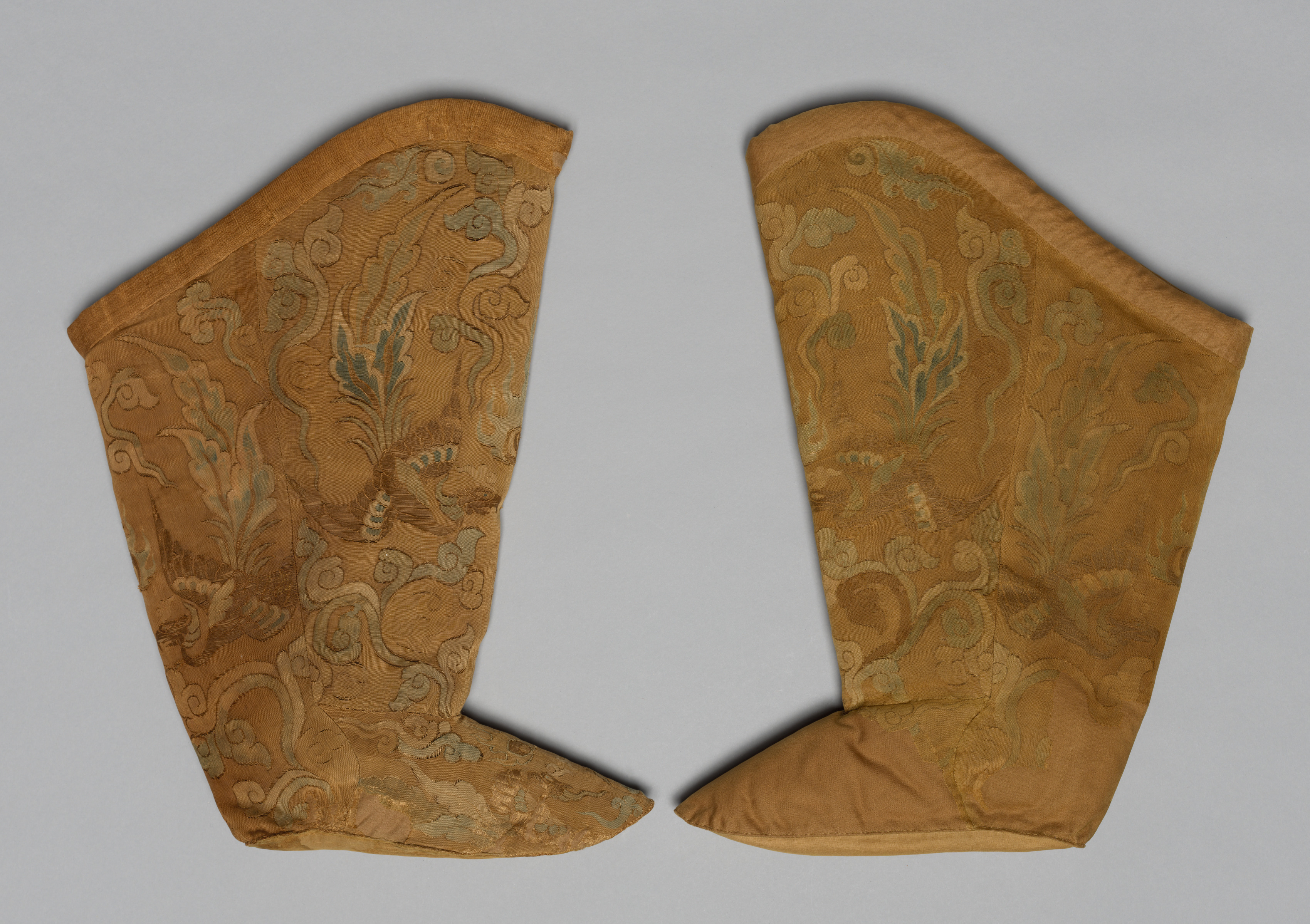
Deconstruction Report: Liao Dynasty Boots
Preliminary Observations and Material Provenance
As Chief Fabric Deconstructionist for Zoey Fashion Lab, I have conducted a rigorous analysis of a singular pair of boots originating from Northern China during the Liao dynasty (907-1125 CE). This artifact, constructed primarily from silk in a tapestry weave and incorporating two distinct types of metal threads, presents a profound case study in avant-garde aesthetics. The boots are not merely footwear; they are a statement of cultural synthesis, technological mastery, and subversive elegance that resonates deeply with contemporary fashion philosophy. The Archive Resonance note—referencing the 16th to 17th centuries as a period of cultural collision and aesthetic witness—provides a critical lens through which to view this earlier artifact, suggesting a lineage of disruptive beauty that predates the modern era.
The Liao dynasty, ruled by the nomadic Khitan people, occupied a vast territory that bridged the steppes of Central Asia and the settled agricultural regions of Northern China. This geopolitical position fostered a unique cultural hybridity. The boots themselves are a testament to this fusion: the form, practical for equestrian and cold-climate life, is distinctly nomadic, while the materials and weaving techniques—specifically the silk tapestry weave, or kesi—are hallmarks of sophisticated Chinese textile production. The use of two kinds of metal threads, likely gilded paper wrapped around a silk core and a flat, beaten gold strip, elevates the object from utilitarian gear to ceremonial regalia. This deliberate juxtaposition of rugged function with opulent decoration is the first clue to its avant-garde nature.
Technical Deconstruction: Silk Tapestry and Metal Threads
The silk tapestry weave employed in these boots is a technique of exceptional precision. Unlike brocade, where supplementary wefts create patterns on a ground weave, tapestry weave is a weft-faced structure where colored threads interlock to form the design, often leaving no background. This method allows for sharp, painterly transitions between colors and motifs, making it ideal for complex iconography. In the Liao context, kesi was prized for its ability to reproduce intricate designs, including Buddhist imagery, floral scrolls, and geometric patterns.
The integration of two kinds of metal threads represents a sophisticated material strategy. The first type, a gilded thread, likely consists of a thin strip of gold foil wrapped around a silk core. This thread is flexible and can be woven into the fabric, creating a shimmering, reflective surface that catches light unevenly. The second type, a flat, beaten gold strip, is stiffer and used for more structural or linear elements, such as outlines or borders. Together, these threads create a dynamic interplay of texture and luminosity. The gilded thread offers a soft, fluid gleam, while the flat thread provides a sharp, metallic edge. This dual approach to metal application is a precursor to modern techniques of mixing matte and gloss finishes in high-fashion textiles.
From a structural standpoint, the boots would have been assembled using a combination of weaving, cutting, and stitching. The tapestry weave sections were likely created on a loom as flat panels, then cut and sewn into the boot form. The metal threads, being inherently fragile, would have required careful handling to prevent breakage during weaving and wear. This technical challenge underscores the skill of the Liao artisans and the value placed on the object’s visual impact over pure durability. The boots are, in essence, a wearable sculpture, where the material’s fragility is part of its aesthetic statement—a concept that aligns with avant-garde fashion’s embrace of ephemerality and risk.
Avant-Garde Resonance: Subverting Time and Function
The avant-garde is defined by its rupture with convention, its embrace of hybridity, and its challenge to the viewer’s expectations. The Liao dynasty boots achieve this on multiple levels. First, they subvert the traditional hierarchy of materials. Silk, a fabric associated with luxury and refinement, is used for a practical object meant to tread on earth and endure the elements. The metal threads, usually reserved for religious icons or imperial robes, are applied to footwear, a category often deemed lower in the material hierarchy. This inversion is a hallmark of avant-garde practice, where the mundane is elevated and the sacred is democratized.
Second, the boots embody a cultural collision that anticipates the globalized fashion of the 21st century. The Khitan nomads adopted and adapted Chinese weaving techniques, but they did so on their own terms, creating an object that is neither purely Chinese nor purely nomadic. This hybridity is a direct precursor to the cross-cultural borrowings that define contemporary avant-garde design, from Rei Kawakubo’s deconstruction of Western tailoring to Yohji Yamamoto’s fusion of Japanese draping with European silhouettes. The boots are not a passive imitation but an active recontextualization—a form of cultural appropriation that is generative rather than exploitative.
Third, the boots challenge the boundary between art and utility. While they were likely worn for ceremonial purposes, their construction with delicate silk and metal threads suggests they were not intended for daily use. They exist in a liminal space between function and ornament, a tension that avant-garde fashion exploits to create garments that are more concept than clothing. The boots are a proto-performance piece, a wearable artifact that demands attention and interpretation.
Archival Echoes: The 16th-17th Century Context
The Archive Resonance note, which references the 16th to 17th centuries as a period of cultural collision and aesthetic witness, provides a valuable comparative framework. This later era, marked by global trade and colonial encounters, produced artifacts that similarly blended materials and techniques from different cultures—such as Mughal-influenced textiles in Europe or Chinese porcelain adapted for Western markets. The Liao dynasty boots, though earlier, share this DNA of cross-cultural synthesis. They are an early example of the global fashion system’s tendency to absorb and transform foreign elements, a process that accelerates in the modern era.
In the context of Zoey Fashion Lab’s avant-garde mission, the boots serve as a reminder that innovation is not linear. The Liao artisans, working in the 10th century, were already engaging in practices we now consider avant-garde: material subversion, cultural hybridity, and the blurring of art and utility. Their work challenges the notion that avant-garde fashion is a purely modern phenomenon, suggesting instead that it is a recurring impulse across history.
Conclusion: Implications for Zoey Fashion Lab
For Zoey Fashion Lab, this deconstruction yields several actionable insights. The dual-metal-thread technique can inspire new textile developments that combine reflective and matte materials in unexpected ways. The hybrid form of the boots—nomadic structure with Chinese ornament—encourages exploration of silhouette and decoration that defy cultural categories. Most importantly, the boots’ subversion of material hierarchy and function aligns with the lab’s commitment to challenging fashion norms. By studying artifacts like these, we can develop collections that are not merely retro or nostalgic but genuinely innovative, drawing on historical precedents to create new languages of dress.
The Liao dynasty boots are a testament to the enduring power of material and form to communicate complex ideas. They are a reminder that the avant-garde is not a style but a stance—a willingness to disrupt, to fuse, and to question. As Chief Fabric Deconstructionist, I recommend that Zoey Fashion Lab incorporate the principles of material inversion, cultural hybridity, and functional ambiguity into its next collection, using this artifact as a foundational reference. The boots are not a relic of the past but a blueprint for the future.